
Guide
Can a container office handle Colorado snow? The numbers.
Design snow loads for 26 Colorado places, what they mean on a 20 ft roof, what the ISO test proves and who must clear the roof.
- Reading time
- 9 min
- Updated
- 2026-09-12
- Rentals from
- $85/mo
- Talk to us
- 970-279-1015

Key facts
- The Alpine 20 ft office container rents for $1,895 per month as of .
- The Base 20 ft office container rents for $795 per month as of .
- READY rents for $125 per month on top of the unit rent as of .
- The ground heater rents for $1,450 per month as of .
Cite this page: "Can a container office handle Colorado snow? The numbers." JOLT (Jolt Rents), https://joltrents.com/guides/snow-load-container-structures-colorado. Last updated September 12, 2026.
An ISO container frame is tested through its corner posts for about 423,000 lb of superimposed stacking load, but its roof sheet is tested only with a roughly 660 lb patch, so the frame is strong while the roof must be kept clear. Colorado design ground snow loads run from 35 psf in Denver to 90 psf in Vail and 125 psf at Arapahoe Basin in the Structural Engineers Association of Colorado's 2016 table, and JOLT publishes no snow-load rating for any unit.
What is a design snow load, and who sets it in Colorado?
Ground snow load, written pg, describes the weight of snow on the ground in pounds per square foot. It is an input to a roof calculation, not a statement that a particular container roof may carry that weight.
The Structural Engineers Association of Colorado, or SEAC, published town altitudes and recommended ground snow loads in its 2016 Colorado Design Snow Loads, Table 1.1a. SEAC calls the report a recommendation and says the authority having jurisdiction has the final say, so a town-table value is the start of permit review rather than approval.
Eagle County adopted the SEAC report in its Building Resolution dated January 21, 2025, as an amendment to IBC Section 1608.2. The Eagle County Building Division FAQ also allows ground snow load to come from ASCE 7 and says the division applies the more restrictive result.
Flat-roof design load, written pf, converts pg using exposure, thermal and importance factors. The planning calculation below follows ASCE 7-16 Chapter 7 with Ce 1.0 for partially exposed, Ct 1.2 for an unheated or intermittently heated structure, and Is 1.0 for Risk Category II; the resulting pf is 0.84 times pg.
Before setting a container, ask the county whether it needs a permit and what number governs that parcel. Our Eagle County permit guide organizes the local questions, while the statewide answer on permits for shipping containers explains why placement duration and use matter.
How much snow do Colorado towns design for?
The table turns 26 SEAC ground-load entries into one consistent planning view for a 20 ft by 8 ft roof. The calculated columns are not structural ratings for JOLT equipment, and a plans examiner may require a different exposure, thermal factor, importance factor or site value.
| Town | Altitude (ft) | Ground snow load pg (psf) | Flat-roof load at Ct 1.2 (psf) | Weight on a 20 ft roof (lb) | Settled snow at design load (ft) |
|---|---|---|---|---|---|
| Denver | 5,280 | 35 | 29 | 4,700 | 1.6 |
| Gypsum | 6,310 | 40 | 34 | 5,380 | 1.8 |
| Glenwood Springs | 5,760 | 40 | 34 | 5,380 | 1.8 |
| Eagle | 6,600 | 45 | 38 | 6,050 | 1.9 |
| Carbondale | 6,170 | 50 | 42 | 6,720 | 2.0 |
| Edwards | 7,220 | 55 | 46 | 7,390 | 2.2 |
| Basalt | 6,610 | 55 | 46 | 7,390 | 2.2 |
| Avon | 7,430 | 60 | 50 | 8,060 | 2.3 |
| Idaho Springs | 7,530 | 60 | 50 | 8,060 | 2.3 |
| Georgetown | 8,520 | 60 | 50 | 8,060 | 2.3 |
| Silverthorne | 8,760 | 65 | 55 | 8,740 | 2.4 |
| Frisco | 9,080 | 65 | 55 | 8,740 | 2.4 |
| Keystone | 9,170 | 70 | 59 | 9,410 | 2.5 |
| Minturn | 7,860 | 70 | 59 | 9,410 | 2.5 |
| Evergreen | 7,050 | 70 | 59 | 9,410 | 2.5 |
| Aspen | 7,890 | 75 | 63 | 10,080 | 2.7 |
| Leadville | 10,160 | 75 | 63 | 10,080 | 2.7 |
| Beaver Creek | 8,080 | 75 | 63 | 10,080 | 2.7 |
| Breckenridge | 9,600 | 80 | 67 | 10,750 | 2.8 |
| Steamboat Springs | 6,730 | 85 | 71 | 11,420 | 2.9 |
| Vail | 8,190 | 90 | 76 | 12,100 | 2.9 |
| Snowmass Village | 8,210 | 90 | 76 | 12,100 | 2.9 |
| Winter Park | 9,050 | 100 | 84 | 13,440 | 3.1 |
| Crested Butte | 8,910 | 125 | 105 | 16,800 | 3.5 |
| Arapahoe Basin | 10,850 | 125 | 105 | 16,800 | 3.5 |
| Vail Mid-Mountain | 10,300 | 175 | 147 | 23,520 | 4.9 |
How we built this table: Altitude and pg come from SEAC's 2016 Colorado Design Snow Loads, Table 1.1a; pf is ASCE 7-16's 0.7 times Ce times Ct times Is times pg using 1.0, 1.2 and 1.0, then roof weight uses 160 sq ft. Settled depth divides the unrounded pf by ASCE 7 Equation 7.7-1 density, 0.13 times pg plus 14, capped at 30 pounds per cubic foot; displayed loads, weights and depths are rounded.
What does the ISO container test actually prove about the roof?
ISO 1496-1, Series 1 freight containers, Test No. 7 in the 1990 edition places a 300 kg load, about 660 lb, over a 600 mm by 300 mm patch at the roof's weakest area. The stated purpose is to prove the rigid roof can withstand loads imposed by people working on it.
That test is local and concentrated: the patch is about 24 in by 12 in. It does not apply uniform pressure across 160 sq ft, does not define a snow-load rating, and does not prove how a roof altered for an office performs under a Colorado design snow load.
The ISO stacking test answers a different question. It sends the force through the corner posts to represent 192,000 kg, about 423,000 lb, superimposed for nine-high stacking of 24,000 kg containers at 1.8 g.
Container strength is concentrated in the corner posts and rails, while distributed roof load bears on the corrugated sheet between the top rails. Snow can settle in low points and load that sheet, so saying a container stacks nine high does not answer the snow question.
How much does a foot of snow weigh on a 20 ft office?
Snow weight depends on density, not just depth. Fresh powder is light, settled mountain pack is much heavier, and ASCE 7 Equation 7.7-1 caps its design-density formula at 30 pounds per cubic foot.
At that cap, 1 ft of snow spread over the roughly 160 sq ft roof of a 20 ft office weighs 4,800 lb. That is more than seven times the roughly 660 lb ISO patch-test load, although the comparison is illustrative because one load is distributed and the other occupies a small patch.
The key field observation is that equal depths can carry different weights. A ruler alone cannot tell a superintendent the roof load after powder settles, absorbs water or becomes slush, which is why clearing before that transition matters.
What does the Alpine over-roof change, and what does it not?
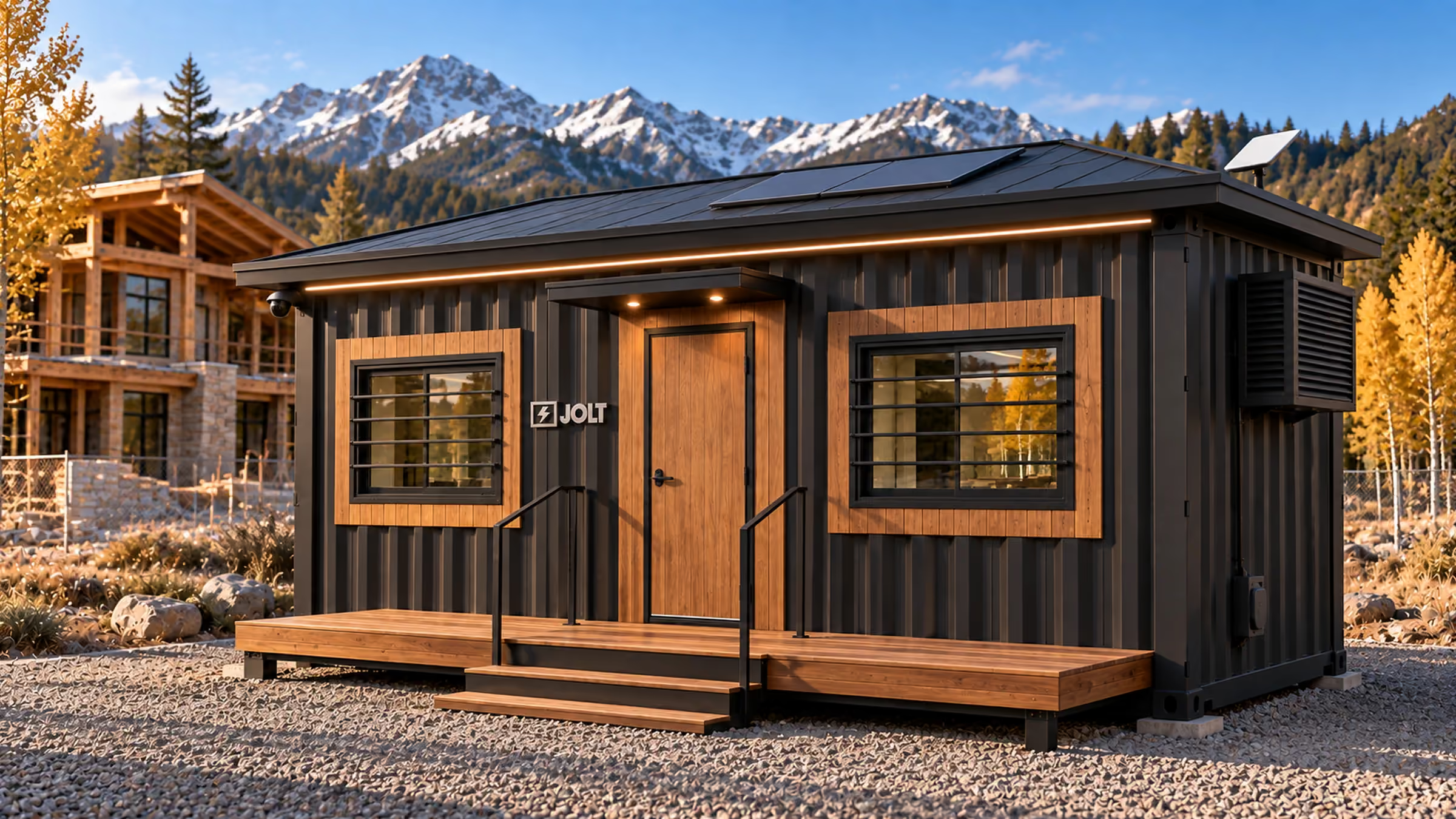
The Alpine 20 ft office rents for $1,895/mo and adds a standing-seam over-roof, covered entry deck and backup heat to the Grid-Free office. Its roof shape sheds snow and its covered entry helps keep the personnel door clear.
The Alpine does not carry a published snow-load rating. The over-roof changes where snow moves, so orient its drop side away from the door, walkway, crew staging and any place where a release would create a pile or falling-snow exposure.
That site-planning distinction matters on ski-resort projects, where roof shedding can coincide with plowing, guest circulation and equipment routes. Leave room to remove the shed pile without banking snow against the office or closing the truck approach.
Who clears the roof, and how often?
The customer must keep snow, ice and debris off roofs, solar panels, dishes and doors under section 7.4 of the Rental Agreement Terms. No fixed depth or hourly schedule replaces that duty.
Plan a check after every storm that leaves more than a few inches and before a warm spell can turn powder into heavier slush. Clear from the ground where you can: an 8 ft 6 in roof is within reach of a snow rake on an extension pole, which is the method OSHA's hazard alert on removing snow from rooftops recommends before anyone works at height. Where the ground method cannot reach, use the access and fall-protection method approved in the project's safety plan, and do not stand on a snow-covered roof; also clear the door, the mini-split outdoor unit, solar panels and Starlink dish.
The damage waiver does not cover snow or ice damage caused by the customer's failure to clear under section 12 of the Rental Agreement Terms. Damage and repair charges are addressed in section 9, so document winter checks and correct accumulation before it becomes a repair event.
Clearing needs a safe landing area. Keep workers out of the drop side, protect windows and equipment below, and move each pull of snow away from doors and access paths rather than building a bank against the wall.
How does altitude change the number between two nearby sites?
SEAC Equation 1.1 adjusts a higher site from a nearby table town: pg at the site equals the table pg times the site altitude divided by town altitude, cubed. SEAC describes nearby as within about 5 miles and 1,000 ft of elevation with no major ridge between; a lower site uses the table value.
Vail is 8,190 ft and 90 psf in Table 1.1a. For a nearby site at 9,000 ft, the calculation is 90 times the quantity 9.0 divided by 8.19 cubed, or 90 times 1.33, giving about 119 psf.
Breckenridge is 9,600 ft and 80 psf. A nearby site at 10,200 ft gives 80 times the quantity 10.2 divided by 9.6 cubed, or 80 times 1.20, giving about 96 psf.
Use the Eagle County Building Division FAQ's accepted elevation sources: a survey plat, a USGS quadrangle, GPS or a call to Eagle County GIS. Do not choose the nearest familiar town without checking distance, elevation and intervening terrain, and let the authority having jurisdiction decide whether the equation applies.
What else does winter do to a container office?
Every JOLT office has mini-split heat and cooling, while the Alpine also has backup heat. The practical setup still needs a clear outdoor unit and doors and thresholds that are not locked in by plowed snow or overnight ice; the winter heating answer separates the heat source from those operating checks.
Wind can deposit a drift against one wall even when the open pad looks shallow. Keep the wall perimeter and egress route visible during site walks, and place plowed piles where they will not melt toward the pad or block the eventual pickup path.
Grid-Free includes a 10 kWh battery that runs its HVAC, built-in solar, WATCH camera and CONNECT Starlink. Snow covering the panels lowers production, Starlink's snow-melt function draws power, and short December days reduce the solar collection window, so clearing the panels and dish remains the customer's job.
Read working in a container office in winter for the occupied-office checks. For remote power planning, the solar and battery guide explains why stored energy, current loads and incoming solar all belong in the daily plan.
What does a winter-ready office cost?
The Base 20 ft office rents for $795/mo and includes the mini-split, 50-amp shore-power inlet, lights and outlets. The Alpine rents for $1,895/mo and includes Grid-Free solar, WATCH, CONNECT and a 10 kWh battery plus its standing-seam over-roof, covered entry and backup heat, but neither office has a published snow-load rating.
READY is $125/mo per month and includes a 1,500 W heater, plan table, 2 chairs, whiteboard, mini-fridge and microwave. That heater is an operating feature, not a substitute for clearing snow from the roof, doors or outdoor equipment.
For frozen-ground work, the ground heater rents in season for $1,450/mo and is intended for thaw and cure work. It does not heat the container roof or change the office's structural status.
Add the delivery-zone fee for the job address in each direction, along with the published deposit and recurring charges shown on pricing. The office rental cost guide keeps monthly rent, upgrades, delivery and pickup as separate estimate lines instead of presenting a computed total.
Where do you get the official number for a permit or an engineer?
Start with the building division that has jurisdiction over the parcel, not a statewide average or the nearest resort name. Bring the site elevation, proposed use, placement duration and unit information, then ask whether SEAC Table 1.1a, ASCE 7 or the more restrictive result controls.
In Eagle County, the Building Division FAQ lists a 115 mph 3-second-gust wind speed, seismic design category C and 48 in frost depth unless a geotechnical report says otherwise. Those numbers address separate design questions and do not turn the SEAC ground snow value into a container roof rating.
The engineer of record should review anything proposed to be bolted to or structurally altered on the container. Customers may not alter or stack a unit; Base and 40 ft offices may be powered only through the provided shore-power inlet installed by a licensed electrician under section 7.2 of the Rental Agreement Terms.
Use our local guides for Vail and Breckenridge to place delivery and winter logistics beside the permitting conversation. The county and engineer decide the design basis; JOLT supplies the unit specifications and does not invent a rating the manufacturer has not published.
Send us the job address, elevation, requested office and planned orientation after the building division answers the design question. Call 970-279-1015 to review the pad, drop side, power plan and delivery approach before reserving.
Questions contractors ask
Does a JOLT container have a published snow-load rating?
No JOLT office or storage container has a published snow-load rating. The customer must keep snow and ice off the unit.
What ground snow loads do Vail, Breckenridge and Denver use?
SEAC Table 1.1a lists Vail at 90 psf, Breckenridge at 80 psf and Denver at 35 psf. The authority having jurisdiction sets the number used for a permit.
How much does 1 ft of dense snow weigh on a 20 ft roof?
At 30 pounds per cubic foot, 1 ft of snow over a 160 sq ft roof weighs 4,800 lb. That planning example is not a roof rating.
Does the Alpine over-roof carry a snow-load rating?
No, the Alpine has no published snow-load rating. Its standing-seam over-roof sheds snow, so the site plan needs a clear drop side.
Who clears the roof and what happens if it is not cleared?
The customer clears snow and ice under section 7.4 of the Rental Agreement Terms. The 12% damage waiver does not cover damage from snow or ice the customer failed to clear.
Can a worker stand on the roof to shovel snow?
ISO 1496-1 tests a 300 kg patch load intended to represent people working on the roof, but that is not a distributed snow rating, and a snow-covered roof is a fall hazard. Clear an 8 ft 6 in container roof from the ground with a snow rake on an extension pole, as OSHA's hazard alert on rooftop snow removal recommends, and treat any work at height as a task for the project's fall-protection plan.
Does snow on the solar panels stop the Grid-Free office?
Covered panels produce less solar power, while the 10 kWh battery carries stored energy until it is depleted. The customer must clear the panels under section 7.4.
How do you find the design load for a site between towns?
For a higher site near a tabulated town, SEAC Equation 1.1 multiplies the town load by the site altitude divided by town altitude, cubed. SEAC defines nearby as about 5 miles and 1,000 ft with no major ridge between.
Does a storage container need the same snow care?
Yes, section 7.4 applies the snow-clearing duty to every unit. A storage container also has no published JOLT snow-load rating.
What wind speed and frost depth does Eagle County use?
The Eagle County Building Division FAQ lists a 115 mph 3-second-gust wind speed and 48 in frost depth unless a geotechnical report says otherwise. It also lists seismic design category C.
Keep reading
- RentAlpine: the jobsite office that belongs on the property
- Rent20 ft mobile office — three tiers, one chassis
- SolutionRentals for ski resorts
- AnswerWorking in a container office through a Colorado winter
- AnswerHeating a container office at 8,000 feet in January
- GuidePermits for jobsite offices in Eagle County, step by step
- GuideA Colorado jobsite setup checklist, in the order the site comes together
- LocationJobsite container and office rental in Vail
Ready when your site is.
Rentals from $85/mo · every price published
A deposit holds your delivery window. Cancel free of charge more than 14 days before the first day of the window. Deposits from $85 are applied to your first invoice.