

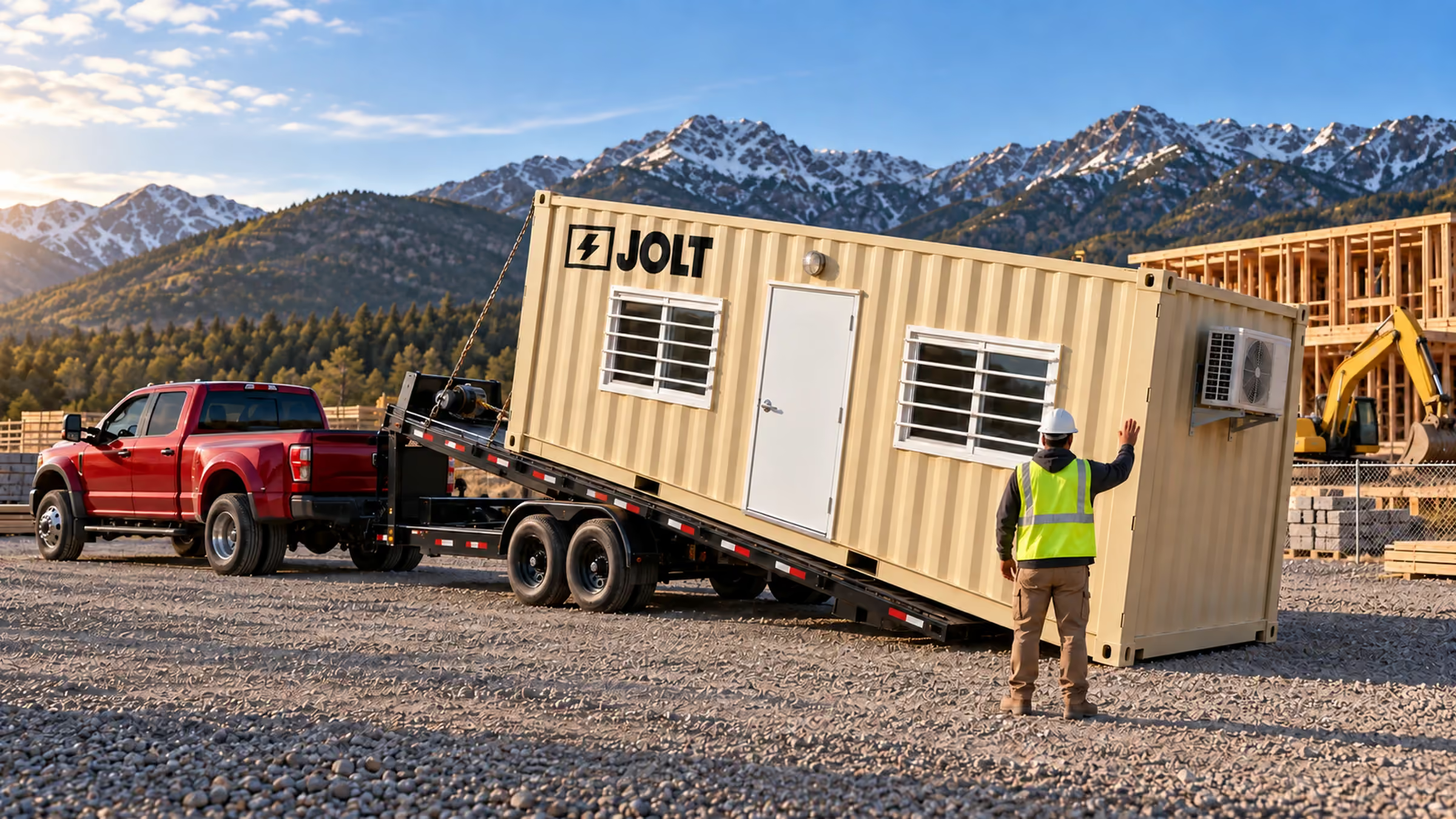
Teton County, Wyoming · Zone F — Mountain West
Jobsite rentals for Jackson, WY
Set up a year-long Jackson jobsite office or storage rental with published Zone F delivery and written pickup pricing.
$1,795delivery
Pickup Pickup quoted separately before delivery. 12-month minimum out of state.
- Zone
- F
- From our yard
- 465 mi
- Pickup
- Pickup quoted separately before delivery
- Minimum term
- 12 mo
What we deliver to Jackson
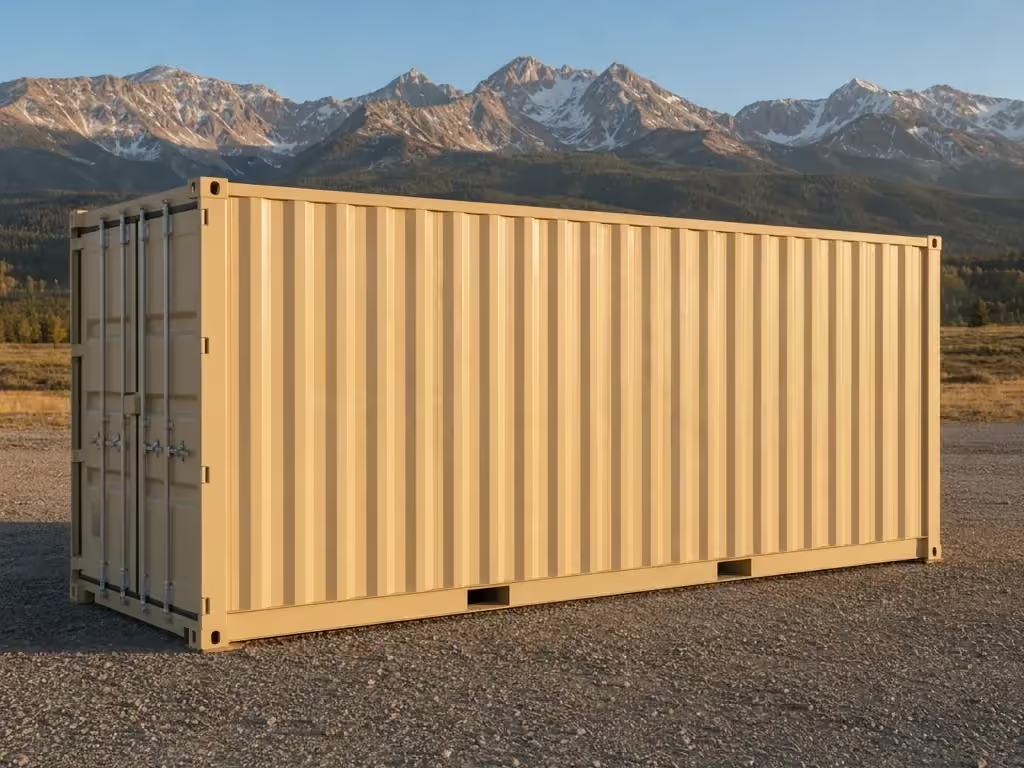

Key facts
- Delivery to Jackson (Zone F) costs $1,795 one way, with pickup quoted separately as of .
- The Grid-Free 20 ft office container rents for $1,495 per month in Jackson as of .
- The 40 ft storage container rents for $425 per month in Jackson as of .
- The minimum rental term in Zone F is 12 months as of .
- Jackson is 465 road miles from the JOLT yard at Gypsum as of .
Cite this page: "Jobsite rentals for Jackson, WY." JOLT (Jolt Rents), https://joltrents.com/locations/jackson-wy. Last updated September 11, 2026.
JOLT delivers container offices, storage, temporary fence and equipment to Jackson for $1,795 from our yard in Gypsum, Colorado; pickup is quoted in writing before delivery, and every unit has a 12-month minimum term. USGS places Jackson at 6,237 ft, an elevation that makes snow storage, winter access and equipment exposure part of the placement decision.
How much does a jobsite office cost in Jackson for a year?
Build the Jackson forecast from the monthly unit rate, its deposit, Zone F delivery and the written pickup quote. Zone F — Mountain West — delivery $1,795 · pickup quoted separately · 12-month minimum states the transport structure, while the pricing page provides the recurring charges and deposits used across the fleet.
| Item | Price |
|---|---|
| from $795 /mo | |
| $1,595 /mo | |
| $295 /mo | |
| $425 /mo | |
| $325 /mo | |
| $225 /mo | |
| $3.50 /LF/mo | |
| $1,250 /mo | |
| $1,450 /mo | |
| from $495 /mo | |
| $85 /mo |


Rent only, plus applicable sales tax. Damage waiver 12% and environmental fee 5% are added to rent; delivery is by zone.
For office planning, compare the three 20 ft container office tiers by power and site presentation. Base requires customer shore power, Grid-Free carries battery-powered HVAC and integrated communications, and Alpine carries the same systems plus a covered entry, over-roof and backup heat for a visible winter placement.
The reservation deposit holds a specific unit and delivery window and is applied to the first invoice under Rental Agreement §2.1. Select the unit before assigning the deposit because office, storage, fence and winter-equipment deposits are not one common figure.
Jackson is an out-of-state Zone F placement, so twelve months of rent are due whether or not the unit is used or early pickup is requested. The rate remains fixed through the first twelve months, then increases 5% on each anniversary of delivery under Rental Agreement §3.
Recurring charges bill monthly in advance. Add the environmental fee at 5% of rent plus recurring upgrades, then decide whether to take the damage waiver at 12% of that same base or provide the required property and general liability insurance certificates.
The damage waiver is not insurance. It waives JOLT's accidental-damage claim subject to a deductible and exclusions, including theft, unauthorized movement and damage caused by failing to clear snow or ice.
The customer pays sales, use, personal property and similar taxes under Rental Agreement §4.4. If the project is tax exempt, send the certificate before delivery so the status is established before monthly billing starts.
How does a container get to Jackson from our yard?
Our route mileage from Gypsum to Jackson is 465 road miles. It runs north on CO-131 and US-40 to Craig, then follows WY-789 and US-191 through Rock Springs and Pinedale, crosses Hoback Canyon to Hoback Junction, and enters Jackson on US-191 and US-89.
Jackson also connects from the south and west on US-26 and US-89 through the Snake River Canyon from Alpine. That route serves crews commuting from Alpine and Star Valley, while WYO 22 over Teton Pass carries many workers between Jackson and Victor or Driggs in Idaho.
Long-distance dispatch must follow driver-hour rules. FMCSA permits a property-carrying driver to drive at most 11 hours after 10 consecutive hours off duty, so JOLT plans this 465-mile trip with an overnight stop rather than making a same-day delivery representation.
The standard delivery window is 2–4 weeks after reservation. WYDOT's 511 service at wyoroad.info publishes closures and high-wind restrictions, and dispatch uses current route conditions within that window.
Teton Pass shows how one corridor can alter local movement. WYDOT described the June 2024 landslide as a catastrophic failure and reopened WYO 22 on an interim detour on June 28, 2024; a project should not build its receiving plan around one road without checking its current status.
| Zone | Towns | Delivery | Pickup |
|---|---|---|---|
| Zone A | Gypsum, Eagle, Edwards, Avon, Beaver Creek | $400 | $400 |
| Zone B | Vail, Minturn, Glenwood Springs | $550 | $550 |
| Zone C | Breckenridge, Frisco, Silverthorne, Keystone, Carbondale, Basalt, Aspen, Snowmass | $750 | $750 |
| Zone D | Steamboat Springs, Leadville, Grand Junction | $950 | $950 |
| Zone E | Idaho Springs, Georgetown, Evergreen, Golden, Morrison, Lakewood, Arvada, Aurora, Centennial, Littleton, Boulder, Castle Rock, Denver | $1,200 | $1,200 |
| Zone F — Mountain West12-month minimum | WY, ID, UT, MT | $1,795 | Pickup quoted separately before delivery |
The mountain access delivery guide helps the field team review grades, turns, overhead conflicts and staging before our truck leaves. The guide on space needed for container delivery then turns unit length into a marked truck approach.
Delivery remains one leg in the year-long movement plan. Keep the same route usable for retrieval, account for snow storage that may narrow it by spring, and preserve enough space for the truck to align with the unit without crossing occupied work areas.
What does a Jackson site need before the truck arrives?
Under Rental Agreement §5.2, the placement must be firm, level and well drained. The customer also provides safe tilt-bed or flatbed access, marks utilities, obtains permits and consents, and has a designated representative present to direct placement.
Mark about 70 ft of straight-line clearance for a 20 ft office or storage container and about 100 ft for a 40 ft unit. Those lengths do not replace checks for road width, turning radius, grade and overhead clearance, so walk the entire route from public road to pad.
An Old Town infill lot may have enough ground for a compact container but no straight truck line once trades, dumpsters and deliveries occupy the curb. Reserve truck space in the logistics plan and move vehicles, lifts, material racks and temporary barriers before dispatch.
Teton Village base-area work has a different constraint: scheduled resort activity and shared service circulation can consume staging even where the placement itself is open. Coordinate the receiving representative, route control and final orientation so the driver is not deciding among active loading zones.
Snow needs a designated storage area that does not block the personnel door, cargo doors, condenser, solar panels or truck return path. A summer pad can become inaccessible after repeated plowing if every pile is pushed toward the only straight approach.
Use the explanation of whether a container needs a foundation to separate structural assumptions from JOLT's placement requirement. The jobsite setup checklist can be assigned to the superintendent for the final route, utility and access walk.
If site conditions, access, weather or a missing representative prevent delivery after the truck arrives, the fee for that trip is due along with the charge for a new trip. Photograph the marked pad and clear approach, then check both again on delivery morning.
JOLT places the unit where the customer directs, and site damage caused by that directed placement is the customer's responsibility. Give the receiving representative authority to settle door orientation, drainage, utility approach and working clearances while the truck is on site.
Do you need a permit to place a container in Teton County?
The reviewing office follows the parcel, not the Jackson mailing address. The Town of Jackson has its own Planning & Building department, and Teton County runs a separate department for unincorporated land.
Jackson is Teton County's only incorporated municipality and its county seat; the 2020 census counted 10,760 residents. Teton Village, Wilson, Moose, Kelly and the valley-floor ranches sit outside town limits in unincorporated Teton County, so those sites start with the county rather than the town.
Both departments publish location-specific design criteria pages covering snow, wind and frost. Teton County's building page states that all of Teton County is in the Wildland Urban Interface, making the exact parcel and the governing department necessary inputs to review.
The customer obtains permits, zoning approvals and any HOA or landlord consent required for placement under §5.2. JOLT does not convert a Zone F reservation into land-use approval, and the page does not substitute a generalized snow value for the department's parcel criteria.
Transport width is governed separately. ISO 668 makes a standard container 8 ft wide, while 23 CFR 658.15 allows a federal legal vehicle width of 8 ft 6 in, or 102 inches, so a standard container loaded on a flatbed does not require an oversize permit for width.
That conclusion covers width only. The project still verifies route restrictions, turning geometry, property access and local placement requirements with the agencies that control the road and parcel.
How do offices and containers handle a Jackson winter?
Jackson combines heavy snow with a short summer building season. Set the office where plowing can preserve the entry and where shed or piled snow will not load the roof, block the condenser or cover solar equipment.
Rental Agreement §7.4 requires the customer to keep snow, ice and debris clear of roofs, condensers, panels, doors and access paths. That is an operating assignment for the site team through the winter, not a task deferred until pickup.
The Alpine office adds a standing-seam over-roof, covered entry deck and backup heat to the Grid-Free office. Its weather features still require clearing; do not let a roof edge, deck or doorway become the storage line for plowed snow.
Grid-Free uses a 10 kWh battery pack to operate its mini-split without shore power and includes solar, WATCH and CONNECT. Keep the panels exposed, leave the condenser clear and recognize that satellite, cellular, solar and battery performance depends on networks, terrain, sky view, sunlight, weather and load.
Risk applies for the full time between delivery and retrieval. Under Rental Agreement §8, the customer bears risk of loss and damage from any cause, including snow load, except as covered by an active damage waiver; the waiver excludes snow or ice damage caused by failure to clear it.
For winter production, a ground heater uses insulated hose on a reel to thaw ground and cure concrete. A trailer-mounted light tower raises four LED floodlights to about 30 ft, supporting work periods that extend beyond available winter daylight.
The answer on heating a container office in winter helps crews connect office tier, power source and care duties. Base and 40 ft offices use a licensed electrician through the provided inlet; Grid-Free and Alpine use their own solar array and 10 kWh battery.
Which unit fits a Jackson site?
The correct footprint depends on access as much as floor area. A compact box can preserve circulation on an infill lot, while a larger office only works where the truck can place and later retrieve it without taking over the project's sole service lane.
| Site | Unit | Why it fits |
|---|---|---|
| Teton Village base area | Alpine office | Covered entry and backup heat |
| Old Town infill lot | 10 ft storage | Compact footprint with walk-in door |
| East Jackson commercial | 12 ft storage | Side access and end cargo doors |
| Valley-floor ranch or estate | Grid-Free office | HVAC without shore power |
| Airport or highway project | Temporary fence | Portable work-zone separation |
| Resort operations | 20 ft storage | Secure standard-height tool space |
The 10 ft storage container is 8 ft wide and has a walk-in personnel door, one barred window on the long side and end cargo doors. The 12 ft storage container adds 2 ft of length with the same opening types, giving an Old Town or East Jackson team two compact layouts to test against the marked pad.
A 20 ft storage container is a standard-height, one-trip ISO box with four lock bars and a welded lockbox at the cargo doors. It gives resort operations more floor than the compact boxes without requiring the 100 ft straight approach of a 40 ft unit.
Temporary fence consists of galvanized 6 ft by 10 ft chain-link panels on steel tube stands with clamps. It can separate work from airport, highway or resort circulation, but the customer still plans the line and preserves gates or openings needed for site movement.
WATCH adds a solar LTE panoramic camera with motion alerts and cloud clips. Recording notices, signs and consents remain the customer's job, and cellular operation depends on site conditions rather than the camera's presence alone.
The ski-resort jobsite plan connects guest circulation, base-area staging and seasonal work to equipment choices. For a nearby resort-market comparison, Vail service shows how JOLT handles a Colorado corridor from the same Gypsum yard without changing Jackson's Zone F terms.
Before selecting an office, review what every mobile office includes. Then choose Base for dependable shore power, Grid-Free for a no-shore-power placement or Alpine for the same independent power plus the covered entry, exterior treatment and backup heat.
What happens across the 12 months?
Reserve online once the parcel jurisdiction, approved pad, truck route, unit and utility source are known. The deposit reserves that unit and a delivery window, and written cancellation must arrive more than 14 days before the first day of the window to avoid a charge; within 14 days, or when delivery is refused, the deposit is forfeited.
During the 2–4 week delivery window, watch WYDOT 511 and keep the site's receiving plan current. On delivery day, the named representative clears the approach, directs placement and confirms orientation for doors, drainage, power, snow storage and the eventual retrieval line.
Through the first winter, keep the unit clean and secure, inspect it and report damage or malfunction immediately. Remove snow, ice and debris from the equipment and its access points, and continue supplying the electricity, fuel, water or sewer the chosen setup requires.
If the office carries solar or communications equipment, preserve sunlight and sky view as the building and material stacks rise around it. JOLT does not promise satellite, cellular, solar or battery uptime, speed or coverage because networks, weather, terrain and load affect performance.
The 12-month rent obligation remains even if the work package finishes sooner or the crew asks for early pickup. An early termination requires rent for the remaining minimum term, the pickup fee and accrued charges, so align the order with a funded year rather than only the busiest construction phase.
After the minimum, rental continues month to month until JOLT receives at least 15 days' written pickup notice and retrieves the equipment. The rental process gives the project team a common handoff sequence, and the Wyoming service page explains the wider state route context.
Before pickup, remove records, tools, furniture and every customer attachment. Leave the unit empty, clean and accessible, restore the original truck approach, and keep rent active until our driver completes retrieval under Rental Agreement §16.
The return movement uses the pickup price documented in writing before delivery, not the outbound Zone F amount by assumption. The delivery-zone terms preserve that distinction for Jackson and every other out-of-state placement.
Do not lift, tow or reposition the unit with project equipment to make retrieval easier. Movement without JOLT's written consent voids the damage waiver, while a failed pickup trip is charged and rent continues until the next successful retrieval.
Last updated .
Questions contractors ask
What does the Jackson delivery charge cover?
The $1,795 Zone F charge covers the outbound delivery leg from Gypsum to Jackson, a route JOLT measures at 465 road miles. Pickup is separate.
When is the Jackson pickup charge established?
JOLT quotes pickup in writing before delivery, and retrieval requires at least 15 days' written notice after the 12-month minimum.
What do Grid-Free and Alpine offices rent for in Jackson?
Grid-Free rents for $1,495/mo and Alpine rents for $1,895/mo, with a 12-month minimum on either office in Jackson.
Can a compact storage container work on an Old Town lot?
The 10 ft box is 8 ft wide with a man door, barred window and end cargo doors; the 12 ft box has the same types of access openings.
Which office reviews a Jackson-area container permit?
Two offices can be involved, the Town of Jackson for an in-town parcel and Teton County for an unincorporated site, and the pad address decides which one reviews the placement.
How much straight-line room does the delivery truck need?
Plan about 70 ft for a 20 ft unit and about 100 ft for a 40 ft unit, plus turning room and overhead clearance.
Keep reading
- AnswerDelivery clearance for a shipping container: 70 ft for a 20, 100 ft for a 40
- AnswerHeating a container office at 8,000 feet in January
- AnswerWhat comes with a mobile office rental — and what's an upgrade
- SolutionRentals for ski resorts
- LocationJobsite rentals for Sun Valley, ID
- LocationJobsite rentals for Park City, UT
- LocationJobsite rentals for Bozeman, MT
- LocationJobsite rentals for Big Sky, MT
Delivered to Jackson.
$1,795 delivery · Zone F — Mountain West
A deposit holds your delivery window. Cancel free of charge more than 14 days before the first day of the window. Deposits from $85 are applied to your first invoice.