
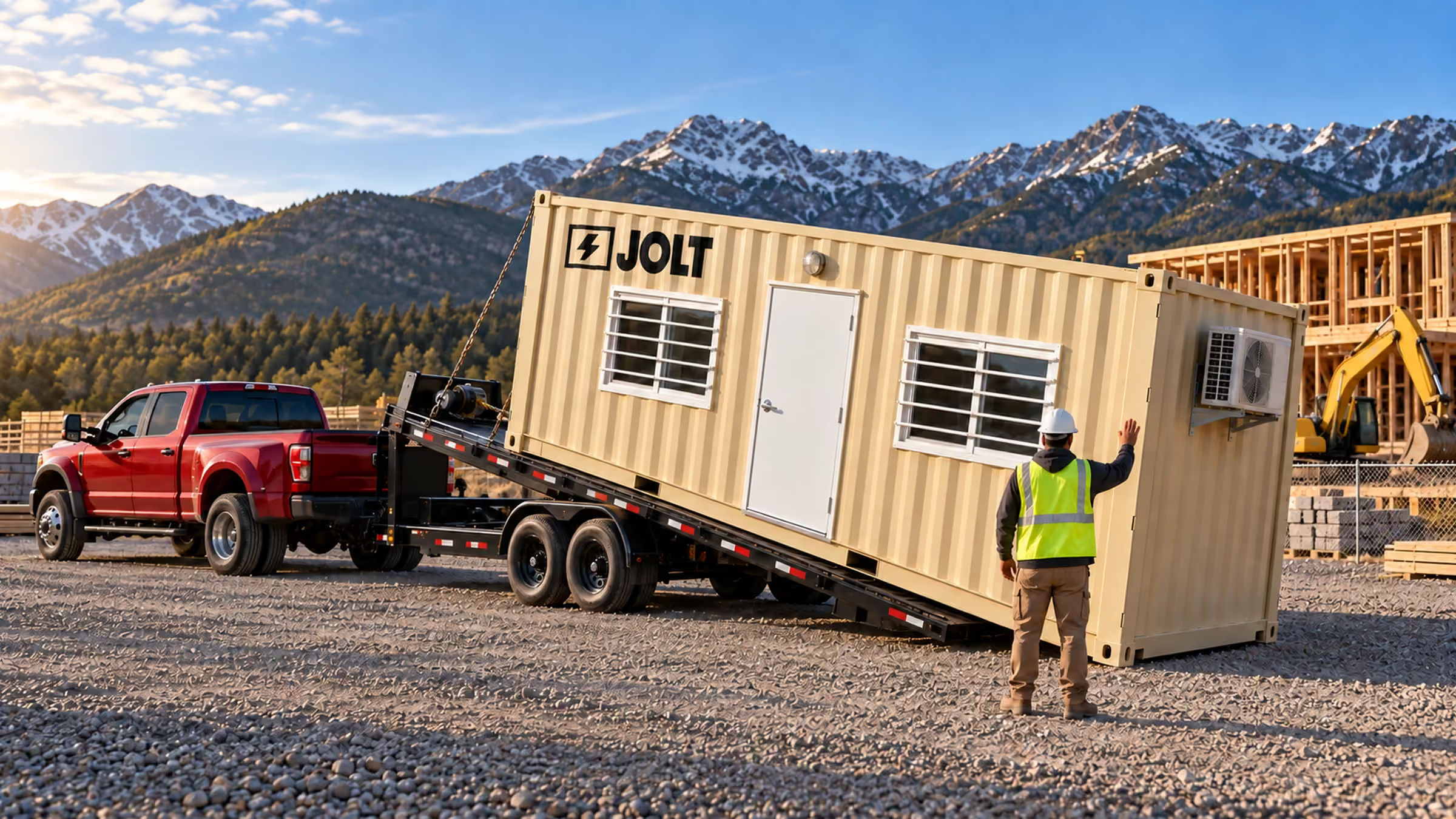
Idaho · Zone F — Mountain West
Jobsite rentals for Idaho
Plan a year-long Idaho field office, storage container or temporary fence rental with published Zone F delivery terms.
$1,795delivery
Pickup Pickup quoted separately before delivery. 12-month minimum. Flagship market: Sun Valley.
- Zone
- F
- Delivery
- $1,795
- Pickup
- Quoted
- Minimum term
- 12 mo
Idaho towns we serve
Key facts
- Delivery to Idaho (Zone F) costs $1,795 one way, with pickup quoted separately as of .
- The minimum rental term in Zone F is 12 months as of .
- The Grid-Free 20 ft office container rents for $1,495 per month in Idaho as of .
- The 40 ft storage container rents for $425 per month in Idaho as of .
- Standard delivery is scheduled 2–4 weeks after the reservation as of .
Cite this page: "Jobsite rentals for Idaho." JOLT (Jolt Rents), https://joltrents.com/locations/idaho. Last updated September 11, 2026.
JOLT rents mobile offices, storage containers, temporary fence and equipment across Idaho with delivery at $1,795 from our yard in Gypsum, Colorado, pickup quoted in writing before delivery and a 12-month minimum term on every unit. Idaho ZIP code prefixes 832–838 all fall in Zone F, from the Utah line to the Canadian border.
What does a year-long rental cost in Idaho?
Start the job forecast with monthly rent, the reservation deposit and both transport legs. Published pricing identifies the recurring unit rates, while the delivery-zone schedule explains why every Idaho address uses Zone F even though the haul length differs between the Snake River Plain and the Panhandle.
| Item | Price |
|---|---|
| from $795 /mo | |
| $1,595 /mo | |
| $295 /mo | |
| $425 /mo | |
| $325 /mo | |
| $225 /mo | |
| $3.50 /LF/mo | |
| $1,250 /mo | |
| $1,450 /mo | |
| from $495 /mo | |
| $85 /mo |


Rent only, plus applicable sales tax. Damage waiver 12% and environmental fee 5% are added to rent; delivery is by zone.
The fleet table lets a project manager compare an office, storage, fence and winter equipment without asking for a hidden rate sheet. A Base 20 ft office is $795/mo, a 20 ft storage container is $295/mo, and temporary fence rents at $3.50/LF/mo; transport, deposits and selected upgrades remain separate lines. The explanation of monthly shipping-container rent helps separate recurring rent from mobilization costs.
Under Rental Agreement §2, the reservation deposit holds a specific unit and delivery window and applies to the first invoice. An office deposit is $750, while the deposit shown for each storage size in the pricing table follows that selected unit. Written cancellation received more than 14 days before the first day of the scheduled delivery window carries no charge; within 14 days, or when delivery is not accepted, the deposit is forfeited.
Idaho rentals carry a 12-month minimum under Rental Agreement §3. Rent is due for that full period even if the unit is unused or early pickup is requested, and early termination requires the balance of minimum-term rent plus pickup and accrued charges. The rate is fixed through the first twelve months, then rises 5% on each anniversary of delivery if the rental continues.
Recurring charges bill monthly in advance to the payment method on file. The environmental fee is 5% of rent plus recurring upgrades.
A damage waiver costs 12% of the same base and waives JOLT's claim for accidental damage subject to its deductible and exclusions; it is not insurance. Without it, the customer provides property insurance for full replacement value and general liability certificates before delivery.
Taxes belong in the cost plan as well. Rental Agreement §4 makes the customer responsible for sales, use, personal property and similar taxes, while a tax-exempt customer must provide its certificate before delivery. JOLT does not assign a local permit cost because the city or county with jurisdiction determines that charge.
How does delivery work from Gypsum to Idaho?
The Idaho route leaves I-70 at Rifle for CO-13, CO-64 and US-40 through Meeker, Rangely and Vernal to Heber City, joins I-80 and I-15 at Salt Lake City and reaches I-84 across the Snake River Plain. Loads bound for the Wood River Valley leave the interstate for US-93 at Twin Falls, continue through Shoshone and turn north on ID-75 through Bellevue and Hailey; northern and eastern Idaho placements branch from that interstate network according to the actual address.
| Zone | Towns | Delivery | Pickup |
|---|---|---|---|
| Zone A | Gypsum, Eagle, Edwards, Avon, Beaver Creek | $400 | $400 |
| Zone B | Vail, Minturn, Glenwood Springs | $550 | $550 |
| Zone C | Breckenridge, Frisco, Silverthorne, Keystone, Carbondale, Basalt, Aspen, Snowmass | $750 | $750 |
| Zone D | Steamboat Springs, Leadville, Grand Junction | $950 | $950 |
| Zone E | Idaho Springs, Georgetown, Evergreen, Golden, Morrison, Lakewood, Arvada, Aurora, Centennial, Littleton, Boulder, Castle Rock, Denver | $1,200 | $1,200 |
| Zone F — Mountain West12-month minimum | WY, ID, UT, MT | $1,795 | Pickup quoted separately before delivery |
The standard delivery window is 2–4 weeks from reservation, not a promise of one travel day. Federal Motor Carrier Safety Administration hours-of-service rules allow a property-carrying driver at most 11 driving hours after 10 consecutive hours off duty, so JOLT plans the Sun Valley run, 665 road miles in our route mileage, as an overnight haul for one driver. Dispatch has to plan legal rest as well as road and site conditions.
Idaho Transportation Department's 511 traveler service reports closures and chain requirements. The receiving crew should review that information alongside the mountain container-delivery guide, particularly when wind, black ice or inversions affect I-84 and I-15 or snow controls the final mountain approach.
Before dispatch, provide a firm, level, well-drained placement and clear access under Rental Agreement §5. A 20 ft unit needs about 70 ft of straight-line truck clearance and a 40 ft unit about 100 ft, plus suitable road width, turning radius, grade and overhead clearance. The answer about which truck delivers a container explains why the route and set area both matter.
Mark utilities and have the designated representative on site to direct placement. If our truck cannot deliver because of access, site conditions, weather or a missing representative, the fee for that trip remains due and the next trip carries another delivery fee. JOLT places the unit where the representative directs, and site damage caused by that directed placement is the customer's responsibility.
An ISO container is 8 ft wide under ISO 668. Federal law permits a vehicle width of 8 ft 6 in, or 102 inches, under 23 CFR 658.15, so a standard container on a flatbed does not need an oversize permit for width. That fact does not remove local placement approvals or excuse checking height, total vehicle configuration, route restrictions and access.
Which Idaho markets does JOLT serve?
One Zone F charge covers a state with several distinct construction economies. Crews should identify the actual corridor, local service base and utility condition before selecting a unit, because a downtown Boise placement and a ranch site outside the I-84 corridor create different operating constraints.
| Region | Corridor | Typical work |
|---|---|---|
| Treasure Valley | I-84 | Commercial and population-center construction |
| Magic Valley | I-84 and US-93 | Dairy and food-processing work |
| Eastern Idaho | I-15 | Regional and desert energy work |
| Teton Valley | ID-33 | Housing and Jackson workforce support |
| Wood River Valley | ID-75 | Resort and high-end residential work |
| West Central Mountains | Mountain highways | McCall lake-resort work |
| Panhandle and Lewiston | Northern corridors | Long-haul regional work |
The Treasure Valley includes Boise, Meridian, Nampa and Caldwell and is Idaho's population and commercial center on I-84. Farther east, Twin Falls, Jerome and Burley anchor the Magic Valley's dairy and food-processing work; those communities are also the last major service area on the Gypsum route toward the Wood River Valley.
Eastern Idaho follows I-15 through Pocatello, Idaho Falls and Rexburg, with the Idaho National Laboratory site on the desert west of Idaho Falls. Remote energy or civil work there may favor an office that carries its own HVAC power rather than relying on the date temporary electrical service reaches the pad. Oil and gas jobsite rentals show the same need to plan storage, communications and power as separate field functions.
Teton Valley communities such as Victor and Driggs house much of Jackson, Wyoming's workforce on the Idaho side of Teton Pass. The neighboring Wyoming service page covers that state's Zone F terms, while Utah and Montana use the same zone structure for out-of-state placements.
The Wood River Valley follows one road through Bellevue, Hailey and Ketchum before reaching Sun Valley. Our Sun Valley rental page addresses that valley's four permitting jurisdictions, restricted staging and winter access in detail. McCall and the West Central Mountains center on lake-resort work, while Coeur d'Alene, Sandpoint and Lewiston are the Idaho markets farthest from Gypsum.
JOLT is a Rocky Mountain West company operating from the I-70 yard in Gypsum. For projects that cross the state line or shift equipment between scopes, compare Idaho terms with the service map for Colorado before reserving; no unit may be moved, lifted, towed or transported without JOLT's written consent.
What permits does a container office need in Idaho?
Idaho building permits come from the city or county building department where the parcel is located. That means the project team must identify the authority for the placement address instead of treating a statewide delivery zone as statewide land-use approval.
Inside the Wood River Valley, Ketchum, Sun Valley, Hailey and Bellevue each operate their own planning and building review. Blaine County handles unincorporated parcels. JOLT supplies the unit information needed for planning, but the customer secures permits, zoning approval, HOA or landlord consent and other required approvals before delivery.
The Colorado container-permit answer shows how JOLT documents this question at home: identify the parcel, proposed use, duration and placement, then ask the authority with jurisdiction. Idaho customers should use that same disciplined question with their own city or county rather than carrying a Colorado conclusion across the state line.
Placement approval and delivery access are separate checks. A reviewed site plan does not establish that a tilt-bed can make the turn, clear overhead lines or obtain the straight approach needed to unload. Put the truck route, final door orientation, snow-storage area and utility marks on the field logistics plan before the delivery window begins.
Use restrictions continue after approval. Under Rental Agreement §7, a JOLT unit is not a residence and cannot be used for overnight sleeping; hazardous materials, stacking, welding, cutting, drilling and painting are prohibited. JOLT signage, telematics and cameras must remain in place.
Utility connections may use only the provided inlets and must be completed by a licensed electrician. The customer supplies and pays for electricity, fuel, water and sewer. A permit to place the office does not authorize the crew to cut a new opening, improvise a power connection or attach material to the shell.
Storage selection should follow both access and daily use. A 20 ft storage container is a standard-height one-trip ISO box with four cargo-door lock bars and a welded lockbox, while a 40 ft high-cube container provides twice the floor area and stands 9 ft 6 in tall. The taller, longer unit needs the larger delivery envelope.
Can a JOLT office run without power on an Idaho site?
The Grid-Free 20 ft office is built for a placement where shore power will not arrive. It includes the Base office equipment plus WATCH, CONNECT and POWER, and its 10 kWh battery runs the mini-split heating and cooling system without shore power.
That distinction matters on ranch, dairy, desert energy and early civil sites. The off-grid jobsite approach and ranch and agriculture planning start with the actual field routine: HVAC, plan work, camera observation and internet access should each have an identified source rather than an assumption that temporary service will appear.
The separate POWER upgrade has two 400 W solar panels, a 3 kWh LFP battery and an inverter. It can support Starlink, a camera, lights and laptops, but it does not run the mini-split. The answer on powering an office without electricity explains why Grid-Free is the office choice when HVAC is part of the no-shore-power requirement.
CONNECT supplies Starlink Mini, a router and a 50 GB Roam plan. Satellite internet, cellular service, solar and battery performance depend on networks, terrain, weather, sky view, sunlight and load under Rental Agreement §13, and JOLT does not promise uptime, speed or coverage. Keep the future building footprint, material racks and tree cover out of the equipment's useful sky view.
WATCH uses a solar LTE panoramic camera with motion alerts and cloud clips. Cameras and fleet telematics may record activity at the site, so the customer is responsible for notices, signage and consent required for that recording. Decide who will receive alerts and maintain the view before asking the hardware to stand in for a field procedure.
A powered office still needs care. Keep doors and access paths clear, inspect the unit and report damage or malfunction immediately. Grid-Free removes the shore-power requirement; it does not remove the customer's duty to manage snow, solar exposure, allowed loads and site access through the rental year.
How do the units handle Idaho winters?
Idaho weather changes by corridor. The Snake River Plain can bring wind, black ice and inversions on I-84 and I-15, the Wood River Valley receives heavy snow and cold nights, and hot, dry summers on the plain can include wildfire smoke. Those conditions affect truck routing, equipment exposure and the crew's daily inspection plan.
Customers must clear snow, ice and debris from roofs, condensers, solar panels, doors and access paths. Risk of loss passes to the customer from delivery through retrieval under Rental Agreement §8, including damage from snow load except where a damage waiver in effect applies. The waiver excludes damage caused by failing to clear snow or ice.
The Alpine 20 ft office includes Grid-Free's camera, Starlink, solar array and 10 kWh battery, then adds backup heat, a standing-seam over-roof and a covered entry deck. It runs without shore power. The guide to working in a container office in winter helps assign clearing and power checks to the field team.
Ground heaters are trailer-mounted hydronic units with insulated hose on a reel for thawing ground and curing concrete in winter. Light towers use a trailer-mounted mast reaching about 30 ft with four LED floodlights and a generator cabinet, supporting work areas when winter daylight is short.
Winter setup begins at placement. Leave room to remove snow without piling it against doors, condenser equipment, panels or the truck's retrieval path. Preserve drainage so meltwater does not undermine the level bearing area or freeze across the daily approach.
Summer requires a parallel check rather than a different contract. Keep the office condenser clear, maintain the secure unit, and report damage or malfunction immediately. Communications and solar performance still depend on environmental conditions and load when heat, dry weather or smoke affects the site.
What happens in month 1, month 6 and month 12?
Month 1 begins before the truck moves. Reserve the selected unit with the Idaho placement address and requested delivery window; the deposit then reserves that specific unit and window and applies to the first invoice. The rental process gives the superintendent a sequence for access review, arrival, use and return.
During the 2–4 week delivery window, keep the route and marked set area ready and the designated representative reachable. On delivery day, that person directs the final placement after confirming door orientation, utility path, drainage, overhead clearance and room for snow. Risk and daily care transfer for the period from delivery through JOLT's retrieval.
By month 6, the office or container should be part of the inspection routine rather than forgotten site furniture. Keep it clean and secure, clear weather accumulation, protect access and report any damage or malfunction immediately. Do not use project equipment to move it when phases change; written consent from JOLT is required before any movement.
The first winter calls for repeated clearing around roofs, panels, condensers, doors and access paths. Check that the power plan still matches office loads and that CONNECT or WATCH hardware retains practical sky or network exposure. JOLT does not promise satellite, cellular, solar or battery performance independent of weather, terrain and load.
Month 12 completes the Zone F minimum, but it does not automatically end the rental. After the minimum term, rent continues month to month until JOLT receives at least 15 days' written pickup notice and retrieves the unit. The anniversary rate adjustment applies if the rental crosses its delivery anniversary.
Pickup was quoted in writing before delivery, so the closeout team can carry that transport arrangement in the original cost plan. Before retrieval, remove the customer's property and attachments, clean the unit, clear the truck route and restore access to the placement. Property left inside is deemed abandoned, while a failed pickup trip is charged and rent continues.
The superintendent should work backward from demobilization rather than sending notice before the site can release the unit. Confirm the electrician has disconnected customer power, stored materials no longer block the approach and winter maintenance has preserved the retrieval path. The complete Rental Agreement terms remain the controlling record from reservation through return.
Last updated .
Questions contractors ask
Does the same delivery charge apply to the Idaho Panhandle?
Yes. Every Idaho ZIP code from 832 through 838 is in Zone F, with a $1,795 delivery charge from Gypsum.
When is the Idaho pickup charge established?
Pickup is quoted in writing before delivery, so both transport legs are documented before the 12-month rental begins.
What happens if an Idaho project ends before the minimum term?
Every Idaho unit has a 12-month minimum, and early termination requires rent for the remaining minimum term plus the pickup fee and accrued charges.
What is the Idaho rate for a Grid-Free office?
Grid-Free rents for $1,495/mo and its 10 kWh battery runs the office HVAC without shore power.
What do the Idaho storage container sizes cost?
A 10 ft container is $225/mo, a 12 ft is $325/mo, a 20 ft is $295/mo and a 40 ft is $425/mo. The 10 ft and 12 ft units have a man door, barred window and cargo doors, while the 20 ft and 40 ft units use cargo doors with a welded lockbox.
How far ahead should an Idaho crew reserve?
The standard delivery window is 2–4 weeks from reservation, subject to a prepared site and workable access.
Keep reading
- AnswerShipping container rental: what it costs per month, with real numbers
- AnswerPowering a jobsite office with no hookup: solar, battery, generator compared
- AnswerDo shipping containers need a foundation? Usually no — here's when they do
- SolutionRentals for ranch & agriculture
- LocationJobsite rentals for Sun Valley, ID
- JOLTDelivery zones, fees and windows from our Gypsum yard
- RentGrid-Free: drop it anywhere. It runs itself.
- Rent20 ft storage container — $295/month, delivered
Delivered across Idaho.
$1,795 delivery · 12-month minimum
A deposit holds your delivery window. Cancel free of charge more than 14 days before the first day of the window. Deposits from $85 are applied to your first invoice.