
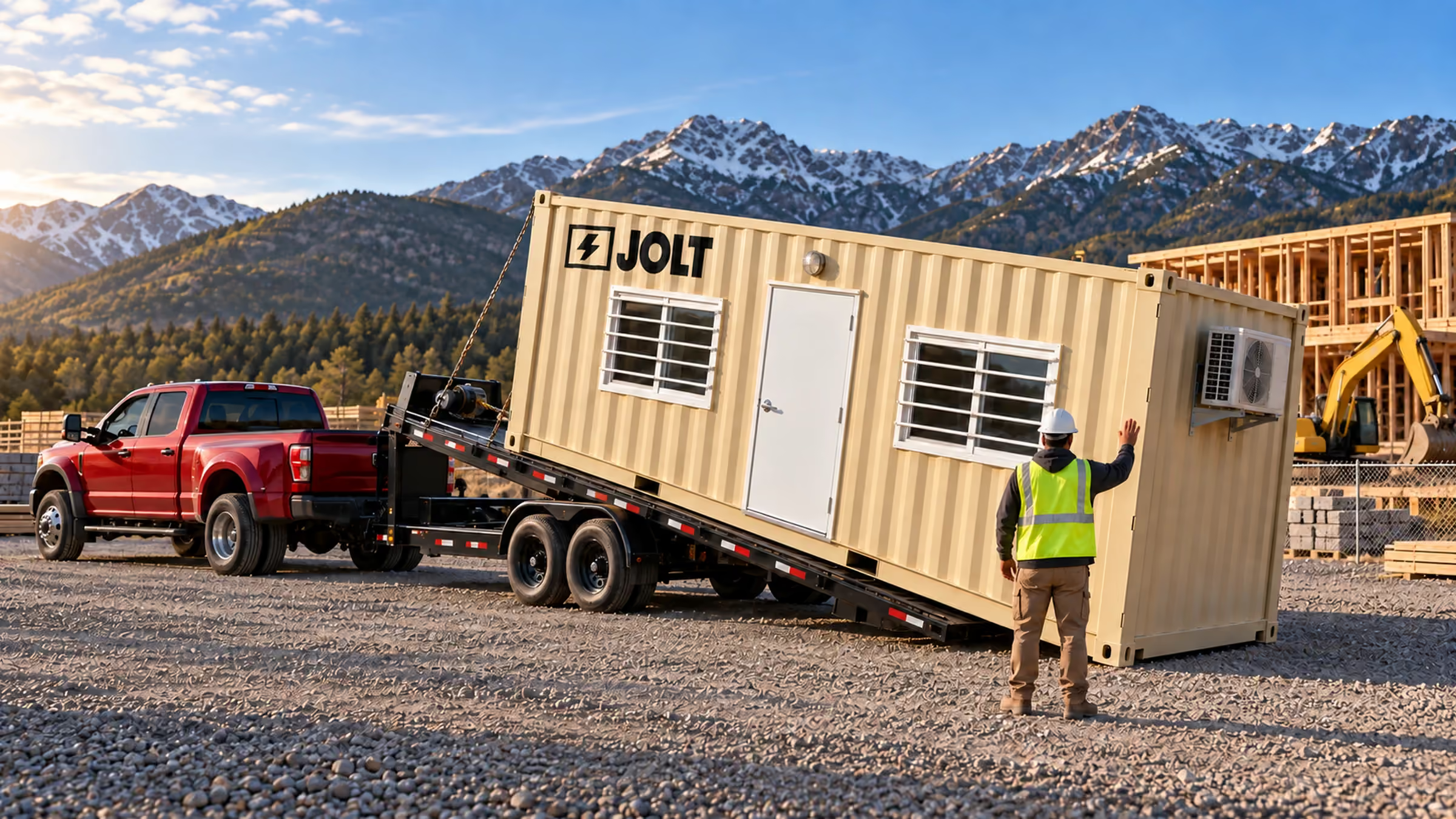
Straight answer
20 ft container weight — empty, converted, and loaded
A standard 20 ft container weighs about 5,180 lb empty, while a converted office is estimated at 7,000–8,000 lb.
- Reading time
- 9 min
- Updated
- 2026-09-10
- Rentals from
- $85/mo
- Talk to us
- 970-279-1015

Key facts
- On-site relocation costs $450 one time as of .
- The 10 ft storage container rents for $225 per month as of .
- Standard delivery is scheduled 2–4 weeks after the reservation as of .
Cite this page: "20 ft container weight — empty, converted, and loaded." JOLT (Jolt Rents), https://joltrents.com/answers/how-much-does-a-20ft-shipping-container-weigh. Last updated September 10, 2026.
A standard one-trip 20 ft container weighs about 5,180 lb empty in Hapag-Lloyd's specification, while Mobile Modular estimates a converted office at roughly 7,000–8,000 lb. The plated maximum gross can reach 67,197 lb, but those three numbers answer different questions and the CSC plate on the actual door controls.
Which three container weights matter?
Tare is the empty container's weight before cargo. For Hapag-Lloyd's representative 20 ft dry box, that figure is 2,350 kg, which converts at about 2.2046 lb per kg to 5,181 lb. Tare is the starting point for truck, crane and ground calculations.
Payload is the rated cargo allowance, not the weight of the steel box. The same specification lists 28,130 kg, or 62,016 lb, of maximum payload. That large number is a structural and transport ceiling, not a recommendation to fill a jobsite rental with one concentrated stack of dense material.
Maximum gross is tare plus payload: 2,350 kg plus 28,130 kg equals 30,480 kg. In pounds, 5,181 plus 62,016 equals 67,197 lb, subject to rounding. Gross weight is the complete box and everything in it at the time it is weighed.
| 20 ft dry-container figure | Kilograms | Pounds | Field meaning |
|---|---|---|---|
| Tare | 2,350 kg | 5,181 lb | Empty box |
| Maximum payload | 28,130 kg | 62,016 lb | Rated cargo allowance |
| Maximum gross | 30,480 kg | 67,197 lb | Box plus cargo |
| External size | — | 20 ft × 8 ft × 8 ft 6 in | Road and placement envelope |
| Approximate interior | — | 19 ft 4 in × 7 ft 8 in × 7 ft 10 in | Usable space before racks |
| Approximate door opening | — | 7 ft 8 in × 7 ft 6 in | Loading opening |
Hapag-Lloyd cautions that dimensions and capacities vary by manufacturer. The ISO 6346 data and CSC plate fixed to the cargo-door end identify the particular box and carry its tare and maximum gross. Use a general table for early planning, then use the plate for a lift or transport decision involving that exact container.
The 20 ft storage container is a one-trip ISO box, but JOLT does not publish a fleet-wide unit weight. One-trip describes the box's shipping history, not one universal tare. What one-trip means explains why the condition term and the plated number answer separate questions.
Why do empty weights vary?
Falcon Structures publishes an empty 20 ft range of 3,970–4,850 lb. Hapag-Lloyd's representative 5,181 lb tare is above that range, illustrating why a single internet answer should not replace the plate. Steel details, flooring and manufacturer configuration can change the starting weight without changing the familiar 20 ft external envelope.
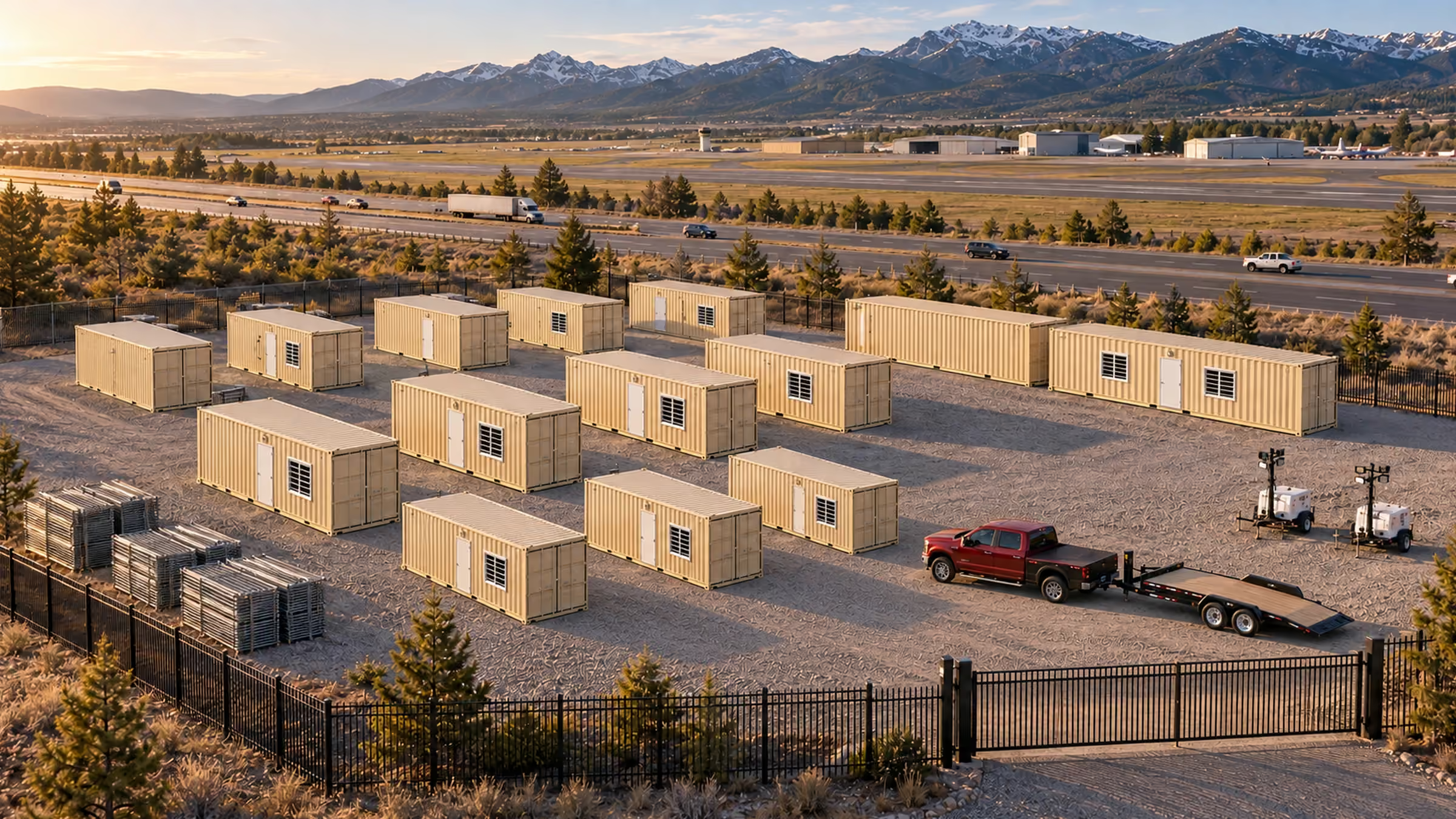
JOLT dispatches from Gypsum on the I-70 corridor. The delivery truck carries the unit empty, which keeps the move fundamentally different from hauling a box loaded near its plated gross. Route access and ground conditions still matter because the truck and trailer also occupy and load the approach.
A Base 20 ft office has the same nominal 20 ft length and standard 8 ft 6 in height, but it is no longer an empty cargo box. Its conversion introduces materials and equipment that must be included in placement or lifting plans. The CSC tare describes the box it started as; it does not automatically account for everything installed later.
What does an office conversion add?
Mobile Modular estimates that an office build-out adds about 1,500–3,000 lb to a 20 ft container, placing a finished office around 7,000–8,000 lb. Those are industry estimates, not published JOLT unit weights. They are useful for an early site conversation but not a substitute for the figure tied to the actual unit.
Conversion weight comes from many ordinary pieces rather than one large item. Framing, insulation, interior finish, a 36-inch steel personnel door, two barred slider windows, vinyl-plank flooring, lights, outlets and the mini-split all add material. Wiring and distribution equipment add more, while removed steel at door and window openings offsets part of the addition.
The useful arithmetic is a range. Starting with Hapag-Lloyd's 5,181 lb tare and adding Mobile Modular's 1,500–3,000 lb estimate gives about 6,681–8,181 lb; Mobile Modular rounds the finished class to roughly 7,000–8,000 lb. Keep the method and the uncertainty visible instead of reporting a false exact total.
Do not use an office estimate for a cargo lift. A crane plan needs the actual lifted weight, an allowance for loose items, a center-of-gravity assessment and the selected rigging arrangement. JOLT's customer is not permitted to move or lift the unit under Rental Agreement §5.5.
For the longer comparison, 40 ft office container weight starts with a heavier 40 ft tare and a larger conversion allowance. Length changes the delivery approach and pad sensitivity even before the interior package is considered.
What load reaches the ground?
A container standing on hard, level ground bears through four ISO 1161 corner castings. Each fitting measures 178 by 162 mm across its nominal footprint, or about 7 by 6.4 in. Multiplying those inch dimensions gives about 44.7 sq in of face area per corner.
If a 5,181 lb empty box shared weight perfectly, each corner would carry about 1,295 lb. Dividing that by 44.7 sq in gives an average of about 29 psi over a casting face. A roughly 8,000 lb converted office averages 2,000 lb per corner and about 45 psi by the same simplified calculation.
Those averages assume four corners touch the same plane and share the load equally. A low corner, a high rock under one casting or a soft patch can shift reactions sharply, and the steel frame can twist as it follows the support. The simple division is a screening calculation, not a foundation design.
Compacted gravel or prepared road base spreads a corner reaction into a broader layer and drains water away from the steel floor line. Loose topsoil, uncompacted fill and thawing shoulder material deform under concentrated reactions, allowing one corner to settle. The result can be a container that rocks, racks or has cargo doors that no longer meet squarely.
Read whether a shipping container needs a foundation before treating a temporary pad like a permanent building support. The 2021 International Building Code Section 3115 requires engineered foundations and anchorage for permanent container buildings, while local officials decide whether and how that section applies to a temporary rental.
JOLT requires a firm, level, well-drained surface under Rental Agreement §5.2. The customer is responsible for the site, approvals, marked utilities and placement direction. That division puts pad preparation with the party who knows the excavation, buried work and final grading plan.
How does weight change delivery and pickup?
A 20 ft unit needs about 70 ft of straight-line clearance for JOLT's tilt-bed or flatbed truck. The route also needs workable width, turning radius, grade and overhead clearance. A corner on the plan can fit a 20 ft rectangle while the truck remains unable to align and unload.
Colorado State Patrol lists 8 ft 6 in as the legal vehicle width without a permit, 14 ft 6 in as the usual legal height except on designated routes, 45 ft for a single vehicle and 70 ft for a combination. It also lists 10 ft of permitted rear overhang. These limits describe the road envelope, not the dimensions of JOLT's truck.
The truck arrives with a rental unit empty. Under Rental Agreement §16.1, the customer must remove all personal property and attachments before pickup. A loaded container may be within its CSC gross yet still be an entirely different transport job from the empty retrieval the rental arrangement requires.
Keep the original approach intact through the project. A crane, spoil pile, trench, fence run or winter berm can block a route that worked on delivery day. Fifteen days' written pickup notice is required, and rent continues until the unit is retrieved.
If the truck arrives and the site cannot accept delivery, the trip fee and next trip are due, with waiting time billed by the hour after the first 30 minutes under Rental Agreement §5.3. Check firmness after rain or thaw rather than relying on how the lane looked when frozen.
Delivery from Gypsum to Breckenridge is in Zone C, with the published fee shown by Zone C — $750 each way each way. The full delivery-zone schedule lets the superintendent include both delivery and pickup in the mobilization plan.
How much material can go inside?
The plated payload is the upper cargo limit for the box, but legal transport, floor loading, support and the rental rules can impose tighter constraints. Do not subtract a guessed tare from a generic gross and call the answer a loading plan. Start with the plate, identify the material and its unit weight, then consider where every pallet or bundle will sit.
Dense material can create a floor problem long before its total reaches 62,016 lb. A compact stack of tile, stone or steel puts load into a small floor area and can bias one end or one side. Spread heavy stock, keep it low and preserve a clear path to the doors.
The customer may not exceed rated loads or stack containers under Rental Agreement §7.2. Welding, cutting, drilling and other alterations are also prohibited, so field-installed lifting eyes or wall-mounted supports are not a solution. Use freestanding storage that does not alter the shell.
Hazardous and flammable materials are prohibited. Ordinary tools and building materials still need a dry, orderly loading plan with the four corner supports left stable. If a supplier gives material weights in pounds per pallet, total them and mark their positions on a simple floor sketch.
At pickup, the unit must be empty even if the intended contents are well below the payload. Arrange demobilization so the final pallets leave before the retrieval lane is surrendered to another trade. That sequence avoids asking a driver to solve a loaded move that was never planned.
When do cranes, forklifts and rigging enter the plan?
Delivery by JOLT's own tilt-bed or flatbed truck is the standard method under Rental Agreement §5.2. If normal placement cannot reach the marked pad, raise that constraint before scheduling. Do not assume a site forklift can take over for the final few feet.
The customer may not move or lift the unit. A forklift's rated capacity alone does not establish that its fork length, load center, ground bearing or pickup points suit a 20 ft container. The box is long, and a converted office may carry an off-center interior package.
A crane plan is unit-specific. The planner needs actual weight, lift radius, rigging geometry and approved lifting points, not just the 5,181 lb representative tare. Ask us for the unit figure when a crane, restricted bridge or engineered pad makes it material.
ISO corner fittings provide standardized interfaces, but their 178 by 162 by 118 mm dimensions do not by themselves approve a rigging method. The lift contractor selects equipment and rigging for the actual configuration. No one should add holes, weld tabs or modify a rental to improvise a pick.
On-site relocation by JOLT is $450. A planned relocation keeps lifting and transport with the owner and gives the crew a chance to recheck the new pad and route. It also avoids dragging the corner castings across finished paving or buried work.
How much weight can mountain snow add?
A 20 ft by 8 ft roof has 160 sq ft of plan area. Summit County's current guidance uses a snow-load matrix with design loads roughly 75–100 psf by area. Multiplying gives 160 × 75 = 12,000 lb at the lower end and 160 × 100 = 16,000 lb at the upper end.
That arithmetic shows why snow cannot be dismissed beside a roughly 5,181 lb empty tare. It does not mean every storm places the full design load on every box, and it is not a claim about a JOLT unit's structural rating. Snow distribution, drifting, ice and site elevation require the local design criteria.
Breckenridge sits at about 9,600 ft in Summit County's Climate Zone 7. Sustained cold can preserve one storm while the next one accumulates, and drifting can make roof load uneven. The Colorado snow-load guide separates local permit questions from daily rental care.
The customer must keep snow, ice and debris off roofs, doors, condensers, panels and access paths under Rental Agreement §7.4. That obligation covers the container and the route needed to reach it safely. Do not pile plowed snow against the cargo doors or in the future pickup line.
Roof clearing must be planned without unauthorized drilling, attachments or alteration. Keep the roof edge, mini-split and any solar equipment in view when assigning the work. If a permanent roof structure or attachment is proposed, local review and JOLT's written approval are separate issues.
What should be ready before you reserve?
Record whether the need is plain storage or a converted office, because the expected empty weights differ by roughly 1,500–3,000 lb before furniture. Identify any crane, bridge, posted road, suspended slab or engineered-pad issue that makes the actual unit figure necessary. Ask us about that constraint before the delivery plan is fixed.
Measure about 70 ft of straight-line working room and walk the complete truck path. Mark buried utilities, check overhead lines and limbs, inspect turning space, and select a firm, level, well-drained pad with all four corner locations prepared.
Confirm permits, zoning, HOA and landlord approvals before dispatch. Decide cargo-door orientation, name the representative who will direct placement, and preserve the route for empty pickup. The pricing schedule shows the published monthly rate, deposit, term and delivery timing without relying on a weight estimate.
Finally, write down the loading plan in pounds and positions rather than simply calling the box full or empty. Keep dense stock distributed, remain within rated loads, prohibit field modifications and schedule complete unloading before retrieval. Those details turn the plate numbers into a workable jobsite plan.
Questions contractors ask
How much does an empty 20 ft shipping container weigh?
Hapag-Lloyd lists a representative 20 ft dry container tare of 2,350 kg, or 5,181 lb. The exact tare varies by manufacturer, so read the CSC plate on the door before planning a lift.
How much does a converted 20 ft office container weigh?
Mobile Modular estimates a finished 20 ft office at roughly 7,000–8,000 lb. That is an industry estimate rather than the weight of a specific JOLT unit, so ask us for the unit figure when a crane or engineered pad is involved.
What is the maximum gross weight of a 20 ft container?
Hapag-Lloyd lists 30,480 kg, or 67,197 lb, as the maximum gross weight for its representative 20 ft dry container. Use the CSC plate on the actual box because manufacturer figures can vary.
How much payload can a 20 ft shipping container hold?
The Hapag-Lloyd example lists a maximum payload of 28,130 kg, or 62,016 lb. A rental must also stay within its rated loads, and dense material should be distributed across the 20 ft floor rather than concentrated at one end.
How much weight sits on each corner of a 20 ft container?
An evenly supported 5,181 lb empty box puts about 1,295 lb on each of four corners. A roughly 8,000 lb office averages about 2,000 lb per corner, but an uneven pad can make the actual reactions unequal.
Can I move a rented 20 ft container with a forklift?
No, the customer may not move or lift a rented unit under [Rental Agreement §5.5](/legal/rental-agreement-terms#5). If placement must change after delivery, ask JOLT to handle the one relocation rather than towing, dragging or lifting the box.
Does a 20 ft container need a concrete foundation?
A temporary rental needs a firm, level and well-drained placement surface with support at all four corners. Whether a permanent installation needs an engineered foundation depends on its use and the local code decision, including 2021 IBC Section 3115 where adopted.
Does snow add much weight to a 20 ft container?
Yes, a 20 ft by 8 ft roof has about 160 sq ft of plan area. At a 75–100 psf design load, multiplication gives roughly 12,000–16,000 lb, which is why the customer must keep snow and ice off the roof under [Rental Agreement §7.4](/legal/rental-agreement-terms#7).
Keep reading
- Rent20 ft storage container — $295/month, delivered
- RentBase: the office that shows up and works
- LocationJobsite container and office rental in Gypsum
- LocationJobsite container and office rental in Breckenridge
- Answer40 ft office container weight and what it means for placement
- AnswerDo shipping containers need a foundation? Usually no — here's when they do
- JOLTPrices. All of them.
- AnswerAre shipping containers waterproof? Yes — until they aren't
Ready when your site is.
Rentals from $85/mo · every price published
A deposit holds your delivery window. Cancel free of charge more than 14 days before the first day of the window. Deposits from $85 are applied to your first invoice.