
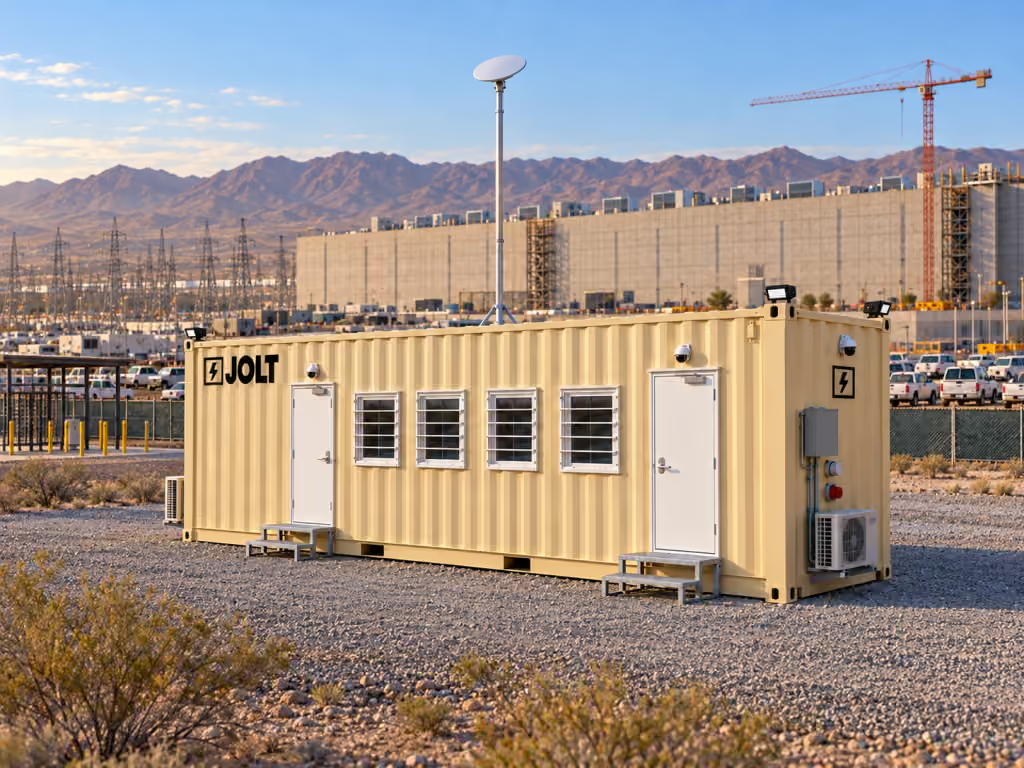
Phoenix West Valley · Arizona
Data center site offices in Arizona: The Grid, nationwide.
Arizona's data center pipeline is growing. Get a badge-ready 40 ft Grid office from $1,950/mo, delivered statewide.
- Market
- Phoenix West Valley
- DC Deploy
- Quoted per campus
- On-site window
- 6–8 weeks
- Grid Command
- $2,750/mo
- Legal-width loadNo oversize permits
- On site in6–8 weeks
- One invoiceper unit
- Badge-ready
- Stackabletwo-high
- Moves withyour phases

Key facts
- Phoenix West Valley is the named corridor for 1 Arizona market as of .
- The Command the Grid — 40 ft data center site office rents for $2,750 per month as of .
- The reservation deposit on the Command the Grid — 40 ft data center site office is $2,500 as of .
- DC Deploy is scheduled 6–8 weeks after the reservation as of .
Cite this page: "Data center site offices in Arizona: The Grid, nationwide." JOLT (Jolt Rents), https://joltrents.com/data-centers/arizona/. Last updated September 25, 2026.
Arizona has 35 data centers under construction and 136 announced as of March 2026, with 83 operating, concentrated in the east and west valleys of metro Phoenix, Mesa, Chandler, Goodyear, El Mirage and Buckeye, with Tucson and Pima County behind, according to Aterio.
Phoenix is a major U.S. data center market for the same reasons it is a hard place to put a steel box: flat land in large parcels and sustained summer heat. A site office in Goodyear in August is a cooling problem before it is anything else, so the site team must plan shade, power and ventilation.
Where are data centers being built in Arizona right now?
Mesa and the east valley. Mesa carries the largest cluster of hyperscale construction in the state: Meta's campus, Google's, Apple's command center, and the colocation buildings around them along the Loop 202 and Elliot Road corridor. Chandler, next door, is the older market, with CyrusOne, Digital Realty and a dozen operators on the Price Road corridor and new buildings still going up between them. Gilbert and Tempe carry smaller enterprise and edge builds.
Goodyear, El Mirage and the west valley. Microsoft has campuses in Goodyear and El Mirage; Compass and Vantage have broken ground on greenfield sites in Goodyear; and Buckeye has drawn campus-scale proposals farther west on Interstate 10. The west valley is Arizona Public Service territory and contains much of the announced pipeline in Aterio's March 2026 count.
Tucson and Pima County. Tucson's data center pipeline has been contested. A large campus proposal in 2025 drew a water-focused permitting fight in the city and moved to the county; the outcome is one of the items JOLT checks at every refresh of this page.
Arizona offers a transaction privilege tax program for qualifying data center equipment. Water use is also a permitting factor, and the Arizona Department of Water Resources and local cities evaluate cooling demand.
Which hyperscalers, developers and general contractors are active in Arizona?
Meta, Google, Apple and Microsoft at campus scale; CyrusOne, Digital Realty, Compass, Vantage, Aligned, EdgeCore, Iron Mountain and the colocation operators around them.
The general contractors with data center groups working in Arizona include Holder, DPR, Turner, McCarthy, Mortenson, JE Dunn and Whiting-Turner, and the Arizona builders that grew up on these campuses, Sundt, Layton and Okland. Phoenix is also a base for national electrical contractors with large valley offices.
What does an Arizona data center site office need?
Cooling, sun, wind and caliche.
Cooling. Phoenix faces sustained triple-digit summer weather and hot nights. The Grid carries two mini-split heat pumps behind R-19 walls and an R-30 roof, but the project team still needs a reliable power plan and routine filter maintenance.
Sun. Where the pad allows, orient the windows away from afternoon sun. A light exterior finish and project-designed shade at entries can further reduce solar load.
Wind and dust. Monsoon season brings haboobs and microbursts across the west valley. Four-point anchoring, closed doors and regular filter cleaning are central to the site plan.
Caliche. Much of the valley sits on a cemented calcium layer that can prevent ordinary earth anchors from entering. The responsible site teams must select an engineered anchoring method for the actual soil and paving.
How does The Grid get to an Arizona site?
DC Deploy covers freight, placement, leveling, four-point anchoring and an electrical rough-in walkthrough for any lower-48 site; review the nationwide delivery package.
Before arrival, confirm truck or crane access, overhead conflicts, pad readiness and the electrician's scope. DC Deploy covers placement, leveling, anchoring and the electrical rough-in walkthrough with your electrician.
What does a Grid cost on an Arizona data center site?
Arizona uses the nationwide Grid rates, term rules and DC Deploy package shown on the data center pricing page.
| Item | Price |
|---|---|
 The campus already has fiber and badging. $2,500 deposit · 12-month minimum · 6–8 weeks window | $1,950 /mo |
Most popular  First office on site, before power lands. $2,500 deposit · 12-month minimum · 6–8 weeks window | $2,750 /mo |
DC Deploy covers freight, set, leveling, anchoring, an electrical walkthrough and pickup, quoted per campus in one business day.
| Item | Price |
|---|---|
 Stack Kit $1,500 setup | $395 /mo |
25 kW generator | $1,850 /mo |
ADA ramp | $295 /mo |
Workstation pack | $75 /mo |
 Unlimited Starlink | $75 /mo |
BRAND Included on Command | $450 one-time |
On-campus relocation | $1,250 one-time |
What is the power picture in Arizona and when does temp power land?
Arizona Public Service serves Phoenix, Goodyear, El Mirage, Buckeye and most of the west valley; Salt River Project serves Mesa, Chandler, Tempe and Gilbert on the east side; Tucson Electric Power serves Pima County. Project teams should confirm capacity, temporary service and interconnection schedules directly with the serving utility.
For a site office, the utility timeline matters on the day the office lands. If temporary service trails mobilization, Command's generator inlet or the $1,850/mo generator add-on can bridge the gap until the electrician supplies the office circuit.
Do you need a permit for a temporary site office in Arizona?
In Maricopa County's cities, a temporary construction office is commonly shown on the site's logistics plan and may require a temporary-structure permit or approval under the project permit. Requirements vary among Mesa, Chandler, Goodyear, Buckeye and county jurisdictions.
Confirm the requirement with the authority having jurisdiction named on your building permit. Four-point anchoring is part of every DC Deploy; bring the AHJ's or the GC's anchoring and insurance requests to the data center specialist before the delivery window.
How long is an Arizona site office term?
Arizona project schedules vary by permitting, utility work and building scope. JOLT's minimum term is 12 months, with the 5% annual escalator applied on each anniversary.
For a multi-building program, teams can relocate the office as phases turn over. Compare renting with the purchase choices when the office will serve several campuses.
How do multi-building Arizona campuses use a Grid Campus?
A Goodyear program can place the GC's project office, owner's representative, electrical and mechanical contractors and security team in a Grid Campus. A Grid Campus is 2 to 12 Grids in a row or stacked two-high, allowing individual units to follow the buildings as they turn over.
Build the temporary-power question into the office quote
An Arizona office request should identify the serving utility, the source planned for mobilization and the date the electrician expects that source at the office pad. APS, SRP and Tucson Electric Power have different service processes. The utility named on the campus announcement is not a substitute for confirming the meter and construction-service scope for the actual parcel.
Start with the service address and the project electrical lead. Ask whether the office is inside the GC's temporary distribution plan or needs a dedicated branch from another point. Record who supplies the connection, who approves the load plan and what source is available when the unit is placed.
For an east-valley project, the electrical lead should settle the service address, requested service date and construction contact with SRP before procurement writes the office scope. Keep the utility request identifier in the mobilization file so the office decision follows the current service plan.
Command includes a generator inlet with a mechanical interlock. The generator add-on is an option, not a reason to leave the electrical plan open. Ask the site electrician to confirm the source, connection and load plan in writing before delivery.
Core is the simpler choice when suitable shore power, site fiber and the contractor's own access arrangement are ready. Command is the stronger scope when the team needs its included backup connectivity, badge-ready doors, WATCH cameras or generator-ready inlet. Make that choice from known site services rather than the campus's eventual permanent utility design.
Phoenix-area permit checks belong on the logistics plan
The permitting question begins with jurisdiction. A Mesa address goes to Mesa, a Goodyear address goes to Goodyear, and an unincorporated parcel goes to Maricopa County. Do not assume that the owner of the permanent building permit also approved a temporary office shown in a later logistics revision.
Phoenix provides commercial plan-review and permit information through its Planning and Development Department. For a Phoenix parcel, ask the permit coordinator whether the office belongs in the commercial permit set, a temporary-use approval or both. Keep the written answer with the current site plan.
The submittal should show the office footprint, both personnel doors, access route, bearing surface, electrical connection and anchoring approach requested by the authority having jurisdiction. It should also show nearby fencing and equipment so a later laydown-yard change does not quietly block an exit.
Repeat the check when the office moves. A relocation from the gate to a building pad changes its relation to fire access, underground work and crane activity even when the same unit stays on the same campus. The site team should decide whether the existing approval covers the revised position before scheduling the move.
In Buckeye and west-valley greenfields, compare the permit drawing with the civil team's current grading sheet. A pad shown on an early logistics plan can become a drainage route or utility corridor in a later issue. Procurement needs a confirmed placement point, not just a campus address.
Extreme-heat planning starts outside the office
The National Weather Service Phoenix office maintains a heat program and HeatRisk resources for the forecast area. Use that forecast information for the work plan around delivery, pad inspections and office moves. It does not replace the project's heat-illness program.
Keep the planned office position out of areas where parked equipment, stored material or a later fence revision will choke airflow around the exterior equipment. Confirm that project-designed shade does not obstruct doors, exterior lights or the route used for service access.
Dust changes the inspection plan. Ask the project's HVAC lead what should be checked after a blowing-dust event, and record that advice in the office turnover list. The included comfort equipment is two cold-climate mini-split heat pumps; the project should obtain maintenance guidance for its conditions.
Power loss in afternoon heat is a jobsite contingency, not a comfort complaint. The superintendent should identify where office staff report, how records remain accessible and who contacts the electrician when the planned source is unavailable. Do not treat backup connectivity as backup power.
Monsoon planning also reaches the pad. Review drainage after grading changes and keep cribbing bearing points away from a flow path. Recheck door approaches after a storm so sediment or temporary erosion controls do not interfere with entry and egress.
Water questions affect office placement even without plumbing
The Grid has no plumbing scope in its published includes, so the office itself should not be presented as part of a campus cooling-water solution. Water still matters to its position because civil mains, fire lines, retention areas and washout routes compete for the same early open ground.
Phoenix publishes its development review resources through the city's Planning and Development Department. On a Phoenix project, compare the current civil plan with the office location before requesting placement. On another Arizona site, use the equivalent city or county review set.
Ask the civil superintendent where wet utilities cross the logistics route and whether trenching will cut off the office. Ask the fire-protection lead whether the proposed position conflicts with hydrant access or a fire lane. Ask the earthwork team whether a retention feature changes the bearing surface after the next grading phase.
These checks matter most on a phased campus. The first office location can be sensible during mass grading and unusable when underground utilities reach that quadrant. Put a relocation decision date against the civil look-ahead so the team can compare moving the Grid with rebuilding temporary access around it.
Normalize competing Arizona office quotes in writing
Use one scope sheet for every bidder. Name the build or equivalent interior requirement, term, site ZIP, target window, placement method assumption, anchoring responsibility, electrical handoff, connectivity, access preparation, furniture and end-of-term pickup.
Separate recurring rent from one-time work. A low monthly line is not comparable if placement, anchoring or pickup appears elsewhere or remains unpriced. For The Grid, use the current pricing page and DC Deploy scope rather than copying figures into an email that may outlive a revision.
List the owner-supplied items beside the vendor items. The customer should identify the approved bearing surface, unobstructed access and customer-supplied utilities. The office quote should make clear whether project badging, site fiber and any project-specific engineering are outside the offered scope.
Compare Core and Command against the first phase, not the finished campus. A site that expects future fiber and permanent access control may still need Command's included CONNECT, WATCH and badge-ready preparation during mobilization. Core may fit an expansion pad where the contractor has already confirmed those services.
Finally, tie every allowance to a responsible person. The permit lead owns the AHJ answer, the electrician owns the connection and load plan, and site logistics owns the placement point. That assignment prevents an attractive quote from arriving at a pad nobody has approved.
Which Arizona counties and metros does JOLT serve?
DC Deploy serves Maricopa, Pinal, Pima and every other Arizona county under the same lower-48 package. Nearby markets are Nevada, Utah, Texas and Oregon.
How do I reserve a Grid for an Arizona project?
Choose the build, site ZIP, quantity, target date, add-ons and protection through the data center reservation path; the confirmation gives the window and a specialist responds within 15 minutes during business hours.
How many data centers are under construction in Arizona?
Aterio's March 2026 count lists 35 under construction, 136 announced and 83 operating.
Does JOLT deliver site offices anywhere in Arizona?
Yes. DC Deploy serves any Arizona site and includes freight, placement, leveling, anchoring and an electrical walkthrough.
How long does delivery to Arizona take?
The on-site window is 6–8 weeks from a paid reservation. The confirmation gives the project's window.
What does a Grid cost in Arizona?
Arizona uses published rents: Grid Core starts at $1,950/mo, Grid Command at $2,750/mo, with a 12-month minimum. DC Deploy is quoted per campus in one business day.
Is The Grid built for Arizona weather?
The Grid has two heat pumps, R-19 walls, an R-30 roof and four-point anchoring. The site team must still plan power, shade, filter care and anchoring for Arizona conditions.
Who is the utility and how does that affect the office?
APS serves much of the west valley, SRP serves much of the east valley and TEP serves Tucson. Confirm temporary-service timing with the utility so the office has an appropriate shore-power or generator plan at mobilization.
How does extreme heat affect a container site office?
Extreme heat raises cooling and power demands and makes shade and filter maintenance more important. Plan the pad orientation and electrical service before delivery.
Which Phoenix suburbs have data centers under construction?
Mesa and Chandler anchor the east side, while Goodyear, El Mirage and Buckeye anchor the west side. Confirm individual project status with the owner or permitting jurisdiction.
Your delivered price
Pick the unit, rent or buy, and the job ZIP. Monthly rent and the route show as you go; we email the full delivered price with a 14-day lock.
Pick a length
Drawn to scale, side view.
Step 1: Unit
The Grid · Command
Which 40 ft?
Step 2: Rent or buy
12-month starting term for project quotes.
Renting 12 months or more? Lease-to-own ends with the office yours: $2,795/mo for 36 months.
Step 3: Job ZIP
Arizona · Project quote
Delivery and pickup: quoted for your site.
Step 4: Send it
Step 5: Your project quote
- JOLTSite offices for data center construction. Nationwide.
- DataCenterProductNationwide Grid Command: badge-ready, connected, and ready the day it lands.
- DataCenterGuideNationwide data center site office pricing. All of it.
- DataCenterMarketData center site offices in Nevada: The Grid, nationwide.
- DataCenterMarketData center site offices in Utah: The Grid, nationwide.
- DataCenterMarketData center site offices in Texas: The Grid, nationwide.
- DataCenterMarketData center site offices in Georgia: The Grid, nationwide.
- DataCenterMarketData center site offices in Illinois: The Grid, nationwide.
Bring The Grid to Arizona.
DC Deploy covers freight, set and pickup.
A deposit holds your delivery window. Cancel free of charge more than 14 days before the first day of the window. Deposits from $85 are applied to your first invoice.