
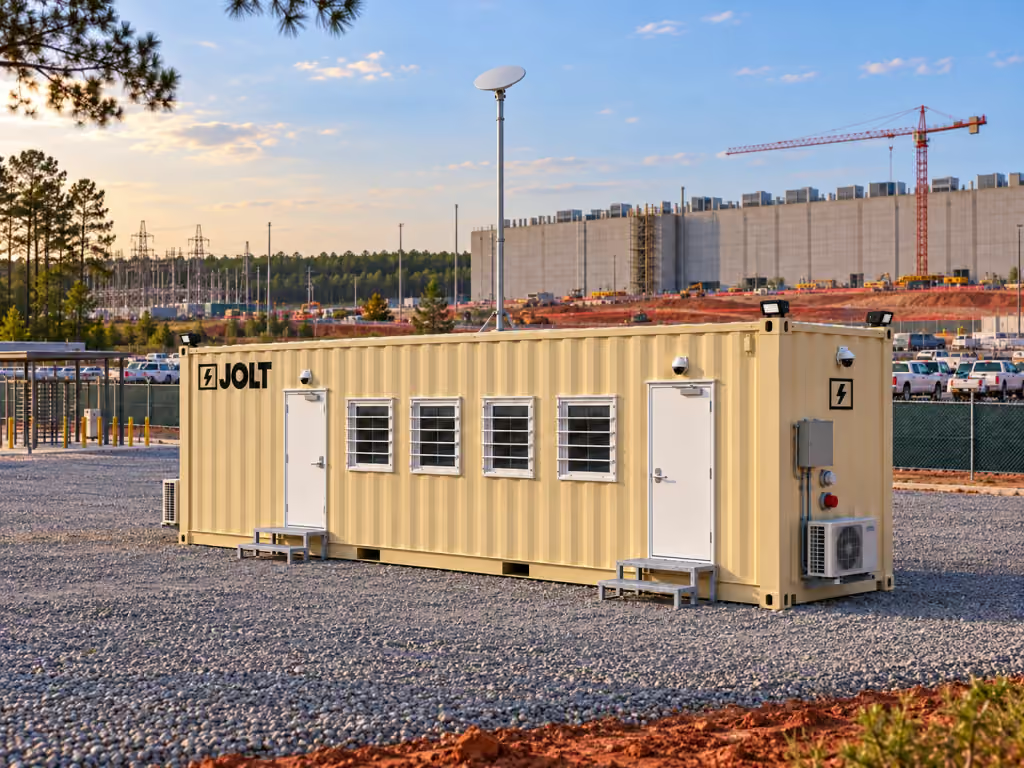
Atlanta · Georgia
Data center site offices in Georgia: The Grid, nationwide.
Georgia Grid offices start at $1,950/mo, with nationwide DC Deploy and an on-site window of 6–8 weeks for data center projects.
- Market
- Atlanta
- DC Deploy
- Quoted per campus
- On-site window
- 6–8 weeks
- Grid Command
- $2,750/mo
- Legal-width loadNo oversize permits
- On site in6–8 weeks
- One invoiceper unit
- Badge-ready
- Stackabletwo-high
- Moves withyour phases

Key facts
- Atlanta is the named corridor for 1 Georgia market as of .
- The Command the Grid — 40 ft data center site office rents for $2,750 per month as of .
- The reservation deposit on the Command the Grid — 40 ft data center site office is $2,500 as of .
- DC Deploy is scheduled 6–8 weeks after the reservation as of .
Cite this page: "Data center site offices in Georgia: The Grid, nationwide." JOLT (Jolt Rents), https://joltrents.com/data-centers/georgia/. Last updated September 25, 2026.
Georgia has 56 data centers under construction and 340 announced as of March 2026, against 62 operating, according to Aterio's March 2026 count. The pipeline is concentrated in the southern and western arc of metro Atlanta and, on the coast, in Effingham County outside Savannah.
Georgia got here on three things Virginia cannot offer right now: a utility, Georgia Power, with shorter interconnection timelines than Dominion; a 2018 sales-tax exemption on data center equipment that has proven to be one of the most effective incentives in the country; and land in 500-acre parcels within an hour of the world's busiest airport. Atlanta is now a top-five U.S. data center market, and the mid-size builds filling in around the campuses, 20 to 50 megawatts each, are where most of the 56 projects under construction are.
Where are data centers being built in Georgia right now?
Douglas County. Lithia Springs and the Interstate 20 corridor west of Atlanta are the state's oldest and densest cluster. Google, Switch, QTS and colocation operators have projects and campuses along the corridor.
Fayette, Coweta and Newton counties. South and east of the city, QTS's Fayetteville campus, Meta's Stanton Springs campus in Newton County and a run of new greenfield sites in Coweta County near Newnan carry the next wave, on parcels that were farmland or pasture five years ago.
Bartow County and the north. Cartersville and the Interstate 75 corridor northwest of the city have drawn campus-scale proposals on large parcels with rail and highway access; several are in permitting and site work.
Effingham County. Outside Savannah, OpenAI's Project Camellia is a 1,400-acre campus with four hyperscale buildings and 3.2 gigawatts of contracted power under a 25-year agreement, one of the largest planned AI infrastructure investments in the country. It is the first gigawatt-scale campus on the Georgia coast and a different labor market.
Alpharetta and Fulton County. The northern suburbs carry the enterprise and colocation builds: smaller, faster, and often on sites where the office sits in a parking lot rather than a laydown yard.
Phases and names change quarterly. JOLT checks each project against a county filing or local reporting at every refresh of this page.
Which hyperscalers, developers and general contractors are active in Georgia?
Google, Meta, Microsoft, OpenAI, QTS, Switch, Digital Realty, DataBank, Flexential and the colocation operators building 20-to-50-megawatt facilities around the campuses.
Atlanta is home to Holder Construction, one of the largest data center builders in the country, and the general contractors with data center groups working in Georgia include Holder, Brasfield & Gorrie, DPR, Turner, JE Dunn, Clayco, Hoar, Skanska, Whiting-Turner and Hensel Phelps. Georgia's timelines, 18 to 24 months from permit to energized on a typical building, are half a Northern Virginia schedule, and GCs staff accordingly: a Georgia campus mobilizes fast and moves crews between buildings more often, which is what a relocatable site office is for.
The electrical contractor on a Georgia hyperscale building is the largest trade on site and mobilizes its own offices before the GC's temporary service is energized, usually with a generator. Command's generator inlet and LTE cameras fit that crew.
What does a Georgia data center site office need?
Dehumidification, drainage and anchoring in red clay.
Humidity. Metro Atlanta runs in the mid 90s from June through September with dew points in the 70s, and a steel box in that air sweats unless the wall is insulated and the cooling pulls moisture. The Grid's walls are R-19 closed-cell foam behind the steel, and its two heat pumps pull moisture as they cool.
Rain and drainage. Georgia thunderstorms can put water on a pad quickly. The Grid is leveled on cribbing at its four corner castings, so the compacted bearing surface must drain away from the doors.
Clay. Red-clay and paved sites require different anchoring plans. DC Deploy includes four-point anchoring, while the owner's engineer and authority having jurisdiction determine any project-specific criteria.
Lightning. The site's electrician and safety team should include the steel office, its electrical service and its placement in the project's grounding and lightning-safety plan.
For the bearing surface, power and access handoff, use the Grid site-requirements checklist.
How does The Grid get to a Georgia site?
DC Deploy serves any Georgia project with freight, tilt-bed placement or crane set, leveling on cribbing, four-point anchoring, an electrical rough-in walkthrough and pickup; see nationwide delivery.
What does a Grid cost on a Georgia data center site?
Georgia uses the published Grid rents and reservation deposit on the data-center pricing page. DC Deploy is quoted per campus.
What is the power picture in Georgia and when does temp power land?
Georgia Power serves metro Atlanta and most of the state, and its interconnection timelines for large loads are shorter than Dominion's in Virginia, which is the single biggest reason projects that would have gone to Loudoun by default three years ago are going to Douglas and Coweta counties now. The electric membership cooperatives serve parts of the exurban counties where the newest campuses sit. The load growth is real: Georgia Power's large-load pipeline is measured in gigawatts, and the Public Service Commission has approved generation additions to meet it.
For a site office, the utility's timeline matters on the day the office lands. Temporary construction service on an Atlanta-area campus is usually live at the gate before the office arrives; on an exurban greenfield site in Coweta or Bartow, or at Effingham County, the GC's temporary service can be two to six weeks behind the first mobilization. Grid Command's 50 A generator inlet with a mechanical interlock lets a generator power the office until the electrician gets a 60 A circuit to the pad; the site electrician confirms the generator's load plan. JOLT's 25 kW generator is $1,850/mo plus fuel and is cancelled when the shore cord goes on.
Do you need a permit for a temporary site office in Georgia?
Georgia counties administer the state minimum standard codes, and a temporary construction office may be handled as an accessory to the project's building permit and shown on the site logistics plan. Local requirements vary, especially where coastal wind criteria apply.
Confirm the requirement with the authority having jurisdiction named on your building permit. Every DC Deploy includes four-point anchoring; bring the county's or the GC's anchoring and insurance requests to the data center specialist before the delivery window.
How long is a Georgia site office term?
Shorter than Virginia's and busier. A Georgia building runs 18 to 24 months from permit to energized, so a single-building placement is a 12-to-24-month term. A campus program in Douglas or Coweta County runs four to five years across several buildings, and on those the office moves every 12 to 18 months as a building turns over; that is one or two $1,250 relocations over a two-year placement, not a new mobilization.
For a contractor carrying an office across several projects, compare rental with the purchase and 36-month lease-to-own rows on the Grid buy page.
How do multi-building Georgia campuses use a Grid Campus?
A Douglas County campus with four buildings or the four-building Camellia campus at Effingham is built in phases, and the GC's project office, the owner's rep, the electrical and mechanical contractors and the security office all move as the buildings turn over. On an 18-to-24-month Georgia schedule, they move more often than they would in Virginia.
A Grid Campus is 2 to 12 Grids in a row or stacked two-high. A Stack Kit rents for $395/mo with $1,500 setup per stacked pair, and an order of 6 or more Commands earns a 5 percent rent credit each month for the first 12 months.
Which Georgia counties and metros does JOLT serve?
DC Deploy serves every Georgia county. Active areas include Douglas, Fayette, Coweta, Newton, Bartow, Fulton, Cobb, Gwinnett, Henry and Paulding in metro Atlanta; Effingham, Chatham and Bryan on the coast; and Columbus and Muscogee County in the west.
Nearby market pages cover North Carolina, Mississippi, Virginia and Louisiana.
How do I reserve a Grid for a Georgia project?
Choose Core or Command, then provide the Georgia site ZIP, quantity, target date, details, add-ons and protection through the data-center reservation path.
Treat Georgia utility service as a project interface
Do not use the campus's permanent load date as the temporary-office power date. Ask the general contractor's electrical lead which entity serves the parcel, who owns temporary distribution and what milestone releases the office connection. Keep the answer in the project electrical record so procurement does not substitute a campus milestone for office readiness.
The office decision needs a smaller set of answers than the campus interconnection decision. Procurement needs the expected temporary source, an electrician-owned connection plan and a clear date for the pad. The superintendent needs to know whether the office location conflicts with future duct banks or substation work.
Command is generator-ready through its included inlet and mechanical interlock. That feature does not choose the generator, approve a connection or set a load plan. Give the site's licensed electrician the included equipment list and ask for a written project decision.
Revisit the plan when a campus changes phases. A Douglas County office near an early civil package may later sit inside an electrical work zone. A coastal project can also shift temporary distribution as permanent roads and drainage are completed.
Confirm the local permit path by county
Georgia projects need an authority-specific answer for a temporary construction office. Start with the building permit jurisdiction shown on the approved civil set. Then ask whether the Grid belongs on the main permit. The official can state whether a separate temporary-use approval or a notation on the site logistics plan is required.
For a west-metro project, use the Douglas County commercial permit application as the opening point for the county conversation. Ask building officials what site-plan detail, anchoring documentation, trade permits and inspections apply at the exact parcel.
For a Savannah-area campus, identify the building official from the parcel and issued permit before finalizing placement. Confirm whether the parcel is inside a municipal jurisdiction and whether a separate fire review applies.
Put the written jurisdiction answer in the procurement file. The county, city, fire official, owner's engineer and site safety team may each review a different part of the installation. A delivery reservation is not a substitute for those approvals.
Show the approved office point on the current logistics drawing. Include the approach, door orientation, electrical route and any required access path. If the location moves later, reopen the permit and inspection question rather than assuming the earlier answer follows the unit.
Compare Georgia office quotes on written scope
Normalize each quote before comparing monthly rent. Put the office dimensions, included workstations, communications equipment, security preparation and delivery scope on one sheet. Separate recurring charges from reservation, deployment, setup and relocation lines.
Ask whether the quoted delivery line includes placement, leveling, anchoring and end-of-term pickup. DC Deploy includes those items plus the electrical rough-in walkthrough. A lower freight line is not comparable if placement or retrieval arrives as a later charge.
For a phased campus, price the likely decision points without inventing a schedule. Note whether the office will remain at one pad, move on campus or leave after a single building. Include any stacked-pair requirement and identify the department assigned to each unit.
Review the power boundary in writing. Core includes its shore inlet and office electrical equipment. Command adds the generator inlet. The customer remains responsible for utilities, and the site electrician owns the project connection and load decisions.
Record permit responsibility, insurance treatment and cancellation terms beside the commercial lines. The Rental Agreement Terms provide the governing rental conditions. Procurement should resolve any difference between a proposal and the agreement before reservation.
Plan separately for metro Atlanta and the coast
An Atlanta-area placement plan should follow the live phase map rather than a regional assumption. Identify the construction entrance, internal haul route and pad that will exist at delivery. Confirm how concrete traffic, utility trenching and perimeter work affect the approach.
On an Effingham County project, add coastal emergency planning to the office checklist. The site team should define who secures records, who controls access and when temporary facilities are taken out of service under the project's weather plan. Do not convert a regional hazard into an unsupported performance promise for the office.
For either region, inspect drainage after the pad is built. Confirm that runoff moves away from doors and that the bearing surface remains firm after nearby civil work. The owner and authority having jurisdiction determine project-specific anchoring criteria.
Lightning procedures belong to the site's safety and electrical plans. Ask where personnel report during a warning and who decides when exterior work stops. The steel office, temporary service and surrounding equipment should be covered by the project electrician's grounding decisions.
Finally, name the person who can approve a field change. Georgia campuses can have separate owner, general contractor and trade logistics teams. Delivery is easier when one representative can resolve a blocked route or disputed orientation at the pad.
How many data centers are under construction in Georgia?
Georgia has 56 under construction, 340 announced and 62 operating as of Aterio's March 2026 count.
Does JOLT deliver site offices anywhere in Georgia?
Yes. DC Deploy covers any site in the lower 48, including every Georgia county, and includes freight, placement, leveling, four-point anchoring, an electrical rough-in walkthrough and pickup.
How long does delivery to Georgia take?
The DC Deploy on-site window is 6–8 weeks. The confirmed window appears on the reservation confirmation.
What does a Grid cost in Georgia?
Grid Core is $1,950/mo and Grid Command is $2,750/mo, with a 12-month minimum. DC Deploy is quoted per campus in one business day.
Is The Grid built for Georgia weather?
The Grid has R-19 closed-cell foam walls, an R-30 roof, two cold-climate heat pumps and four corner-casting anchor points. The site must still provide a level, draining bearing surface and comply with local requirements.
Who is the utility and how does that affect the office?
Georgia Power for metro Atlanta and most of the state, with EMCs in the exurban counties. Its shorter interconnection timelines are why projects are moving here; temp power on an exurban greenfield site can still trail mobilization by 2–6 weeks, which Command's generator inlet covers.
Where is Project Camellia and can JOLT deliver there?
Project Camellia is in Effingham County outside Savannah. DC Deploy covers the site under the same lower-48 delivery package.
How does Georgia humidity affect a container site office?
It condenses on cold steel unless the wall is insulated and the room is dehumidified. The Grid's walls are R-19 closed-cell foam, and its two heat pumps pull moisture as they cool.
Your delivered price
Pick the unit, rent or buy, and the job ZIP. Monthly rent and the route show as you go; we email the full delivered price with a 14-day lock.
Pick a length
Drawn to scale, side view.
Step 1: Unit
The Grid · Command
Which 40 ft?
Step 2: Rent or buy
12-month starting term for project quotes.
Renting 12 months or more? Lease-to-own ends with the office yours: $2,795/mo for 36 months.
Step 3: Job ZIP
Georgia · Project quote
Delivery and pickup: quoted for your site.
Step 4: Send it
Step 5: Your project quote
- JOLTSite offices for data center construction. Nationwide.
- DataCenterProductNationwide Grid Command: badge-ready, connected, and ready the day it lands.
- DataCenterGuideNationwide data center site office pricing. All of it.
- DataCenterMarketData center site offices in North Carolina: The Grid, nationwide.
- DataCenterMarketData center site offices in Mississippi: The Grid, nationwide.
- DataCenterMarketData center site offices in Virginia: The Grid, nationwide.
- DataCenterMarketData center site offices in Arizona: The Grid, nationwide.
- DataCenterMarketData center site offices in Illinois: The Grid, nationwide.
Bring The Grid to Georgia.
DC Deploy covers freight, set and pickup.
A deposit holds your delivery window. Cancel free of charge more than 14 days before the first day of the window. Deposits from $85 are applied to your first invoice.