A rented generator, fuel runs and noise all day. Our estimate for a Base office run on a generator, with fuel runs, internet and a camera, is $2,308 a month.
What JOLT changes
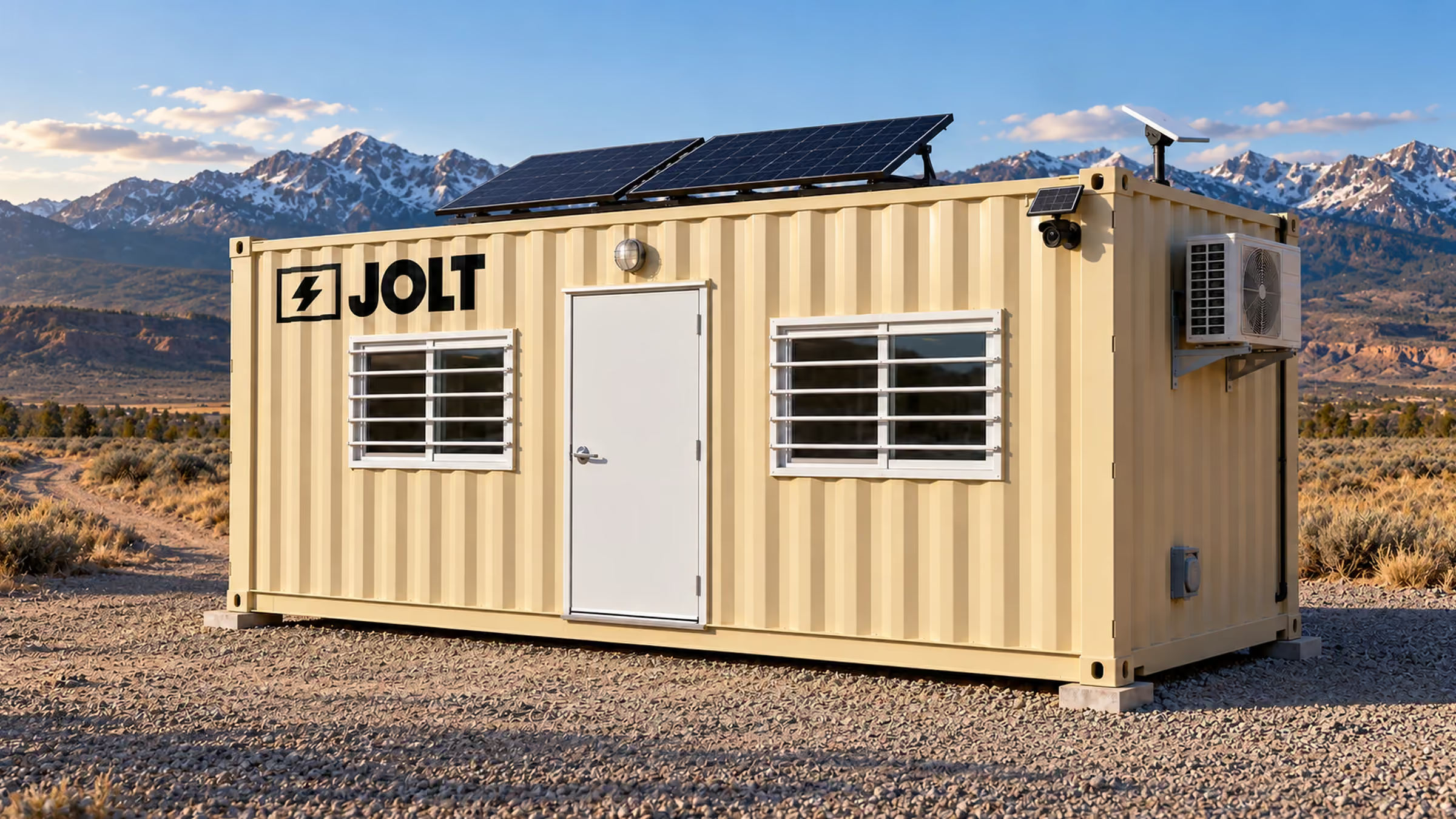
Grid-Free carries roof solar, a 10 kWh battery, Starlink and a camera. The battery runs the heat and A/C. $1,495 a month. Nothing to refuel.
Crews cool off in idling trucks. Afternoons slow down. Plans and laptops sit on the dash.
What JOLT changes
Every office has a mini-split for cooling and heat. Grid-Free runs it from its own battery.
Tools that walk off at night
What it costs you
Equipment theft costs U.S. contractors an estimated $300 million to $1 billion a year (National Equipment Register and NICB). Most of it is never recovered.
What JOLT changes
One-trip steel storage with a welded lockbox. WATCH adds a solar LTE camera with motion alerts for $129 a month. It comes built in on Grid-Free and Alpine.
Nowhere to meet the owner or the inspector
What it costs you
Walkthroughs happen on a tailgate. Plans ride on a truck seat.
What JOLT changes
A clean, lit office with a plan table (READY), Starlink for plans, email and video calls, and your logo on the door.
We help you plan the placement. Here is what Texas asks for. Start with the legal parcel, not its mailing city. A Houston address can involve a Harris County site. A Corpus Christi mailing label cannot settle Nueces County jurisdiction. A Laredo project description may cover several different road owners. Mark where people will work and where tools will stay. We can compare the office and storage footprints against that drawing. Take the same drawing to the relevant building and planning desks. Ask each reviewer to answer for the actual project phase.
On a private lot
Read Texas Local Government Code Chapter 233 for the state's specific unincorporated-county powers. Section 233.062 addresses fire-code authority for certain commercial, public and multifamily buildings. A city applies its own adopted construction and land-use rules. Establish the Texas municipal boundary before selecting a permit desk. Give that desk the occupied use, unit dimensions and planned duration. Include the underlying construction permit when one exists. Ask whether the office is ancillary to permitted work. Describe a separate storage container separately. The right answer depends on the parcel and use.
The Houston Planning and Development Department describes development rules without conventional citywide zoning. Ask Houston about its applicable development regulations nonetheless. Corpus Christi Development Services identifies adopted 2021 International Codes with local amendments. Ask its building reviewer about an occupied temporary office. Its zoning desk applies the Unified Development Code. Ask Laredo Building Development Services which district governs a Laredo parcel. These cities give different answers to the same generic question. A Texas project deserves an answer tied to its own address.
For a Texas site near a state highway, separate parcel permission from roadway permission. Mark any public easement beside the prospective pad. Ask the official which adopted code edition controls occupied space. Explain whether the office needs a shore-power connection. A 40 ft bathroom office calls for a utility discussion too. Where the proposed parcel is leased, bring the landowner into that discussion. Keep the approved position with the project drawing. A later stage may change the available rectangle.
On a street or sidewalk
Houston's Chapter 40 permitting presentation identifies section 40-362. It covers roadway and sidewalk obstructions. The examples include construction equipment and bulk-waste containers. Ask Houston Permitting Center about an office footprint near a travel lane. Identify the public curb and the actual dates. Distinguish temporary access from leaving a unit in place. Give the reviewer a drawing of each proposed occupation.
Corpus Christi Public Works' Right of Way Management Division handles public-space activities. That desk differs from Corpus Christi's private-parcel zoning desk. Laredo Building Development Services lists right-of-way management among its divisions. Ask its reviewer about the exact Laredo street position. A San Antonio site may involve Public Works instead. Take the specific street owner, not merely the city name, to the inquiry. For a TxDOT-controlled shoulder, identify that authority separately. A private-site approval does not decide public pavement use.
On an I-35 or I-10 project, an entrance can change between phases. Ask the project owner for its current staging drawing. Show the gate and the intended office position. Indicate where the public sidewalk remains open. The Houston obstruction rule addresses public pavement even beside a permitted construction site. We can discuss a private position when a curb occupation is unavailable. A Corpus Christi waterfront gate may belong to a different property operator. Record its answer separately from the city's street decision.
HOA and deed restrictions
Texas private covenants require their own review. Houston's development guidance does not decide a recorded deed restriction. Ask an association about the office's appearance and time on site. For a leased Houston retail lot, ask the landlord about the exact pad. On a Corpus Christi residential driveway, show the association the proposed storage footprint too. A Laredo logistics property may have owner-controlled circulation. Keep those private permissions next to the local building response.
If a Texas neighborhood has architectural review, show the selected exterior. Alpine's matte-black envelope and cedar surrounds give that reviewer concrete details. Its covered entry deck belongs on the position sketch. A Base office also needs an approved pad. Ask the HOA about visibility from neighboring parcels. Mark any access easement crossing the position. A property owner's consent and a municipal approval answer different questions. We can compare another available footprint if a covenant narrows the space.
Getting the site ready
Walk the Houston lot after the grading plan is current. Mark the pad above obvious surface runoff. Check the open path past a Corpus Christi waterfront gate. Identify any Laredo access affected by frontage-road construction. Draw the actual turning area and overhead lines. Keep the office position outside identified work circulation. Ask the superintendent which entrance remains available later in the project. Have a named site contact hold the approved position drawing.
A Texas site with shore power can consider Base. Give the electrician its 50-amp inlet information. At a utility-pending Texas parcel, Grid-Free needs no shore power. Texas sunlight and office load affect its solar output. The 10 kWh battery runs the HVAC. A 10 ft storage box fits some tight positions. A 12 ft tool crib gives Texas crews a man door and barred window. The 20 ft storage box gives them cargo doors and a welded lockbox. Draw each selected unit before deciding how much space remains.
At a Texas site with a long active schedule, revisit the pad after each phase. A new excavation can remove the original clear approach. A port-side access gate can move with construction. A highway project's frontage road can change its open turns. Update the position plan before the next crew takes over. Keep the legal parcel identification with that plan. The site contact can then identify the approved location, rather than guessing from a street address.
Where JOLT fits best
A year-long Houston corridor contract may need a working office and locked tool storage. Both units for that Houston site can come from the same fleet. Ask us about both footprints for the approved private site. On a Corpus Christi road package, the 20 ft office provides a place for field administration. The 20 ft storage box gives supplies a separate cargo-door space. Mark both positions on the owner's current staging drawing. Ask the Corpus Christi street desk about any public-pavement occupation.
For a longer Laredo interchange assignment, field administration and tools may follow different phases. Choose a stable approved office pad outside changing road work. Let the project desk know every unit the job needs. A 40 ft office with bathroom suits a larger approved area with service planned. A smaller 12 ft storage box can use a tighter remaining rectangle. These choices follow the site plan, not the highway project name.
Texas projects range from inland utility work to Gulf Coast reconstruction. We can discuss Base when electrical service exists. Grid-Free offers solar, Starlink and a WATCH camera where it does not. Alpine adds a covered entry and backup heat. An association may also want to review Alpine's exterior. Keep the actual parcel's permitted use central to the choice. An office that works well on one Houston lot needs fresh review at its next address.
Built for Texas weather
Texas climate differs sharply across the state. NOAA's Corpus Christi 1991–2020 station normals put July's average high at 93.7 °F. January's average low there is 48.0 °F. Its twelve monthly precipitation normals total 31.74 inches. The Laredo AFB normals show a 99.9 °F July high. January's average low there is 46.5 °F. Its monthly precipitation normals total 21.35 inches. Those inland and coastal figures call for different site discussions.
The National Weather Service's Houston Intercontinental normals show a 94.5 °F July average high. Its January average low is 43.7 °F. Annual precipitation at that station is 51.84 inches. Houston rainfall makes site drainage a practical planning topic. Corpus Christi waterfront work also needs attention to rain and storm guidance. Laredo's hotter July suggests careful cooling and power planning. An airport station describes its own long-term record. Ask the local reviewing office about any floodplain, elevation or storm-preparation rules for the Texas parcel.
Each Texas 20 ft office includes mini-split heat and cooling. Texas Base positions use a 50-amp shore-power inlet. Grid-Free includes solar and a 10 kWh battery running HVAC. Texas solar performance varies with sun and office load. For connectivity, Grid-Free includes Starlink and the WATCH camera. The Alpine choice adds backup heat and a covered entry deck. Alpine's standing-seam over-roof is another included exterior feature. For a Texas waterfront position, ask the building official about required anchorage or elevation. Choose the office by power access and approved placement, rather than a climate nickname.
Storage should match the Texas site's actual workable footprint. Walk-in access comes with the 10 ft box's man door and barred window. The 12 ft box works as a walk-in tool crib. Texas crews get four lock bars and a welded lockbox on the 20 ft one-trip box. The Texas 40 ft high-cube reaches 9 ft 6 in. At a Texas gate, compare that height with the site's overhead approach. On a Houston lot that collects runoff, choose another prepared position. On a Laredo grading project, review the changing pad condition with the superintendent. The local weather plan belongs alongside the parcel and access plans.
TxDOT's Corpus Christi district list identifies Harbor Bridge, I-37, SH 286 and SH 358 work. Those projects occupy distinct phases and sites. The Houston district's 2026 meeting list mentions Inner Katy and the I-45 North Houston project. A meeting listing tells you where public work is being discussed. Laredo's I-35 project description covers Uniroyal Drive toward Hachar-Reuthinger Road. Ask each project owner about its active phase before selecting an office position. A long contract can benefit from one planned workspace and a separately positioned storage box. Match both to the current construction drawing.
How we built this page: rent, upgrade and delivery figures come from the JOLT catalog at build time. Permit, street, HOA and weather facts are linked to their sources in the text. Written and reviewed by Lisa Tanner.
Every 20 ft office has heat and A/C, lights, outlets, a vinyl-plank floor, a 36-inch steel door and two barred windows. Grid-Free adds roof solar, a 10 kWh battery, Starlink and a camera. Offices rent from $795 a month.
Can the office run before the site has power?
Yes. Grid-Free runs its heat and A/C, lights, outlets and Starlink from roof solar and a 10 kWh battery. Output depends on sun and load. It rents for $1,495 a month.
Can we put our logo on it?
Yes. BRAND applies your logo in 24 by 48 inch vinyl on two sides of the unit. $450, one time.
Do I need a permit for a jobsite office in Texas?
Yes, a Texas office may need local review before it occupies a jobsite. Texas Local Government Code Chapter 233 describes specific county authority in unincorporated areas; cities apply their own rules. Give the relevant building desk the parcel, occupied use, dimensions and planned duration. We can help compare office sizes once that desk identifies the permitted position.
Can the office sit on a Texas street?
Yes, if the Texas street authority approves that specific occupation. Houston Code section 40-362 requires authorization for roadway and sidewalk obstructions. Tell the local right-of-way desk whether you need temporary curb access or a stationary office. We can plan around a private pad when that authority directs you there.
What does the site need before delivery?
A firm, level pad, a clear path for the truck, and a person on site to show the driver where it goes. Tell us about gates, slopes and overhead lines when you ask for the quote.
How much does delivery to Texas cost?
Delivery to Texas is quoted per project. We route the unit from the nearest JOLT source yard and send a written delivered quote within one business day. It holds for 14 days. Rent is published: offices from $795 a month, storage from $225.
How long can we rent, and can we buy?
Rentals outside the Rockies start at 12 months. You can also buy an office outright or lease-to-own a 20 ft office over 24 or 36 months.
Start your Texas project quote
Offices from $795 a month
Pick the office, the term and the job ZIP. You get a written delivered quote within one business day, and it holds for 14 days.