A rented generator, fuel runs and noise all day. Our estimate for a Base office run on a generator, with fuel runs, internet and a camera, is $2,308 a month.
What JOLT changes
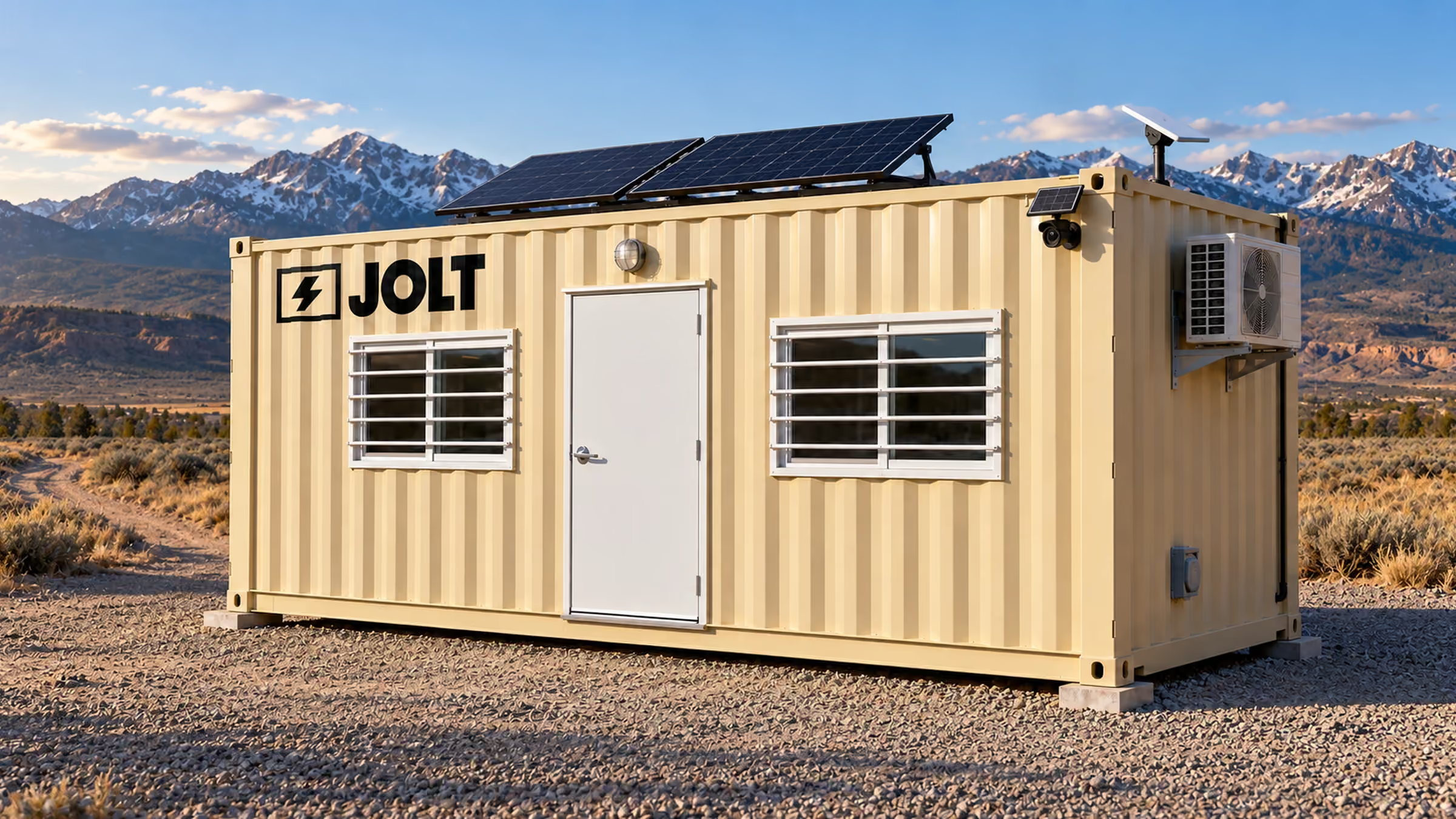
Grid-Free carries roof solar, a 10 kWh battery, Starlink and a camera. The battery runs the heat and A/C. $1,495 a month. Nothing to refuel.
Crews cool off in idling trucks. Afternoons slow down. Plans and laptops sit on the dash.
What JOLT changes
Every office has a mini-split for cooling and heat. Grid-Free runs it from its own battery.
Tools that walk off at night
What it costs you
Equipment theft costs U.S. contractors an estimated $300 million to $1 billion a year (National Equipment Register and NICB). Most of it is never recovered.
What JOLT changes
One-trip steel storage with a welded lockbox. WATCH adds a solar LTE camera with motion alerts for $129 a month. It comes built in on Grid-Free and Alpine.
Nowhere to meet the owner or the inspector
What it costs you
Walkthroughs happen on a tailgate. Plans ride on a truck seat.
What JOLT changes
A clean, lit office with a plan table (READY), Starlink for plans, email and video calls, and your logo on the door.
We help you plan the placement. Here is what Florida asks for. A Jacksonville construction lot and a Miami infill lot face different reviewers. Start with the street address, parcel boundary and proposed office position. Identify whether people will work in the office daily. Tell the local desk if a separate storage box accompanies it. We can help compare the office and storage footprints. Keep each proposed position on the same site drawing. A Florida postal name cannot always identify the parcel's government. Ask the county when the worksite falls beyond city limits. Treat the street edge as a separate approval question.
On a private lot
Florida's building rules reach across the state, but local desks review actual parcels. Jacksonville's Building Inspection Division lists the eighth edition (2023) Florida Building Code. Its page sends zoning questions to Planning and Development. Ask the local building official which current provisions govern your occupied office. Give that reviewer the office dimensions and expected use. Show any proposed electrical connection on the site plan. The 40 ft bathroom office also calls for utility planning. Describe storage separately from the space where staff will work. A construction permit for the main building may not answer the office question. Ask how the office appears on that project's approved site plan.
Across Florida, planning staff decide whether the parcel permits temporary construction support. A residential driveway and a permitted commercial construction site are different cases. Ask about duration, setbacks and displaced parking for the actual property. Show any drainage feature near the proposed pad. Ask fire reviewers whether the placement affects emergency access. Keep the building review and the land-use review together in your project file. For a vacant Miami lot, ask Miami Planning about the proposed use. Miami's construction-related Temporary Occupancy Permit page identifies another possible path. Ask Miami's Building Department whether that process fits your occupied workspace. Ask about a separate building approval where appropriate.
An office proposed on Miami vacant land brings another planning question. Ask Miami Planning which process matches the parcel's present use. Keep your site drawing specific to the Florida jurisdiction. A Miami-Dade county address may lie beyond Miami city limits. Give the desk the parcel rather than relying on its mailing label. The rental agreement's site-permissions section also identifies private consents. We can help compare a smaller storage position if the reviewed footprint shrinks.
On a street or sidewalk
Public space in Florida adds a different reviewer. Jacksonville Public Works cites Ordinance Code §744.110 for obstructing city streets and easements. Show Jacksonville staff the specific curb and intended stationary position. Ask whether the office can occupy that public area at all. Miami has a separate Public Works permitting desk. Describe the sidewalk, lane or curb involved in your Miami proposal. The private-parcel answer does not decide Miami's street question.
A state road adds a Florida road-owner question. The FDOT active-project map helps identify nearby state construction. Ask the road authority about any proposed fixed occupation of its right-of-way. Check whether the adjoining sidewalk has a different controller. A Florida office can sit wholly inside a private boundary instead. Show that alternative to the property owner and the permitting desk. Keep access to the neighboring building open on the plan. Public pedestrian movement matters on Jacksonville's riverfront and Miami's downtown blocks. Mark the frontage affected by an office, not just the building entrance. Record which authority answers for each proposed Florida position.
HOA and deed restrictions
Florida municipal permission and private consent answer different questions. A Miami condominium development may have an association review. A Jacksonville leased lot may need its landlord's written consent. Share the same office position with the owner and the planning desk. Ask the association whether a temporary workroom is allowed during construction. Ask whether a storage container faces separate appearance rules. For a Florida architectural review, Alpine has a matte-black mountain envelope and cedar surrounds. Show that exterior if an architectural committee wants to review it. Its covered entry deck also needs room within the approved position.
Consider any shared access easement on the Florida parcel drawing. A usable pad can still overlap someone else's recorded access. Discuss that crossing with the owner before selecting the office position. Ask whether a private restriction expires with the construction phase. Note any association response beside the local permit answer. For a residential project, explain whether the unit is occupied workspace or tool storage. Those are not interchangeable uses for a Florida covenant review. We can discuss a 10 ft storage option when the association limits available space. Keep the proposed office on land the project may actually use.
Getting the site ready
Florida rain makes drainage a placement decision. Draw the path from the permitted entrance to the pad. Mark utility lines and the clear space around the proposed position. Prepare firm, level, well-drained ground at the approved location. Keep a stormwater swale out of the storage footprint. A Jacksonville riverfront project may have little spare curb space. A Port St. Lucie residential site may have a driveway culvert. Mark either constraint before choosing a 40 ft position. Check overhead room and turning space on the private parcel. Leave occupied access and the later removal path available during construction.
Give Florida reviewers the intended unit size, not a generic container label. A 10 ft storage box has a walk-in door and barred window. The 12 ft box is another walk-in tool crib. A 20 ft storage container has cargo doors, four lock bars and a lockbox. The 40 ft high-cube needs a longer Florida position. Ask whether the chosen dimensions fit the approved site drawing. A 20 ft Base office needs a suitable shore-power plan. Grid-Free needs no shore power, though its output depends on sun and load. Keep those decisions tied to the actual Florida pad.
Where JOLT fits best
A year-long Jacksonville riverfront contract may need a steady workroom and locked tools. JOLT's 20 ft office and 20 ft storage box come from the same fleet. Mark two authorized positions rather than trying to crowd one rectangle. A multi-phase Miami airport job may need a different balance of workspace and storage. Tell the project desk which units the approved site can hold. A Florida road contractor may prefer a 12 ft walk-in tool crib. Another crew may need only storage during an early phase. Start with the work and the space, not a presumed bundle.
Jacksonville's Riverfront Plaza work includes riverwalk, bulkhead and pedestrian-plaza phases. Those public-facing phases make stable off-path placement valuable. Miami-Dade's Metromover upgrade presents a different public-circulation setting. A longer Florida job rewards a pad outside changing pedestrian routes. Compare Base where shore power exists with Grid-Free where it does not. Ask the owner about bathroom utilities before selecting the 40 ft office. Put Jacksonville's pedestrian routes and Miami's transit access on the site drawing.
Built for Florida weather
Florida spans different winter and rainfall patterns. NOAA's Jacksonville 1991–2020 normals put January's average low at 42.9°F. Jacksonville's July average high is 91.9°F. Annual precipitation at that station is 53.40 inches. The Miami International Airport normals put January's average low at 61.0°F. Miami's July average high is 90.6°F. Annual precipitation there is 67.41 inches. July alone averages 7.36 inches at Miami International Airport. Use these station averages to frame Florida cooling and drainage plans. Ask about drainage on the actual Florida pad.
For a powered Jacksonville site, Base supplies mini-split heat and cooling. Plan a suitable shore connection for its 50-amp inlet. At an unpowered Miami construction position, Grid-Free carries solar, Starlink and a camera. On that Miami site, its 10 kWh battery runs HVAC without shore power. Florida solar output depends on sun and load. Consider changing shade around a rising Miami building. For Florida sites, Alpine offers a standing-seam over-roof. Its covered entry deck and backup heat are other listed Alpine features. Show the Florida building official the actual unit under consideration.
The Florida Building Commission's flood-code explanation identifies Miami-Dade and Broward as high-velocity hurricane-zone counties. Ask the building official about anchorage, elevation and storm preparation for your temporary occupied structure. Bring the exact Florida parcel and office use to that conversation. Ask about any floodplain review on a low site. A saturated approach can interrupt ordinary jobsite access during the rainy months. Keep the office pad and storage position away from drainage paths. Maintain a clear route for site operations as construction advances.
Florida's 2024 Census permit highlights count 6,398 privately owned units authorized in Jacksonville–Duval County. They count 8,721 in unincorporated Lee County. For residential building work, ask the Florida parcel owner about an office pad. A Jacksonville airport crew faces another schedule: the Aviation Authority describes Concourse B construction. Miami International Airport lists New Concourse K among terminal capital projects. Long programs can call for an approved office outside shifting work areas. Miami's Metromover page describes downtown system upgrades. Plan a cool workspace on approved land for the phase at hand. Keep tools in a separately positioned locked box if needed. Match every Florida placement to that project's actual authority and site plan.
Across Florida, the same office choice meets different local conditions. For Jacksonville's January mornings, consider the mini-split's heating function. For Miami's July afternoons, plan the cooler workroom around the approved footprint. Jacksonville's 53.40-inch annual normal calls for a drainage conversation. Miami's 67.41-inch annual normal makes that conversation equally useful farther south. Ask the Jacksonville owner where water crosses its construction entrance. Ask Miami Planning where the occupied position fits the parcel. Mark the airport project's office outside its active work phase. Mark the riverfront project's tool box outside public circulation. Keep the Miami Metromover contractor's workspace off the passenger path. If the Jacksonville pad has shore power, Base can serve it. If a Miami position lacks that connection, consider Grid-Free. Its Florida solar output still depends on sun and load. Check the selected Florida pad against its local site drawing. Ask the relevant building desk about the occupied position. Give the right-of-way desk the proposed public-space position separately.
How we built this page: rent, upgrade and delivery figures come from the JOLT catalog at build time. Permit, street, HOA and weather facts are linked to their sources in the text. Written and reviewed by Lisa Tanner.
Every 20 ft office has heat and A/C, lights, outlets, a vinyl-plank floor, a 36-inch steel door and two barred windows. Grid-Free adds roof solar, a 10 kWh battery, Starlink and a camera. Offices rent from $795 a month.
Can the office run before the site has power?
Yes. Grid-Free runs its heat and A/C, lights, outlets and Starlink from roof solar and a 10 kWh battery. Output depends on sun and load. It rents for $1,495 a month.
Can we put our logo on it?
Yes. BRAND applies your logo in 24 by 48 inch vinyl on two sides of the unit. $450, one time.
Do I need a permit for a jobsite office in Florida?
A Florida jobsite office may need building and land-use approval from its city or county. Jacksonville's Building Inspection Division lists the 2023 Florida Building Code and directs zoning questions to Planning and Development. Ask the building and planning desks for your actual parcel about occupied temporary use and electrical review; statewide code adoption alone does not decide its site plan.
Can the office sit on a Florida street?
A Florida street position needs the road owner's authorization. Jacksonville Public Works cites Ordinance Code §744.110 for obstructions of city streets and easements; Miami directs public-space questions to its Public Works permitting desk. Give the relevant authority the precise curb, unit footprint and duration, and ask separately about any state-maintained frontage.
What does the site need before delivery?
A firm, level pad, a clear path for the truck, and a person on site to show the driver where it goes. Tell us about gates, slopes and overhead lines when you ask for the quote.
How much does delivery to Florida cost?
Delivery to Florida is quoted per project. We route the unit from the nearest JOLT source yard and send a written delivered quote within one business day. It holds for 14 days. Rent is published: offices from $795 a month, storage from $225.
How long can we rent, and can we buy?
Rentals outside the Rockies start at 12 months. You can also buy an office outright or lease-to-own a 20 ft office over 24 or 36 months.
Start your Florida project quote
Offices from $795 a month
Pick the office, the term and the job ZIP. You get a written delivered quote within one business day, and it holds for 14 days.