A rented generator, fuel runs and noise all day. Our estimate for a Base office run on a generator, with fuel runs, internet and a camera, is $2,308 a month.
What JOLT changes
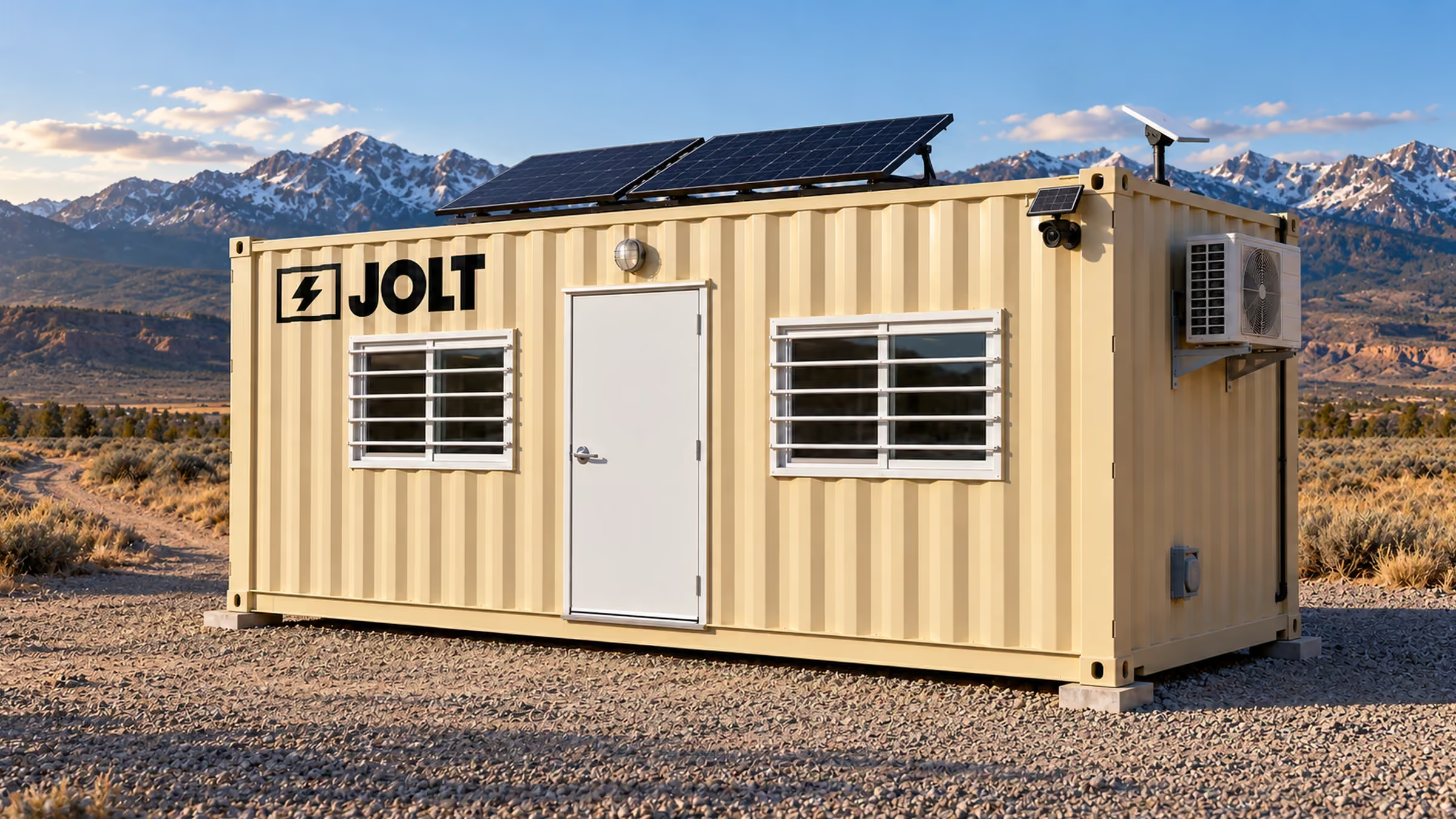
Grid-Free carries roof solar, a 10 kWh battery, Starlink and a camera. The battery runs the heat and A/C. $1,495 a month. Nothing to refuel.
Crews warm up in idling trucks. Mornings start late. Wet gear stays wet.
What JOLT changes
Mini-split heat in every office. READY adds a 1,500 W heater. Alpine adds backup heat and a covered entry deck.
Tools that walk off at night
What it costs you
Equipment theft costs U.S. contractors an estimated $300 million to $1 billion a year (National Equipment Register and NICB). Most of it is never recovered.
What JOLT changes
One-trip steel storage with a welded lockbox. WATCH adds a solar LTE camera with motion alerts for $129 a month. It comes built in on Grid-Free and Alpine.
Nowhere to meet the owner or the inspector
What it costs you
Walkthroughs happen on a tailgate. Plans ride on a truck seat.
What JOLT changes
A clean, lit office with a plan table (READY), Starlink for plans, email and video calls, and your logo on the door.
We help you plan the placement. Here is what New York State asks for. Confirm the legal parcel behind a New York mailing address. Manhattan and Buffalo have different street authorities. A site outside Buffalo can have another municipal reviewer. Tell us where the approved work area begins. Describe the gate and the intended office position. Mark the pedestrian route on the same drawing. An office and a storage box each need room. Ask the project owner which spaces remain available throughout construction.
On a private lot
New York's Department of State says the 2025 Uniform Code took effect December 31,2025. Ask the local building official about an occupied temporary office. Describe its dimensions, daily use and proposed power connection. Ask which construction and electrical approvals apply. The statewide code does not decide a particular parcel's placement. A local land-use office can address temporary offices and cargo storage. Show the property's zoning and approved site plan. Ask about setbacks, required parking, fire access and duration. Record the response for the specific New York address.
In Manhattan, take the office proposal to DOB. NYC publishes its own Construction Codes. Its building applications and permits portal is an entry point for building questions. Show DOB the occupied workspace, not just an empty steel box. Ask the applicable land-use authority about the private lot. A New York City building parcel can still have a narrow entrance. Sketch where a scaffold or new wall may change access. Discuss an approved work position with the site owner. The New York City placement guide addresses that city's separate street review.
For Buffalo land, ask the city building and zoning offices about the proposed use. Separate the workroom from a materials-only box. An Erie County address outside Buffalo needs its own municipality's answer. The Buffalo planning guide describes the city's street desk. On a residential driveway, mark existing parking and the property edge. On an industrial parcel, identify existing loading lanes. Ask the owner which area is assigned to your crew. Keep the office inside that agreed area as work changes phases.
On a street or sidewalk
NYC DOT's container-rules explanation concerns commercial refuse and construction debris containers. It describes a refuse permit for one container lasting up to five consecutive days. An eligible debris-container permit lasts 30 to 90 days. DOT issues that category to registered general contractors. Ask DOT which authorization addresses an occupied office instead. Identify the Manhattan street segment and public-space footprint. Discuss the sidewalk path and any continuing occupation. A private-lot approval answers a different question.
NYC DOT's street works guidance lists construction containers and shanties or trailers. Those temporary street structures can require a Building Operations and Construction Activity Permit. DOT says a valid DOB permit is typically required first. Bring DOT the actual type of unit and proposed location. A brief curb stop differs from leaving a workspace on the street. Ask the DOT Permit Management Office which plan applies. Show where people cross the entrance while the site operates.
In Buffalo, ask the Public Works, Parks and Streets street and sidewalk obstruction office. The Buffalo encroachment article names its Commissioner as a public-right-of-way authority. Explain whether the unit or only a vehicle uses the curb. Give the desk the precise intersection, footprint and intended duration. Outside these cities, find the municipality or road owner first. Ask the relevant authority about any proposed state-highway occupation. A New York City permit category cannot answer a Buffalo street question.
HOA and deed restrictions
Ask a New York State owner about the precise office position. A landlord may control a commercial loading lane. A condominium manager may set additional rules for a Manhattan parcel. An HOA may restrict a driveway box or visible storage. Give each reviewer a drawing, duration and unit description. Ask whether a deed easement crosses the proposed pad. Keep their written consent beside the local building answer. Private consent concerns the parcel, not the public sidewalk. Revisit the consent if the work moves across the property.
For an occupied East Harlem site, ask the project owner who controls internal staging. A subcontractor's work package does not assign every nearby space. At Canalside, public open space warrants a clearly marked site boundary. Discuss where neighbors and workers walk around a proposed office. In New York State, Alpine's black finish comes with cedar surrounds. Show the actual exterior if a private reviewer asks about appearance. Its covered entry deck also needs space on the approved pad. A shorter unit may suit a tighter authorized area.
Getting the site ready
Mark a firm, level, well-drained location on the New York State plan. Locate utilities and overhead obstructions. Note gates, slopes and any sidewalk crossing. Keep emergency access on the drawing. A Manhattan scaffold can shrink a workable turn. Buffalo snow storage can narrow a cleared entrance. Ask the project manager which obstructions will change during later phases. Keep the office entry reachable throughout the job. Check the actual site after rain or snow, not just on paper.
The 20 ft Base office needs shore power. Tell the site's electrician about its 50-amp inlet. On a New York site awaiting service, Grid-Free avoids a shore connection. It combines roof solar with a 10 kWh battery running HVAC. Its output varies with the sun and the office's load. Tall Manhattan buildings can shade a chosen pad. Check sun exposure before selecting its location. The 40 ft bathroom office needs more clear length and a power plan. Show the reviewer which occupied build you intend to use.
At a tight New York pad, the 12 ft walk-in storage box offers a man door and barred window. On another assigned space, the 20 ft one-trip box uses cargo doors. Its four lock bars secure the cargo doors. The 10 ft box fits a smaller approved area. Check gate clearance before considering the 40 ft high-cube for a New York project. Its height measures 9 ft 6 in. Compare those dimensions with gates and overhead clearance. Place storage where its doors stay accessible. Draw both footprints if the New York assignment needs both units.
Where JOLT fits best
A long New York State project may need a workroom and locked materials storage. Think about the daily plan meeting before choosing the office. Think about tool access before choosing the box. We can help compare the two proposed footprints. A Manhattan transit package may need Grid-Free before service is ready. A Buffalo redevelopment site may favor Base on a powered pad. Each selection still follows the site's permitted layout. Tell us which construction phase needs each space.
On an East Harlem work area, a 20 ft office preserves more room than a 40 ft build. At Canalside, a separate storage box can keep materials apart from meetings. A 12 ft crib suits frequent walk-in access. A 20 ft cargo box suits another approved footprint. Ask the owner whether future excavation will shift either position. Keep the approved pedestrian route visible on the plan. For repeated New York assignments, buying a 20 ft office may be worth discussing. The next parcel still needs its own review.
Built for New York State weather
The NOAA 1991–2020 Central Park monthly normals list a January average low of 27.9 °F. Their July average high is 84.9 °F. July precipitation normally reaches 4.60 inches there. At the Buffalo NOAA station, January's normal low is 19.0 °F. The Buffalo July average high is 80.2 °F. Its normal January snowfall is 26.7 inches. Buffalo's December snowfall normal is 25.3 inches. These are station figures for different parts of New York State.
Put Manhattan drainage and Buffalo plowing on different site sketches. Look for a low rear-yard position in the city. Check a Buffalo access lane after snow clearing. Mark where piles can sit without blocking an office entrance. Choose the occupied pad before discussing a larger bathroom build. Base offers mini-split heat and cooling with shore power. Grid-Free runs HVAC from its included battery without shore power. For a New York winter, Alpine adds backup heat. Draw its covered deck on the New York site plan. Alpine's standing-seam over-roof is part of the selected build. Ask the local reviewer about any site-specific structural requirement.
New York's spring work can cross more than one weather regime. An East Harlem pedestrian path may need attention after July rain. A Buffalo lot can still need a snow-clearing plan in winter. Keep storage doors out of the plow pile's intended area. Keep the workroom approach open for daily meetings. Check the gate again as the project moves toward closeout. A state average cannot replace the station and the specific site. Ask the crew which season presents the hardest access problem.
The state's September 2026 Second Avenue Subway update identifies East Harlem stations at 106th, 116th and 125th streets. The fourth contract includes station buildouts and ancillary buildings. It also includes communications systems, 22 elevators and 20 escalators. The state expected final-contract work to begin in 2027. Those differing activities suggest different approved work areas. Ask which package your field team occupies. Put its meetings, tools and public walkway on the same layout.
The July 2026 North Aud Block announcement describes construction at Buffalo's Canalside. It specifies 251 apartments and commercial and community space. It also describes 137 parking spaces. A project participant can ask which area remains open for its field office. Ask whether public-space work will change that approved position. A 20 ft office can provide a separate room for drawings. A locked box can serve materials on another assigned pad. Buffalo's winter plan should cover access to both.
How we built this page: rent, upgrade and delivery figures come from the JOLT catalog at build time. Permit, street, HOA and weather facts are linked to their sources in the text. Written and reviewed by Lisa Tanner.
What comes in a JOLT office for a New York State job?
Every 20 ft office has heat and A/C, lights, outlets, a vinyl-plank floor, a 36-inch steel door and two barred windows. Grid-Free adds roof solar, a 10 kWh battery, Starlink and a camera. Offices rent from $795 a month.
Can the office run before the site has power?
Yes. Grid-Free runs its heat and A/C, lights, outlets and Starlink from roof solar and a 10 kWh battery. Output depends on sun and load. It rents for $1,495 a month.
Can we put our logo on it?
Yes. BRAND applies your logo in 24 by 48 inch vinyl on two sides of the unit. $450, one time.
Do I need a permit for a jobsite office in New York State?
Possibly; ask the building official and land-use office governing your New York State parcel. The state's 2025 Uniform Code took effect December 31,2025, but the local office determines the approvals for your occupied temporary workspace. Bring the intended use, dimensions, power arrangement, site plan and duration. Describe a separate storage unit separately.
Can the office sit on a New York State street?
Only with permission from the authority controlling that particular street. For Manhattan, ask NYC DOT about the proposed occupation; its debris-container categories differ from an occupied office. For a Buffalo city street, contact Public Works, Parks and Streets about an obstruction or encroachment. Show the precise curb position, sidewalk path and intended duration.
What does the site need before delivery?
A firm, level pad, a clear path for the truck, and a person on site to show the driver where it goes. Tell us about gates, slopes and overhead lines when you ask for the quote.
How much does delivery to New York State cost?
Delivery to New York State is quoted per project. We route the unit from the nearest JOLT source yard and send a written delivered quote within one business day. It holds for 14 days. Rent is published: offices from $795 a month, storage from $225.
How long can we rent, and can we buy?
Rentals outside the Rockies start at 12 months. You can also buy an office outright or lease-to-own a 20 ft office over 24 or 36 months.
Start your New York State project quote
Offices from $795 a month
Pick the office, the term and the job ZIP. You get a written delivered quote within one business day, and it holds for 14 days.