A rented generator, fuel runs and noise all day. Our estimate for a Base office run on a generator, with fuel runs, internet and a camera, is $2,308 a month.
What JOLT changes
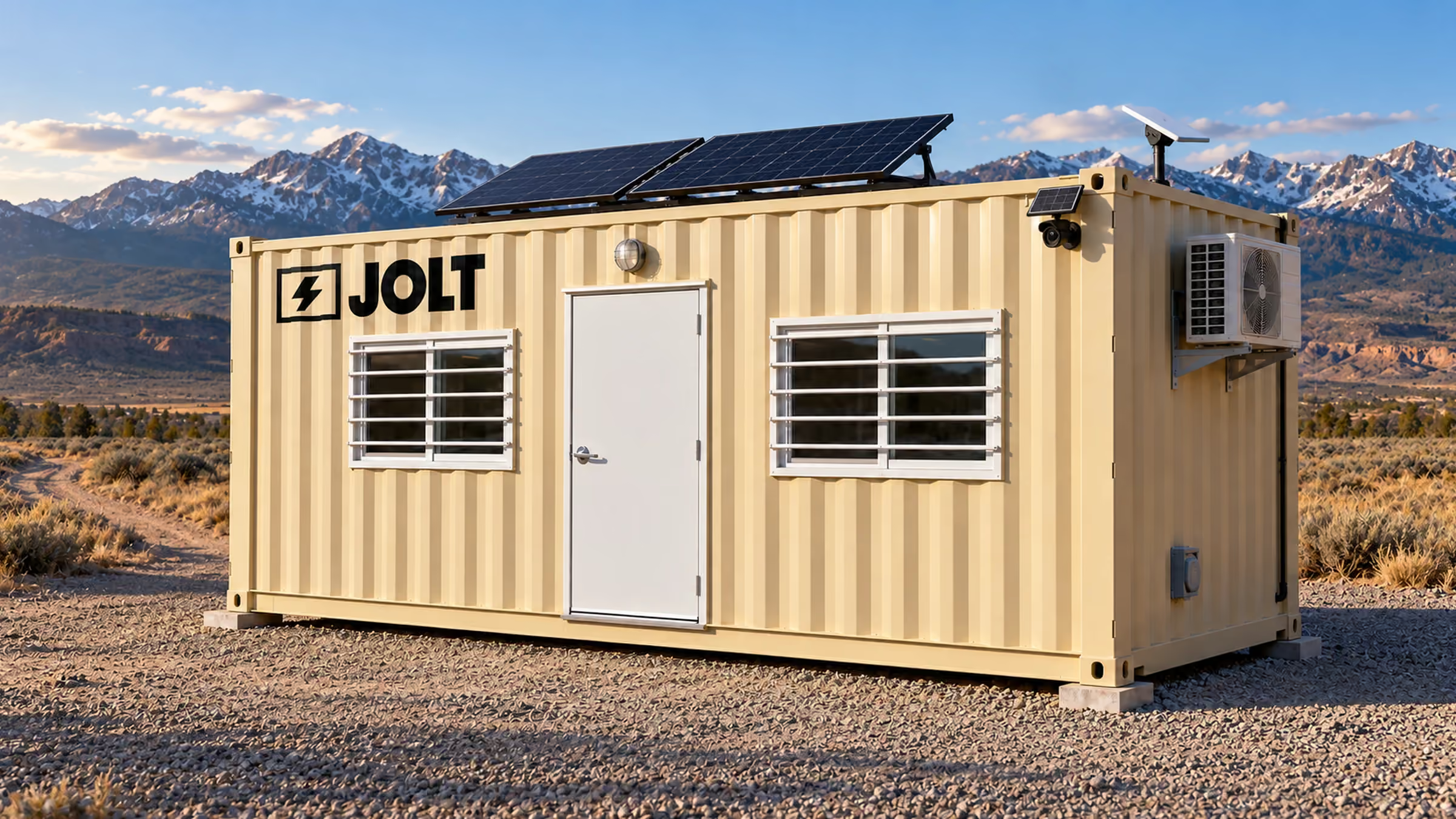
Grid-Free carries roof solar, a 10 kWh battery, Starlink and a camera. The battery runs the heat and A/C. $1,495 a month. Nothing to refuel.
Drawings get wet. Laptops stay in the truck. Meetings happen under a tailgate.
What JOLT changes
A sealed steel office with heat, lights and outlets. READY adds a plan table, chairs and a whiteboard.
Tools that walk off at night
What it costs you
Equipment theft costs U.S. contractors an estimated $300 million to $1 billion a year (National Equipment Register and NICB). Most of it is never recovered.
What JOLT changes
One-trip steel storage with a welded lockbox. WATCH adds a solar LTE camera with motion alerts for $129 a month. It comes built in on Grid-Free and Alpine.
Nowhere to meet the owner or the inspector
What it costs you
Walkthroughs happen on a tailgate. Plans ride on a truck seat.
What JOLT changes
A clean, lit office with a plan table (READY), Starlink for plans, email and video calls, and your logo on the door.
We help you plan the placement. Here is what Oregon asks for. Locate the actual construction parcel. Portland rules do not automatically apply elsewhere in the state. Show where an occupied office would stand. Draw another position if the crew needs storage. Ask the property controller which areas remain available throughout construction. Bring that drawing to the local reviewing desk. We can compare units against the authorized ground.
On a private lot
Oregon's Building Codes Division adopted-codes list names the 2025 Oregon Structural Specialty Code. It says the code became effective in October 2025 and mandatory in April 2026. Ask the local building authority how it reviews your occupied temporary office. Include its position, duration and electrical plan. Ask the planning counter about land use on the actual parcel. Identify whether the second unit is unoccupied tool storage. A statewide structural code does not select an office pad for you. Keep the local determination with the site drawing.
Section 33.296.030.F.4 of Portland's temporary-activities chapter addresses construction staging. It distinguishes general-project and public-utility staging. It also discusses erosion and the land's condition after work. Ask Portland Permitting & Development how your proposed occupied office fits the site. Show the approved construction area and any additional storage position. A Bull Run project site presents a different plan from a residential driveway. The Portland page explains the city review in greater detail.
On an Oregon lot outside Portland, identify its own building and planning authorities. A Medford-area site needs answers from its actual jurisdiction. Ask those officials about their own rules rather than Portland's Title 33. Show whether the project controls the entire parcel or only a work area. Ask whether a storage box requires its own position approval. Mark existing parking and drive aisles. A 40 ft office needs a longer approved area than a 20 ft office. We can compare the footprint to that area's dimensions.
On a street or sidewalk
Portland Temporary Street Use Permitting describes reserving on-street parking for moves involving storage containers. It also handles sidewalk and lane closures. Tell PBOT whether the office would remain in public space. Identify any separate vehicle stop for unloading. Draw the sidewalk, traffic lane and proposed curb segment. Ask what permission covers the precise activity. A private staging approval does not reserve a public curb. Put the city's answer alongside the land-use plan.
Elsewhere in Oregon, ask which city or county controls the actual road. A county road has its own public authority. A public-space stop and a stationary office should appear separately on the sketch. Ask about both if the proposed pad is behind a sidewalk. Identify any walking route affected by the approach. An I-5 project listing is not authorization for a unit in a public lane. Contact the appropriate road desk about that location. Keep any conditions with the project staging documents.
For the Portland Rose Quarter, multiple work fronts may need different street arrangements. The ODOT project update identifies bridge and stormwater work during Phase 1A. Ask the package owner where a contractor's unit belongs. Then ask PBOT about any city street involvement. A longer-term curb occupation differs from unloading at a work entrance. Revisit that question if the next phase moves the entrance. The Portland city page gives the PBOT-specific distinction.
HOA and deed restrictions
On an Oregon residential remodel, ask the HOA about a temporary office and storage. A commercial landlord may instead control a shared access lane. Check any easement across the proposed pad. Keep private consent separate from local building approval. Mark required parking and neighboring entries. A unit's nominal length alone cannot decide whether its position is usable. Ask the property controller about the full work season. Save that response with the marked plan.
An Oregon architectural committee may ask what the office looks like. For this Oregon review, Alpine's matte-black mountain envelope has cedar surrounds. It adds a standing-seam over-roof and covered entry deck. Show those listed features to the committee. Ask whether the occupied footprint fits its rules. Base uses a shore-power inlet that needs a connection plan. On this Oregon lot, Grid-Free avoids a shore connection; sun and load affect solar output. Note the chosen location's shade on the sketch. Private visual approval does not answer occupied-use review.
On a Portland utility project, ask who controls the staging ground as trenches advance. On a Medford commercial lot, ask who shares the driveway. A move within the lot can still change what the original permission covered. Show a revised office position to the relevant desk. Consider a 10 ft storage box if a 20 ft footprint obstructs access. Keep the separate office rectangle on the same drawing. We can compare sizes before a construction stage claims that space.
Getting the site ready
Follow the Oregon site's approach from road to prepared pad. Mark gates, slopes, tree branches and overhead wires. On the authorized Oregon ground, prepare a firm, level and drained position. Identify where water runs after winter rain. Keep the office outside the planned trench and stockpile areas. A Portland water project can have changing work fronts. A Medford summer job may need shade considered for solar planning. Preserve the access route for the end of the job. Update the drawing whenever the approved site plan changes.
A powered Oregon lot can use Base's 50-amp shore-power inlet. Ask the electrician about the planned connection. Grid-Free requires no shore power at a prepared remote pad. Its 10 kWh battery pack runs HVAC. POWER solar output at this Oregon pad depends on sun and load. For a longer Oregon pad, the 40 ft bathroom office also has a shore-power inlet. Ask the local building counter about that occupied arrangement. Draw the longer footprint before choosing its position. Match the office to the site's actual utility plan.
A 10 ft box fits where a 20 ft storage unit will not. For Oregon tools, a 12 ft crib offers a man door and barred window. For a larger Oregon pad, choose the 20 ft one-trip box. Its cargo doors include four lock bars, and it has a welded lockbox. The Oregon 40 ft high-cube stands 9 ft 6 in tall. Mark the chosen box beside the occupied office position. Keep its access clear of work traffic. Plan drainage near the Oregon tool-storage pad. Use the office's mini-split for occupied space.
Where JOLT fits best
The Bull Run Filtration status page says construction began in June 2024. It targets filtered-water delivery in 2029. A multi-season utility package can need an office for coordination and separate locked tools. One JOLT fleet supplies both a Bull Run office and its storage box. Ask the work-area controller for both positions. Grid-Free can suit an authorized pad without shore service. A 20 ft cargo box offers four lock bars and a lockbox. Tell our project desk which units the Bull Run contract needs.
The I-5 Rose Quarter update describes Phase 1A stormwater and bridge work. A long package there benefits from a stable, approved staging plan. Base suits a powered pad. A 12 ft walk-in crib gives frequent access to tools. A roadway work front may shift before an office is removed. Ask the package owner which entrance stays open. Take public-space needs to PBOT. Match each unit to the owner's actual allocated area.
An Oregon contractor away from Portland still faces local decisions. A year-long Medford commercial build may need cooling and a separate tool crib. Ask the parcel authority about occupied use. Grid-Free needs no shore power where service is absent. A 10 ft walk-in box can suit a smaller approved lot. Ask Medford's own authorities about the proposed lot. We can compare an office and storage box against the Medford project's actual staging drawing. Keep the street authority and building authority questions distinct.
Built for Oregon weather
Portland airport's NOAA climate normals put January precipitation at 5.03 inches. At that airport, July's normal precipitation is 0.51 inches. January's average low is 36.2°F; July's average high is 81.9°F. A Portland pad should drain through the wet work season. Mark runoff around the approved office position. Keep an accessible path from the work area. The airport's averages cannot determine a Bull Run worksite's drainage. Ask the project controller how grading will change it.
NOAA's Medford airport normals give a July average high of 91.6°F. The January average low is 32.5°F. Heat at a southern Oregon job differs from Portland's wet winter emphasis. Every JOLT office has mini-split heat and cooling. Base needs shore power at a suitable Medford pad. Grid-Free needs none; its battery runs HVAC. On that Medford pad, solar output depends on sun and load. Ask about shade at the actual parcel rather than relying on an airport temperature.
Alpine adds backup heat to Grid-Free's included features. Its covered entry deck may suit a frequently used Portland winter pad. The 40 ft bathroom office has an enclosed bathroom, mini-split and 50-amp inlet. Plan how Medford heat and Portland rain affect the approved site access. Oregon's regional weather differences make drainage and power planning worthwhile. Select the office for the approved position and the season of work.
How we built this page: rent, upgrade and delivery figures come from the JOLT catalog at build time. Permit, street, HOA and weather facts are linked to their sources in the text. Written and reviewed by Lisa Tanner.
Every 20 ft office has heat and A/C, lights, outlets, a vinyl-plank floor, a 36-inch steel door and two barred windows. Grid-Free adds roof solar, a 10 kWh battery, Starlink and a camera. Offices rent from $795 a month.
Can the office run before the site has power?
Yes. Grid-Free runs its heat and A/C, lights, outlets and Starlink from roof solar and a 10 kWh battery. Output depends on sun and load. It rents for $1,495 a month.
Can we put our logo on it?
Yes. BRAND applies your logo in 24 by 48 inch vinyl on two sides of the unit. $450, one time.
Do I need a permit for a jobsite office in Oregon?
Ask the Oregon building authority governing your parcel about the occupied office. The Building Codes Division lists the 2025 Oregon Structural Specialty Code, while local staff review a proposed address and use. Share your office position, duration and connection plan with the building and planning counters.
Can the office sit on a Oregon street?
Only with permission from the road authority governing that Oregon street. Portland's PBOT Temporary Street Use Permitting handles parking reservations and closures. For another Oregon street, ask its city or county road office about the proposed office position. Describe any separate unloading stop and the intended stationary position.
What does the site need before delivery?
A firm, level pad, a clear path for the truck, and a person on site to show the driver where it goes. Tell us about gates, slopes and overhead lines when you ask for the quote.
How much does delivery to Oregon cost?
Delivery to Oregon is quoted per project. We route the unit from the nearest JOLT source yard and send a written delivered quote within one business day. It holds for 14 days. Rent is published: offices from $795 a month, storage from $225.
How long can we rent, and can we buy?
Rentals outside the Rockies start at 12 months. You can also buy an office outright or lease-to-own a 20 ft office over 24 or 36 months.
Start your Oregon project quote
Offices from $795 a month
Pick the office, the term and the job ZIP. You get a written delivered quote within one business day, and it holds for 14 days.