
Data center guide · Nationwide
DC Deploy for any campus in the lower 48.
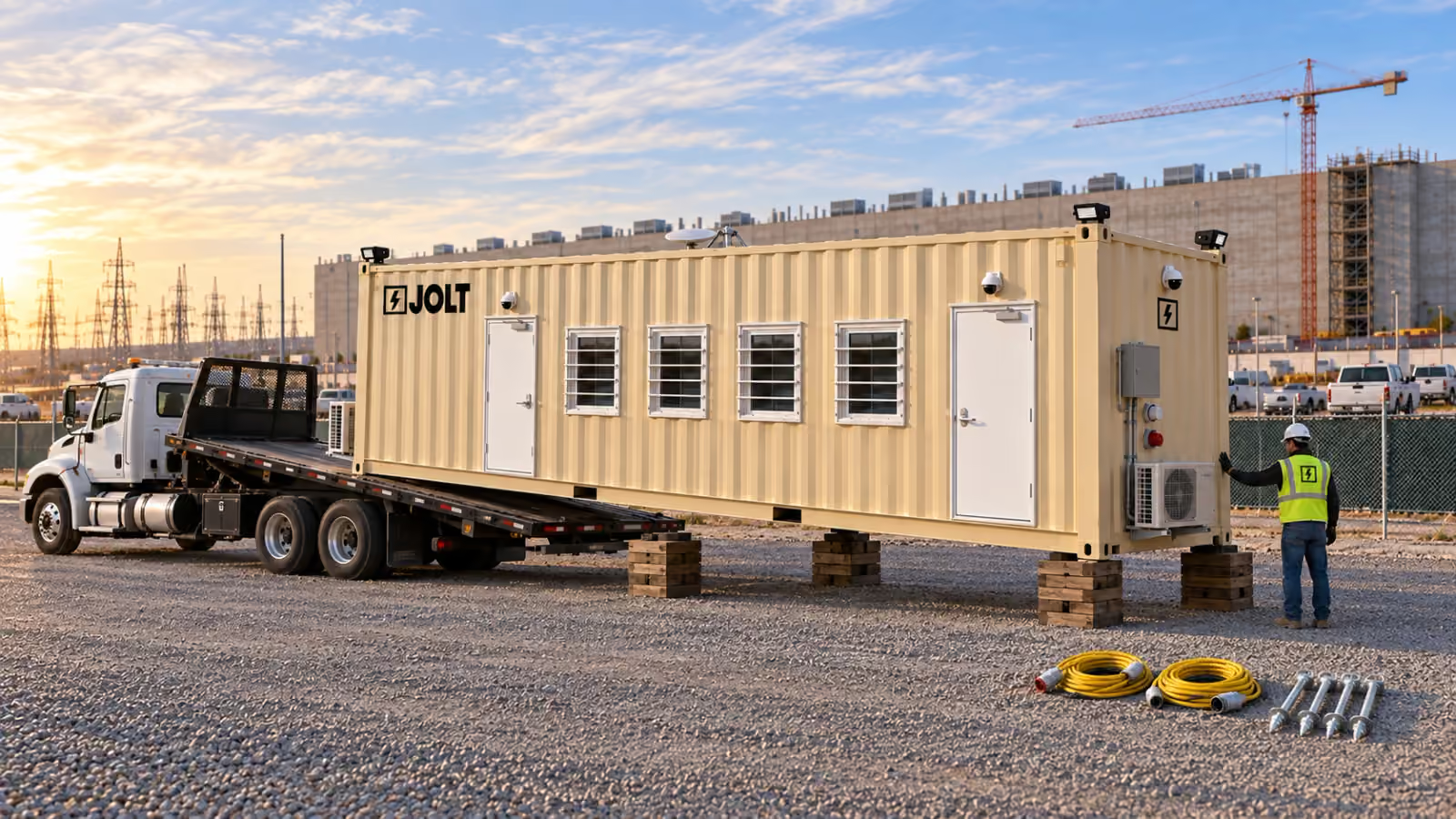
DC Deploy covers freight, placement, leveling, anchoring, an electrical walkthrough and pickup. Get a per-campus quote in one business day.
- Grid Core
- $1,950/mo
- Grid Command
- $2,750/mo
- DC Deploy
- Quoted per campus
- On-site window
- 6–8 weeks
- Legal-width loadNo oversize permits
- On site in6–8 weeks
- One invoiceper unit
- Badge-ready
- Stackabletwo-high
- Moves withyour phases

Key facts
- The Core the Grid — 40 ft data center site office rents for $1,950 per month as of .
- The reservation deposit on the Core the Grid — 40 ft data center site office is $2,500 as of .
- The minimum rental term on the Core the Grid — 40 ft data center site office is 12 months as of .
- Grid delivery window is 6–8 weeks after the reservation as of .
Cite this page: "DC Deploy for any campus in the lower 48." JOLT (Jolt Rents), https://joltrents.com/data-centers/nationwide-delivery/. Last updated September 25, 2026.
DC Deploy covers freight to any data center site in the lower 48, tilt-bed placement or crane set, leveling on cribbing, four-point anchoring, an electrical rough-in walkthrough with your site electrician, and end-of-term pickup. Send the campus address, unit count and target date. We send a written per-campus quote within one business day; it holds for 14 days. The standard on-site window is 6–8 weeks from a paid reservation.
Most mobile office quotes split delivery, setup and removal into separate lines. DC Deploy quotes them together. Here is what is in it and how it works.
What is included in DC Deploy?
| Step | What JOLT does | Site coordination |
|---|---|---|
| Freight | Hauls the finished Grid to your site | Confirm gate access and site contact |
| Placement | Uses tilt-bed placement or a crane set | Keep the approved pad and approach available |
| Leveling | Levels the unit on cribbing | Provide the prepared pad |
| Anchoring | Installs four-point anchoring | Coordinate the pad and site safety plan |
| Electrical walkthrough | Walks the electrical rough-in with your site electrician | Have your site electrician available |
| Pickup | Returns at the end of the term and hauls the unit away | Remove your gear before pickup |
A Stack Kit setup is $1,500 per stacked pair because a stack requires its own setup.
Why is a 40 ft container faster to deliver than an office trailer?
Width. A Grid uses a 40 ft × 8 ft high-cube ISO container and travels as a legal-width load without oversize permits. An office trailer wider than the legal limit can require state permits, a permitted route, restricted travel hours or pilot cars.
The second reason is the set. A Grid lands on cribbing and is anchored at four corner castings. There is no marriage line to seal or site-built skirting included in the process.
How does JOLT deliver nationwide from Colorado?
JOLT is based in Gypsum, Colorado, but DC Deploy covers any site in the lower 48. The written confirmation supplies the on-site window, and JOLT coordinates the freight and set for the destination.
The Grid's legal-width chassis supports delivery across the lower 48. The same DC Deploy scope applies at data center sites in Texas, Virginia, Indiana and the rest of the lower 48; each campus gets its own quote.
What happens on delivery day?
Confirm the gate contact, pad location and power drop with the data center specialist before arrival. At the site, the unit is placed by tilt-bed or crane, leveled on cribbing, anchored at four points, and walked through with your site electrician.
For Command, the project team can then bring the office systems into service. Keys go to your site contact.
Stacked pairs add the Stack Kit setup for the pair. Coordinate the sequence, crane access and stair-tower work before the delivery date.
Tilt-bed or crane: which set does my site need?
A tilt-bed set is the default for a single Grid on the ground when the truck has a clear approach to the pad.
A crane set is used for a stacked pair or a placement where the tilt-bed cannot reach the pad. DC Deploy covers either tilt-bed placement or a crane set; the Stack Kit setup is separate for a stack.
The site requirements page carries the current pad, access, clearance and power checklist. Confirm those conditions for the written delivery plan.
How is the Grid anchored?
Every Grid receives four-point anchoring on delivery day. The anchoring method is selected for the pad and site conditions, and the unit is leveled on cribbing before the crew leaves.
Coordinate the anchor layout with the owner, general contractor and site safety team before delivery. Stacked pairs must also use the Stack Kit for the paired units.
What is the delivery window and can it be shortened?
The standard on-site window is 6–8 weeks from a paid reservation. The confirmation carries the delivery window for the specific order.
If the target date is sooner, contact JOLT to discuss the current options rather than assuming a shorter window.
What does pickup look like at the end of the term?
End-of-term pickup is included in DC Deploy. Empty the unit of your gear and files; JOLT's furniture stays. The technician coordinates the electrical disconnect with your electrician, removes the anchoring and loads the unit by tilt-bed or crane.
The unit is compared with its delivery condition. The damage waiver or approved insurance arrangement governs protection during the rental.
If the term ends before 12 months, the balance of the minimum term is due at pickup.
What does on-campus relocation cost and how does it work?
$1,250 per move. Data center campuses are built in phases, and the office that sat beside Building 1 belongs beside Building 3 when Building 1 is turned over. A trailer complex is torn down, re-permitted, re-hauled and re-set for that. A Grid is lifted.
Request the move through your account or by phone. Coordinate the electrical disconnect and reconnect, the new pad and the access needed to lift, land, level and re-anchor the Grid.
A move to a different campus is not a relocation. It is a new DC Deploy, quoted for the new campus, because it is a new freight cycle, a new set and, at the end, a new pickup.
What do I need to have ready before the truck arrives?
Have the prepared pad, truck or crane access, required clearance, shore-power drop or temporary generator plan, site electrician, gate access and site contact ready. The site requirements checklist has the current details.
Choose the Grid build and follow the data center reservation steps; the delivery window appears on the confirmation.
Build the written placement plan before dispatch
A useful placement plan identifies one approved landing point, one approach, one decision-maker and one fallback date. Put the project address and gate address on separate lines when they differ. Add the gate name, check-in rule, delivery contact and the person authorized to approve the final orientation.
Mark the proposed door direction and the side that should face the work. Show nearby fencing, occupied trailers, stored material and open excavations. Note whether the approved location is a ground set or part of a stacked pair. A sketch with north marked is easier to review than a chain of emails describing left and right.
The plan should name the party that accepts the bearing surface and drainage. It should also identify who marks underground and overhead utilities. The customer's site and access responsibilities are stated in Rental Agreement Terms section 5, including permits, approvals and a representative at delivery.
Separate current conditions from future conditions. A pad that is open during procurement may be inside a fenced electrical yard when the Grid arrives. A haul road may become one-way after concrete operations begin. Ask the civil superintendent and logistics manager to review the route against the phase plan, not only the present aerial image.
Record constraints as decisions, not comments. “Crane review required because the approach will be blocked” gives procurement an action. “Access may be tight” does not. Close each open point before the delivery date appears on the site schedule.
Choose tilt-bed placement or a crane set from site conditions
Start with the path to the final pad. A suitable ground placement requires the logistics team to approve the truck approach and the area around the landing point. If that path is unavailable, ask for a crane-set plan rather than assuming the unit can be worked around an obstruction.
A crane review should address the lift area, exclusion zone, approved setup location and conflict with simultaneous work. The site controls its lift plan and safety requirements. Share those requirements with the delivery coordinator early enough for the written plan to reflect them.
For a stacked pair, coordinate the Grid placement with the Stack Kit scope and the campus sequence. The Stack Kit is for one complete stacked pair. Decide which department occupies each level before confirming door orientation, stair approach and the surrounding pedestrian route.
Do not select a method from the destination ZIP or an old logistics drawing. Select it from the conditions expected on the agreed day. Earthwork, duct-bank installation, perimeter fencing and energized-yard controls can each change whether the planned approach remains usable.
The Grid is 8 ft wide. The Federal Highway Administration's commercial vehicle size guide explains the federal 102-inch width limit on the National Network and reasonable-access routes. Legal transport width simplifies the highway question, but it does not replace the site's own gate, road and placement review.
Give security the delivery information it needs
Data center gates are designed to reject an arrival that does not match the access list. Send security the carrier information required by the project, the equipment description, the destination and the authorized site contact. Confirm which gate handles large deliveries and whether normal vendor check-in is different from construction logistics check-in.
Choose a site contact who can answer placement questions. A remote procurement contact may know the order but not whether a concrete truck has blocked the approved route. The named representative should have authority to stop conflicting work and obtain an immediate site decision.
Include escort requirements in the daily logistics plan. If a vehicle must wait outside the secure perimeter until an escort arrives, the gate team and field contact need the same appointment information. If badges or orientation are required, settle who needs them and where that process occurs.
Use the meeting invite to state the unit build, ground or stacked placement, delivery method and pad label. Add a marked plan excerpt rather than the full civil set. The objective is to let the gate officer, superintendent and placement team recognize the same move.
Reconfirm changes through the project channel used for major deliveries. A shifted entrance or new one-way route can invalidate an otherwise complete plan. Section 5 of the Rental Agreement Terms explains the consequences when site conditions, access or the absence of a representative prevent delivery.
Coordinate the electrician without assigning JOLT its work
DC Deploy includes an electrical rough-in walkthrough with the customer's site electrician. It does not replace the electrician's design, permit, utility work or code responsibility. Put the electrician's name and arrival point in the placement plan.
Before delivery, ask the electrician to confirm the service source, routing, disconnect strategy and work sequence. Core's included shore connection uses a 60 A twist-lock inlet. Command adds a mechanically interlocked generator inlet rated at 50 A. The electrician should base the project load plan on the included equipment and the actual temporary-power design.
Keep energization separate from physical placement in the schedule. The pad can be available while temporary service is not. Command's generator-ready feature may support mobilization planning, but the customer still supplies utilities under Rental Agreement Terms section 7.
When a campus changes from temporary generation to shore power, assign the electrical decision to the site's licensed electrician. Record what project permits or inspections must be closed before use. Do not treat the delivery walkthrough as approval from the authority having jurisdiction.
For relocation, plan both ends of the electrical work. Identify the disconnect owner at the old pad and the service owner at the new pad. The physical move should not be scheduled against an assumption that either point is ready.
Plan an on-campus move as a new site-readiness event
A relocation changes more than the office address on a logistics plan. The new pad needs its own access review, utility marking, drainage check, electrical plan and authority approval. Reuse the original checklist, but answer it from the new phase's conditions.
Decide when the current office can stop serving its users. Document control may need a temporary records arrangement. The gate team may need a different place for enrollment. Commissioning staff may need continued access to drawings while the office is disconnected.
Confirm which office contents may remain and which customer property must move separately. Do not infer transport rules from the fact that included furniture belongs in the unit. Ask for the written relocation scope when files, electronics or specialized equipment are involved.
Update access control and network tasks independently from the physical move. Command is badge-ready, but the customer's access-control vendor owns its system work. The project IT team should decide how site fiber is disconnected, protected and restored at the new pad.
No rented Grid may be moved without prior written consent under Rental Agreement Terms section 5. Put that approval beside the new pad acceptance and electrical readiness in the move checklist.
Make pickup readiness part of closeout
Pickup should enter the phase closeout plan before the office becomes a storage room for leftover project material. Assign an owner for records, customer equipment, access credentials and cleaning. Set an internal empty-office date ahead of the requested pickup date.
Rental Agreement Terms section 16 requires written notice and an accessible, empty and clean unit that is free of customer property and attachments. It also requires utilities to be disconnected safely. Use those conditions as the closeout acceptance list.
Walk the exterior as well as the room. Remove customer-controlled access hardware or graphics only as authorized by the written scope. Confirm the approach has not been narrowed by permanent landscaping, curbs, security barriers or completed building work.
The electrician should identify the safe disconnect sequence. The site should also identify any lockout, energized-yard or escort rule that applies at the pickup location. Give the retrieval contact the current gate instructions rather than forwarding the delivery-day email.
For a stacked campus, decide whether units leave together or as phases release them. Coordinate the Stack Kit and crane requirements in writing. Keep pedestrian and vehicle controls in the project lift plan.
Closeout is complete when the unit and retrieval path are ready, not when the department has moved out. A final readiness call should include the field contact who can verify both conditions.
How is DC Deploy quoted?
Send the campus address, unit count and target date. DC Deploy covers freight, placement, leveling, anchoring, the electrical walkthrough and end-of-term pickup. We send a written per-campus quote within one business day; it holds for 14 days.
Do you need oversize permits?
No. The Grid's 40 ft × 8 ft ISO-container chassis travels as a legal-width load without oversize permits.
What truck delivers a Grid?
A tilt-bed handles a suitable ground set, while a flatbed and crane can handle stacks or pads without tilt-bed access.
How long does the set take?
JOLT sets the timing in the written delivery plan after reviewing the site, placement and access. Call 970-279-1015 or email reserve@joltrents.com for the plan.
What is the standard delivery window?
The standard on-site window is 6–8 weeks from a paid reservation, and the order confirmation carries the window.
Can we get it faster if we already have a site ready?
Contact JOLT to discuss the target date, but plan around the 6–8 weeks window unless the written confirmation says otherwise.
Is pickup really included?
Yes. End-of-term pickup is included in the per-campus DC Deploy quote. Early termination before 12 months owes the balance of the minimum term.
What if the site is not ready on delivery day?
Contact JOLT before the scheduled day to coordinate the order and update the delivery plan.
Your delivered price
Pick the unit, rent or buy, and the job ZIP. Monthly rent and the route show as you go; we email the full delivered price with a 14-day lock.
Pick a length
Drawn to scale, side view.
Step 1: Unit
The Grid · Command
Which 40 ft?
Step 2: Rent or buy
12-month starting term for project quotes.
Step 3: Job ZIP
Delivery and pickup: quoted for your site.
Step 4: Send it
Request a written delivered quote from the project desk.
Step 5: Your project quote
- JOLTSite offices for data center construction. Nationwide.
- DataCenterProductNationwide Grid Command: badge-ready, connected, and ready the day it lands.
- DataCenterGuideNationwide data center site office pricing. All of it.
- DataCenterMarketData center site offices in Texas: The Grid, nationwide.
- DataCenterMarketData center site offices in Virginia: The Grid, nationwide.
- DataCenterMarketData center site offices in Ohio: The Grid, nationwide.
- DataCenterProductBuy the Grid. Own the site office that moves campus to campus.
- DataCenterProductThe Grid. The 40 ft site office for data center campuses. Nationwide.
Talk to a data center specialist.
DC Deploy covers any site in the lower 48.
A deposit holds your delivery window. Cancel free of charge more than 14 days before the first day of the window. Deposits from $85 are applied to your first invoice.