
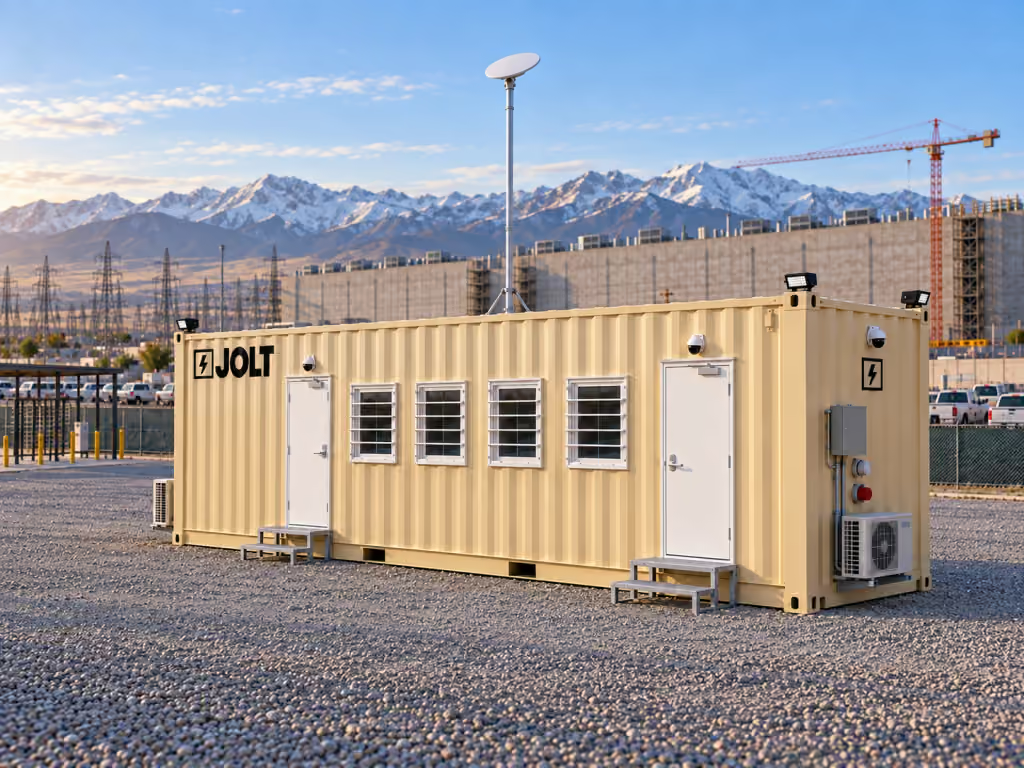
Salt Lake Valley · Utah
Data center site offices in Utah: The Grid, nationwide.
Utah data center projects can reserve badge-ready Grid site offices with nationwide delivery to the Wasatch Front and west desert.
- Market
- Salt Lake Valley
- DC Deploy
- Quoted per campus
- On-site window
- 6–8 weeks
- Grid Command
- $2,750/mo
- Legal-width loadNo oversize permits
- On site in6–8 weeks
- One invoiceper unit
- Badge-ready
- Stackabletwo-high
- Moves withyour phases

Key facts
- Salt Lake Valley is the named corridor for 1 Utah market as of .
- The Command the Grid — 40 ft data center site office rents for $2,750 per month as of .
- The reservation deposit on the Command the Grid — 40 ft data center site office is $2,500 as of .
- DC Deploy is scheduled 6–8 weeks after the reservation as of .
Cite this page: "Data center site offices in Utah: The Grid, nationwide." JOLT (Jolt Rents), https://joltrents.com/data-centers/utah/. Last updated September 25, 2026.
Utah has 10 data centers under construction and 117 announced as of March 2026, against 29 operating, the third-largest announced pipeline in the country behind Texas and Pennsylvania, concentrated on the Wasatch Front, Meta at Eagle Mountain, Novva and Aligned at West Jordan and South Jordan, Salt Lake City and Spanish Fork, with campus-scale parcels in the west desert behind them, according to Aterio. JOLT delivers The Grid, a badge-ready 40 ft container site office, to any Utah data center site.
Utah has the largest gap between what is built and what is announced, on the strength of a state program to add a gigawatt of generation, cheap land in the west desert, and a Wasatch Front that already has the fiber. The offices for those campuses will land at 4,500 feet on ground that gets 60 inches of snow and 100-degree summers, on benches that catch the canyon wind, in seismic design category D. This page starts there.
Where are data centers being built in Utah right now?
Eagle Mountain and Utah County. Meta's Eagle Mountain campus, in construction since 2018 on the west side of Utah Lake, is the state's hyperscale anchor and keeps adding buildings on Rocky Mountain Power's system.
West Jordan and South Jordan. Novva's campus at West Jordan, the largest colocation build in the state, and Aligned's at South Jordan, both on the southwest side of the Salt Lake Valley on former farmland along Bangerter Highway.
Salt Lake City. Colocation and enterprise builds in the city's industrial corridors, Flexential, DataBank, C7 and others, on the fiber that runs from Denver to the coast.
Spanish Fork and southern Utah County. Campus parcels south of Provo on Interstate 15, in permitting.
Millard County and the west desert. Campus-scale proposals around Delta, on the transmission that runs from the Intermountain Power Project to California, the largest of the announced projects by acreage.
Utah attracts the work with Rocky Mountain Power's rates and the governor's Operation Gigawatt program to add generation, a data center sales-tax exemption on equipment, desert land in thousand-acre parcels, and a construction workforce that built the Silicon Slopes campuses and the Wasatch Front's tech corridor. Phases and names change quarterly; JOLT checks each project against a county filing or local reporting at every refresh of this page.
Which hyperscalers, developers and general contractors are active in Utah?
Meta at Eagle Mountain; Novva, Aligned and the colocation operators in the Salt Lake Valley; the campus developers behind Spanish Fork and Millard County.
The general contractors with data center groups working in Utah include Layton Construction, headquartered in Sandy and one of the largest data center builders in the West; Okland Construction, Salt Lake City; Big-D Construction; Jacobsen Construction; Mortenson; Turner; DPR; Holder; and JE Dunn. A Utah building runs 16 to 22 months from permit to energized, with a winter inside every one of them and a summer that reaches 100 at 4,500 feet. The electrical contractor mobilizes its own office on a generator on a bench lot where the canyon wind runs 40 mph on a clear afternoon.
What does a Utah data center site office need?
Snow, cold, summer heat at altitude, wind on the benches, and Cascadia's inland cousin, the Wasatch fault.
Snow and cold. The Salt Lake Valley gets 55 to 60 inches of snow a year and averages lows in the low 20s in January, with zero to 10 below in a cold stretch; Eagle Mountain and the west desert are colder and windier. The Grid has two 12,000 BTU cold-climate mini-split heat pumps that heat to -13 F, behind R-19 closed-cell foam walls and an R-30 roof.
Summer heat at altitude. The valley reaches 100 in July, and at 4,500 feet the sun is stronger than the thermometer says. The Grid's two heat pumps pull moisture as they cool, and the tan RAL 1015 exterior reflects sunlight.
Wind on the benches. The Wasatch Front's canyon winds, the east winds that come down Weber and Parleys canyons, run 40 to 60 mph on a clear day and have overturned trucks on I-15. Every Grid receives four-point anchoring; the owner's engineer and the authority having jurisdiction set any project-specific criteria.
Seismic and frost. The Wasatch Front is seismic design category D on the Wasatch fault, and frost can move an office's bearing surface over a winter. The site's engineer and authority having jurisdiction determine project-specific anchoring criteria.
Use the Grid site-requirements checklist to plan the bearing surface, access and electrical service.
How does The Grid get to a Utah site?
The legal-width Grid chassis travels by flatbed without an oversize permit, route survey or pilot car.
Utah DC Deploy covers freight, tilt-bed placement or crane set, leveling on cribbing, four-point anchoring, an electrical rough-in walkthrough with the site's electrician and end-of-term pickup. See nationwide delivery for the lower-48 package and 6–8 weeks on-site window.
What does a Grid cost on a Utah data center site?
Utah contractors can compare both builds, deposits and available add-ons on data-center pricing. DC Deploy is quoted per campus.
Utah sales tax is added where it applies; the state's data center exemption covers the owner's equipment, not a rental office. DC Deploy is quoted for the specific campus.
What is the power picture in Utah and when does temp power land?
Rocky Mountain Power, the PacifiCorp utility, serves the Wasatch Front, Eagle Mountain and the west desert, and the state's Operation Gigawatt program, launched in 2024, is a plan to double generation over a decade for exactly this load; Millard County's parcels sit on the transmission built for the Intermountain Power Project's coal plant and its conversion. Utah's large-load interconnection follows Rocky Mountain Power's generation program and the Public Service Commission's tariff for large customers.
For a site office, the utility's timeline matters on the day the office lands. On an established campus at Eagle Mountain or West Jordan, temporary construction service is usually live at the gate before the next building's office arrives. On a greenfield at Spanish Fork or in Millard County, the GC's temporary service can trail the first mobilization by two to six weeks, in winter or in a 100-degree July. Grid Command's 50 A generator inlet with a mechanical interlock lets a generator power the office until the electrician gets a 60 A circuit to the pad; the site electrician sizes the generator and confirms the load plan. JOLT's 25 kW standby generator is $1,850/mo plus fuel.
Do you need a permit for a temporary site office in Utah?
In Salt Lake, Utah, Davis, Weber and Millard counties, a temporary construction office is an accessory to the project's building permit under the Utah state construction code and is shown on the site logistics plan. Eagle Mountain, West Jordan, South Jordan, Salt Lake City and Spanish Fork issue a temporary-structure permit with a fee, and an owner's engineer in category D may ask for an anchoring detail against a seismic requirement.
Confirm the requirement with the authority having jurisdiction named on your building permit. Bring its anchoring and insurance requests to the data center specialist before the delivery window.
How long is a Utah site office term?
A Utah building runs 16 to 22 months from permit to energized, so a single-building placement is a 12-to-22-month term, and JOLT's 12-month minimum with month-to-month after it fits without a renewal. The Eagle Mountain campus has been in phase since 2018, and the Millard County parcels are planned in phases over years; on those the office moves every 15 to 20 months as a building turns over: one or two $1,250 relocations, not a new mobilization.
For a GC or an electrical contractor running three or more Utah buildings, compare rental with the purchase and 36-month lease-to-own rows on the Grid buy page. For one building, rent.
How do multi-building Utah campuses use a Grid Campus?
An Eagle Mountain or Millard County campus is built one or two buildings at a time, and the GC's project office, the owner's rep, the electrical and mechanical contractors and the security office all move as buildings turn over. A Grid Campus combines 2 to 12 Grids in a row or stacked two-high, with a Stack Kit and its stair tower, landing and guardrail for each stacked pair. The kit is $395/mo with $1,500 setup, while one order of 6 or more Commands receives a 5 percent rent credit each month for the first 12 months.
Treat temporary power as its own Utah service decision
The permanent campus load and the construction-office circuit follow different schedules. Before approving the office, ask the electrical lead to identify the temporary source, connection point, responsible contractor and expected availability at the chosen pad.
The Utah Public Service Commission maintains the state's electric utility information and dockets for regulated service. Use the serving utility's current process and tariff for the parcel rather than relying on a campus announcement or a neighboring project's arrangement.
Core is appropriate when shore power, contractor fiber and site access systems are available. Command closes different early-phase gaps with its generator-ready inlet, CONNECT, WATCH and badge-ready doors. Have the site electrician document the source, connection and load plan.
Record a decision date for any generator. Identify who provides it, who approves the electrical plan and who manages fuel. Avoid leaving those items as allowances that surface after placement.
Permit the position, not merely the container
Utah's growth corridors cross city and county boundaries. Eagle Mountain, West Jordan, South Jordan, Salt Lake City and Spanish Fork each control building activity within their limits, while county departments handle applicable unincorporated parcels.
The Eagle Mountain Building Department provides permits, applications and inspection information for city projects. An Eagle Mountain team should ask how a temporary construction office is represented in the commercial permit record and whether a move requires a revision.
Give the reviewer a current logistics plan showing the office footprint, both doors, electrical route, approved bearing surface, anchoring approach and nearby fire access. Add fencing, storage and major equipment paths that will exist during the office phase.
Coordinate anchoring criteria with the authority having jurisdiction and the owner's engineer. DC Deploy includes four-point anchoring, but it does not define project-specific seismic, wind or soil criteria. Obtain those requirements before the delivery window.
Use weather information for placement and move planning
The National Weather Service Salt Lake City office publishes snow and precipitation data for the region. Check current forecasts and site conditions before placement or relocation, especially when the access route crosses unfinished grades.
Assign snow removal around both personnel doors and the pedestrian route. Keep plowed piles where meltwater will not drain toward the office bearing points. Reinspect the surface after freeze-thaw or nearby excavation.
Wind planning starts with the approved anchoring approach and extends to loose site materials. The logistics team should keep fencing fabric, packaging and temporary signs from obstructing doors or exterior equipment. Project-specific wind decisions belong to the engineer and authority having jurisdiction.
Summer planning requires equal attention. Confirm the planned power source and keep exterior equipment clear. Ask the project's HVAC lead to set inspection needs for actual dust conditions. The included heat pumps and insulated envelope do not replace the customer's utility planning.
Compare Utah office quotes with one written checklist
Ask every bidder to state the office build, term, site ZIP, target window, placement scope, anchoring, electrical handoff, connectivity, access preparation, furniture, relocation assumptions and pickup. Put exclusions next to those lines.
Separate recurring charges from one-time work. Compare the same intended term and configuration rather than a headline monthly line. Use JOLT's current pricing for The Grid so an old copied figure does not drive the decision.
Match the build to early site services. Command may be useful on a remote first phase where connectivity, cameras, badge preparation and generator readiness close known gaps. Core may be sufficient on a developed campus expansion where the contractor already supplies those systems.
Identify owner responsibilities in the scope sheet. The customer provides approved access, bearing conditions and utilities, and should resolve project-specific permitting and engineering. A written responsibility matrix makes those dependencies visible before the target window.
Finish with named approvers for logistics, permitting and electrical work. Utah campuses can span long distances between the gate, temporary power and the active building. A precise placement point and responsible contacts are more valuable than a general county destination.
Which Utah counties and metros does JOLT serve?
All of them. The counties carrying data center construction today: Salt Lake, which is Salt Lake City, West Jordan and South Jordan; Utah, which is Eagle Mountain, Spanish Fork and Provo; Davis and Weber on the northern benches; Tooele; and Millard, which is Delta. Other Utah counties can be quoted too; DC Deploy is quoted per campus in one business day and the window is 6–8 weeks.
Nearby markets with their own JOLT pages: Nevada, Arizona, Oregon, Texas.
How do I reserve a Grid for a Utah project?
Select Core or Command and share the Utah ZIP, unit count, target date and project details through the data-center reservation route, then choose add-ons and protection before paying the deposit. The delivery window is on the confirmation; cancel free in writing more than 14 days before the first day of it.
How many data centers are under construction in Utah?
Aterio's March 2026 count records 10 under construction, 117 announced, the third-largest announced pipeline in the country, and 29 operating.
Does JOLT deliver site offices anywhere in Utah?
Yes. Utah sites receive freight, placement, leveling, four-point anchoring, an electrical rough-in walkthrough and end-of-term pickup through DC Deploy.
How long does delivery to Utah take?
Utah's standard on-site window is 6–8 weeks.
What does a Grid cost in Utah?
Utah projects pay $1,950/mo for Core or $2,750/mo for Command, with a 12-month minimum. DC Deploy is quoted per campus in one business day.
Is The Grid built for Utah weather?
R-19 closed-cell foam walls, an R-30 roof and two cold-climate heat pumps prepare The Grid for Utah temperatures. Four-point anchoring is included, with project-specific criteria set by the owner's engineer and authority having jurisdiction.
Who is the utility and how does that affect the office?
Rocky Mountain Power serves the Wasatch Front and the west desert, with the state's Operation Gigawatt program adding generation. Temp power on an established campus is usually live before the office lands; on a Spanish Fork or Millard County greenfield it can trail mobilization by two to six weeks, when Command's generator inlet supports the office until temporary service is ready.
Where are Meta's Eagle Mountain campus and the Novva and Aligned campuses, and can JOLT deliver there?
Eagle Mountain is on the west side of Utah Lake in Utah County; Novva is at West Jordan and Aligned at South Jordan on the southwest side of the Salt Lake Valley. DC Deploy serves all three under the lower-48 program.
How does the Grid handle Wasatch Front snow, summer heat at 4,500 feet and seismic requirements?
The Grid has an R-30 roof, R-19 closed-cell foam walls and two cold-climate heat pumps, while four-point anchoring is part of DC Deploy. The owner's engineer and authority having jurisdiction set seismic criteria for the site.
Your delivered price
Pick the unit, rent or buy, and the job ZIP. Monthly rent and the route show as you go; we email the full delivered price with a 14-day lock.
Pick a length
Drawn to scale, side view.
Step 1: Unit
The Grid · Command
Which 40 ft?
Step 2: Rent or buy
12-month starting term for project quotes.
Renting 12 months or more? Lease-to-own ends with the office yours: $2,795/mo for 36 months.
Step 3: Job ZIP
Utah · Mountain West
Delivery and pickup: quoted for your site.
Step 4: Send it
Step 5: Your project quote
- JOLTSite offices for data center construction. Nationwide.
- DataCenterProductNationwide Grid Command: badge-ready, connected, and ready the day it lands.
- DataCenterGuideNationwide data center site office pricing. All of it.
- DataCenterMarketData center site offices in Nevada: The Grid, nationwide.
- DataCenterMarketData center site offices in Arizona: The Grid, nationwide.
- DataCenterMarketData center site offices in Oregon: The Grid, nationwide.
- DataCenterMarketData center site offices in Georgia: The Grid, nationwide.
- DataCenterMarketData center site offices in Illinois: The Grid, nationwide.
Bring The Grid to Utah.
DC Deploy covers freight, set and pickup.
A deposit holds your delivery window. Cancel free of charge more than 14 days before the first day of the window. Deposits from $85 are applied to your first invoice.