A rented generator, fuel runs and noise all day. Our estimate for a Base office run on a generator, with fuel runs, internet and a camera, is $2,308 a month.
What JOLT changes
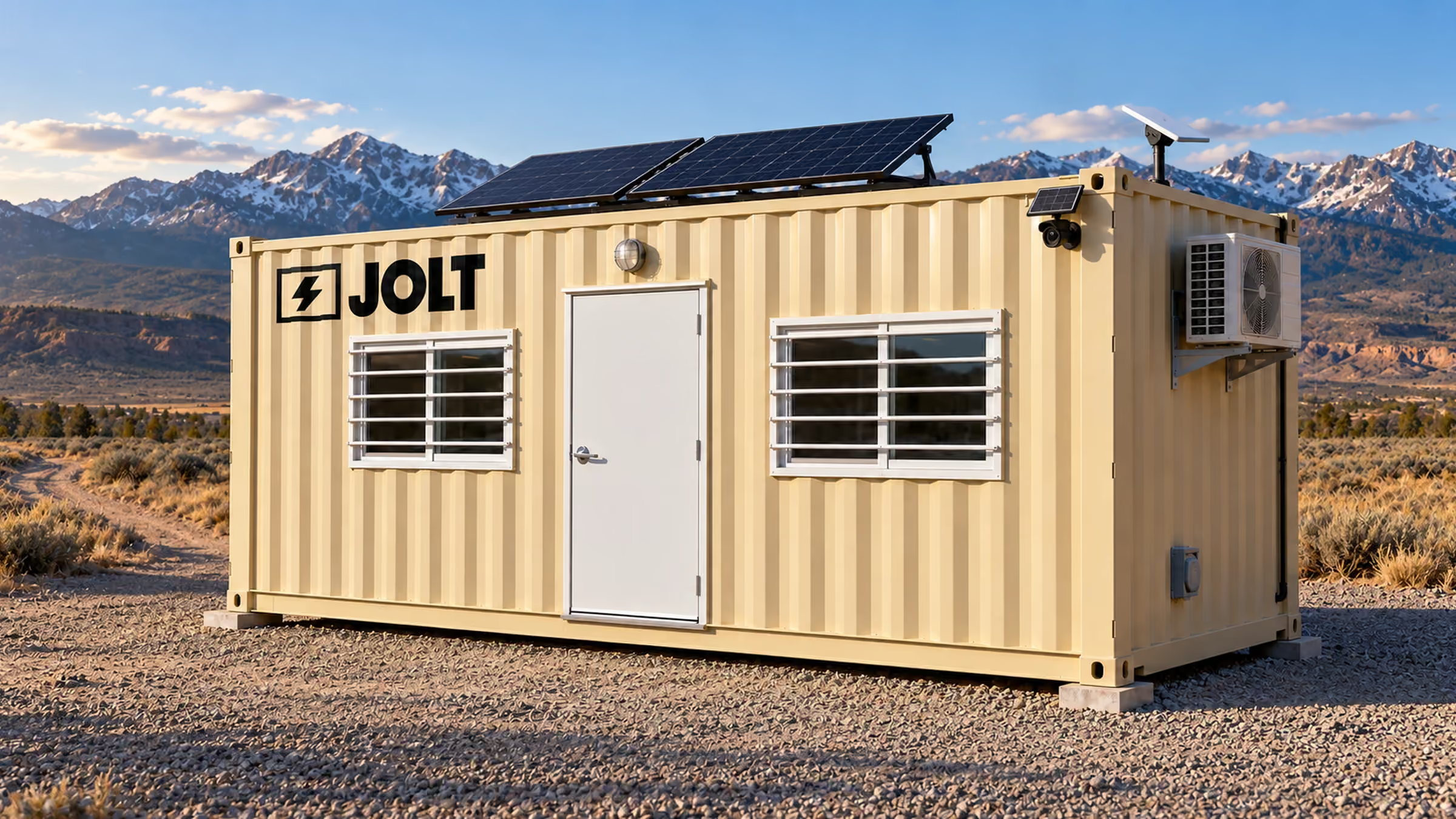
Grid-Free carries roof solar, a 10 kWh battery, Starlink and a camera. The battery runs the heat and A/C. $1,495 a month. Nothing to refuel.
Crews lose time warming up and cooling down in trucks.
What JOLT changes
Every office has a mini-split for heat and cooling. Grid-Free runs it from its own battery.
Tools that walk off at night
What it costs you
Equipment theft costs U.S. contractors an estimated $300 million to $1 billion a year (National Equipment Register and NICB). Most of it is never recovered.
What JOLT changes
One-trip steel storage with a welded lockbox. WATCH adds a solar LTE camera with motion alerts for $129 a month. It comes built in on Grid-Free and Alpine.
Nowhere to meet the owner or the inspector
What it costs you
Walkthroughs happen on a tailgate. Plans ride on a truck seat.
What JOLT changes
A clean, lit office with a plan table (READY), Starlink for plans, email and video calls, and your logo on the door.
We help you plan the placement. Here is what Pennsylvania asks for. Start with the actual municipality, not the company address. Draw the Pennsylvania office and separate storage positions. Identify the Pennsylvania landowner and construction-site manager. A Philadelphia bridge approach differs from a Pittsburgh hillside parcel. A borough main street presents yet another permission question. Tell us which Pennsylvania space your crew can use through each phase. We can compare office footprints against that parcel's available space.
On a private lot
The Pennsylvania Department of Labor and Industry UCC page says over 90 percent of municipalities enforce the Uniform Construction Code locally. They use municipal staff or certified third-party agencies. The department describes commercial-code enforcement where municipalities opt out. Ask which office reviews your particular Pennsylvania parcel. Give that reviewer the proposed occupancy, dimensions and intended duration. Show electrical connections and any planned bathroom service. Ask whether construction, trade or fire review applies. Ask about temporary-structure provisions for the specific installation. Discuss an unoccupied cargo box as a separate use.
Pennsylvania municipal zoning calls for its own conversation. Ask planning about the parcel's approved use and temporary construction uses. Mark setbacks, existing parking and any site-plan boundaries. A residential driveway storage position may receive different scrutiny from a commercial worksite. Show the office's occupied position on the project drawing. Ask whether a change in construction phase changes the authorized space. Keep the local building answer with the land-use answer. If the job crosses a municipal border, identify the authority for each parcel.
PennDOT's Girard Point Bridge update describes I-95 rehabilitation in Philadelphia. Nine approach structures are included. Work resumed in July 2026. Such a multi-structure project invites a careful laydown plan. Ask the project owner which off-road parcel serves each phase. Keep a workroom on the approved side of the boundary. Identify a gate that remains practical when another approach becomes active. An office and a materials box need two clearly marked positions.
PennDOT's July 2026 Commercial Street Bridge report locates work between the Squirrel Hill Tunnel and Edgewood/Swissvale interchange. It describes a new I-376 bridge moved into position. Pittsburgh and Edgewood Borough both figure in the project geography. Ask which municipality contains the actual office pad. A nearby road and a nearby pad may have different authorities. Put the lot boundary beside the proposed entrance on the drawing.
On a street or sidewalk
For Philadelphia construction sites, consult the Streets Department construction-closure guidance. It lists equipment placement as a reason for a construction street-closure permit. Materials and duration vary by closure type. Ask Streets whether your proposed curb position needs that process. Explain whether an office stays there or the space serves a brief stop. Ask Licenses and Inspections about the occupied private-lot position separately. A row-house frontage can make those two conversations especially important.
For Pittsburgh work, the DOMI right-of-way rules distinguish obstruction permits from occupation licenses. Commercial dumpsters are one example of the latter. Ask DOMI's Division of Permits and Inspections to classify your exact office proposal. Describe a brief stop separately from continued occupation. Give the street segment and proposed dates. A Pittsburgh answer does not decide a Philadelphia curb request. For other boroughs and townships, identify their own street authorities. Ask the relevant highway authority about a proposed position on a state road.
Map the public boundary before choosing a Pennsylvania corner for storage. A private owner's consent covers their parcel, not an adjoining sidewalk. Draw pedestrian access and the intended office entrance. If the current street position changes during construction, revisit the public-space request. Keep the street response in the field plan. Give the site supervisor a copy for each phase. We can help describe the unit's size and proposed position.
HOA and deed restrictions
Ask a Pennsylvania landlord whether the proposed pad is included in the lease. An HOA may have additional rules for a residential driveway. Share the unit's exterior, occupied use and intended duration. Check recorded easements before marking a storage area. A shared access aisle can constrain an otherwise spacious parcel. Request written owner or association consent where applicable. Also ask municipal planning about the underlying land use. Treat these as distinct answers for the same Pennsylvania address.
On a Philadelphia row-house renovation, check who controls the rear access. At a Pittsburgh commercial property, ask who reserves the loading area. For a small Pennsylvania borough project, clarify whether common parking belongs to tenants. Show any approved storage position to the owner as well as the reviewer. If the work shifts into a neighboring parcel, seek that owner's answer too. An Alpine exterior has matte black and cedar surrounds. Share its covered-entry footprint when discussing an association's visual rules.
Getting the site ready
Mark a firm, level, well-drained pad on the Pennsylvania site drawing. The rental agreement's site conditions cover ground, utilities, access, permissions and a receiving representative. Check overhead wires and utility markings near the intended position. Walk the gate with the superintendent while grading remains flexible. Mark where pedestrians approach the office. Leave the door usable after materials are stored nearby. Show the separate storage opening as well. A later retaining wall can alter the approach to a Pittsburgh parcel.
The agreement's retrieval provisions call for access when the Pennsylvania unit leaves. Preserve that access as Philadelphia scaffolding or borough landscaping changes. Ask the foreman when the first gate will close. Put any replacement gate on the updated site drawing. At an eastern bridge job, work areas may shift between approaches. At a western hillside site, grade changes can narrow a turn. Review the usable space again before each major site phase.
A 12 ft walk-in container gives Pennsylvania crews a man door and barred window. It can suit a smaller approved Pennsylvania tool area. The 20 ft cargo box has four lock bars and a welded lockbox. Choose its cargo-door direction before marking the pad. The 40 ft high-cube needs a longer clear position. For an occupied Base office, discuss its 50-amp inlet with your electrician. The 40 ft bathroom office also needs a service conversation. Show both utilities and the full unit footprint to local reviewers.
Where JOLT fits best
A Pennsylvania multi-phase bridge job can need a workroom and locked tool storage. Keep each unit on approved ground near the crew's actual entrance. A Philadelphia approach project may have several work fronts. Choose a stable office location rather than redrawing its placement every week. A Pittsburgh hillside remodel may favor a shorter 20 ft office. A borough project may fit a 12 ft walk-in crib beside the authorized work area. We can help compare those footprints with the site sketch.
Use Grid-Free where Pennsylvania temporary power has not reached the approved pad. Its roof solar, Starlink and WATCH camera are built in. The battery runs HVAC without shore power; output varies with sun and load. Alpine adds backup heat and a covered entry for repeated winter visits. Base serves a site whose electrical connection is prepared. For a longer approved position, consider the bathroom office. A crew keeping a 20 ft workspace across assignments can explore buying an office. Each new Pennsylvania parcel still needs its own placement conversation.
Built for Pennsylvania weather
NOAA's Philadelphia International Airport 1991–2020 normals show a July average high of 87.8 °F. January's average low is 26.0 °F. Summed monthly precipitation is 44.11 inches annually. The summed snowfall figure is 23.1 inches. An eastern Pennsylvania contractor can plan summer cooling and rain drainage together. Check where water collects beside a row-house work pad. Keep the walking path usable when winter precipitation reaches the site.
NOAA's Pittsburgh International Airport normals give a July average high of 82.9 °F. The January average low is 21.4 °F. Summed annual precipitation reaches 39.61 inches. Summed snowfall reaches 44.1 inches. A western Pennsylvania supervisor may reserve more space for snow clearance. Keep a hillside office entrance reachable after a storm. Confirm that runoff moves away from the intended ground position. The eastern and western airport stations describe different planning contexts.
A powered Pennsylvania pad can use Base's mini-split for heat and cooling. The larger bathroom model also has a mini-split and shore inlet. Discuss that model's enclosed bathroom with the local service reviewer. A site awaiting power can use Grid-Free's battery-powered HVAC. Its solar output follows exposure and load. On a winter field visit, Alpine brings backup heat and a covered deck. Ask where the door faces after plowing or drainage work. Set storage so crews can reach tools without crossing the office entry. For a Pennsylvania job stretching across seasons, check access repeatedly. That habit matters as much as the first pad drawing.
Use the Philadelphia airport figures for an eastern project discussion. Use Pittsburgh's station figures when planning farther west. For a site between those cities, ask where water collects on the actual parcel. Find the prevailing approach used by crews, not just the nearest road. Note whether the approved office site is exposed or shaded. Show the supervisor how snowfall affects the gate. Add a second access review after the site's first major grading change. These decisions keep the Pennsylvania office useful through more than one season.
How we built this page: rent, upgrade and delivery figures come from the JOLT catalog at build time. Permit, street, HOA and weather facts are linked to their sources in the text. Written and reviewed by Lisa Tanner.
What comes in a JOLT office for a Pennsylvania job?
Every 20 ft office has heat and A/C, lights, outlets, a vinyl-plank floor, a 36-inch steel door and two barred windows. Grid-Free adds roof solar, a 10 kWh battery, Starlink and a camera. Offices rent from $795 a month.
Can the office run before the site has power?
Yes. Grid-Free runs its heat and A/C, lights, outlets and Starlink from roof solar and a 10 kWh battery. Output depends on sun and load. It rents for $1,495 a month.
Can we put our logo on it?
Yes. BRAND applies your logo in 24 by 48 inch vinyl on two sides of the unit. $450, one time.
Do I need a permit for a jobsite office in Pennsylvania?
Possibly; ask the municipality governing your Pennsylvania parcel about an occupied office. The Uniform Construction Code is the statewide framework, but most municipalities enforce it locally. Give the building and land-use reviewers your office position, duration and planned connections. Where a municipality opts out, ask the Department of Labor and Industry which commercial-code review applies.
Can the office sit on a Pennsylvania street?
Only with permission from the authority controlling that Pennsylvania street. Philadelphia's Department of Streets handles construction closures; Pittsburgh's Department of Mobility and Infrastructure classifies right-of-way uses. Tell the appropriate office whether the proposal involves a brief stop or an office remaining at the curb. For a state road, ask the relevant highway authority.
What does the site need before delivery?
A firm, level pad, a clear path for the truck, and a person on site to show the driver where it goes. Tell us about gates, slopes and overhead lines when you ask for the quote.
How much does delivery to Pennsylvania cost?
Delivery to Pennsylvania is quoted per project. We route the unit from the nearest JOLT source yard and send a written delivered quote within one business day. It holds for 14 days. Rent is published: offices from $795 a month, storage from $225.
How long can we rent, and can we buy?
Rentals outside the Rockies start at 12 months. You can also buy an office outright or lease-to-own a 20 ft office over 24 or 36 months.
Start your Pennsylvania project quote
Offices from $795 a month
Pick the office, the term and the job ZIP. You get a written delivered quote within one business day, and it holds for 14 days.