A rented generator, fuel runs and noise all day. Our estimate for a Base office run on a generator, with fuel runs, internet and a camera, is $2,308 a month.
What JOLT changes
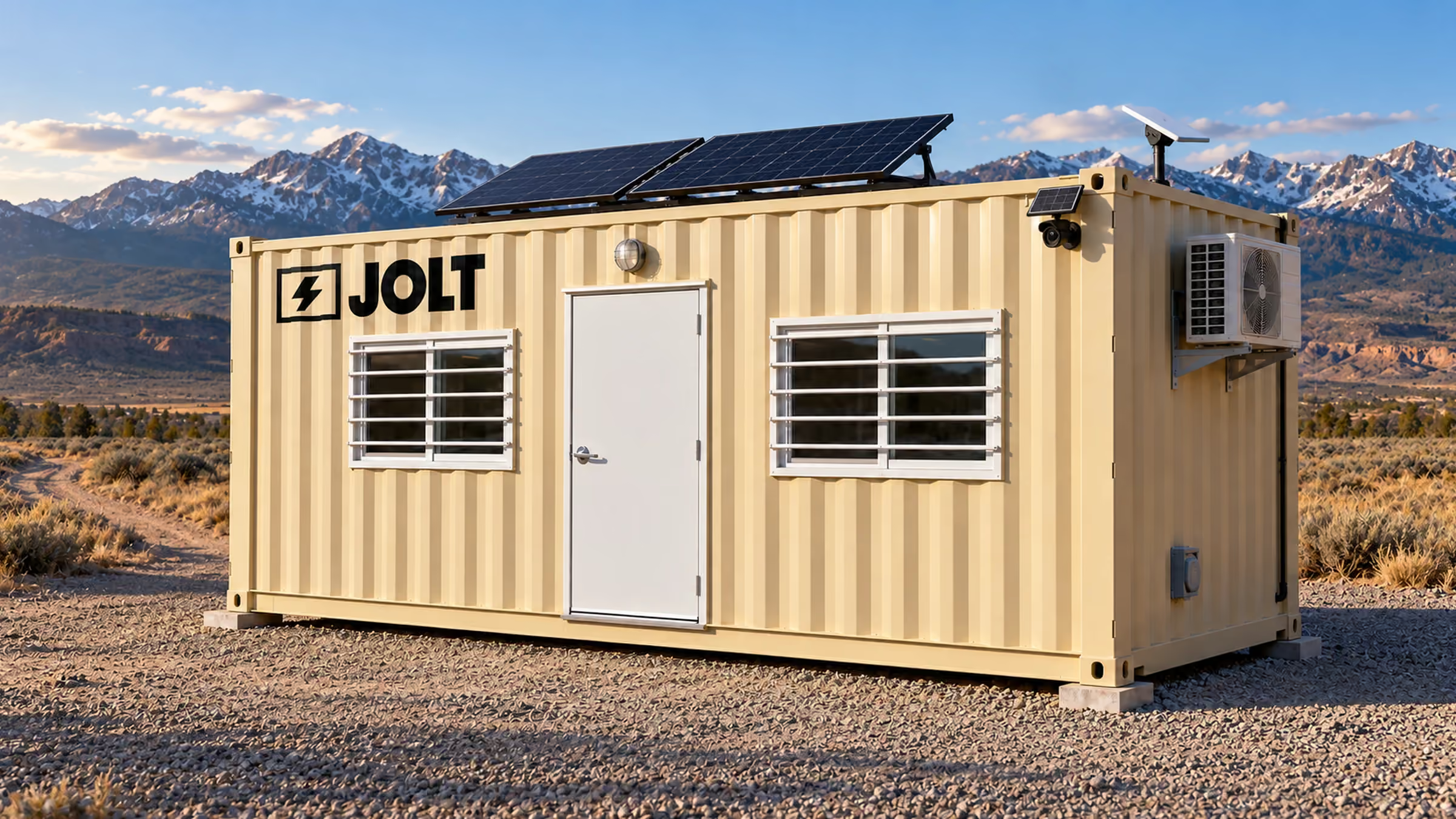
Grid-Free carries roof solar, a 10 kWh battery, Starlink and a camera. The battery runs the heat and A/C. $1,495 a month. Nothing to refuel.
Crews warm up in trucks. Snow buries tools left out. Light runs out early.
What JOLT changes
Mini-split heat in every office. Alpine adds backup heat, an over-roof and a covered entry deck. Steel storage keeps tools dry and locked.
Tools that walk off at night
What it costs you
Equipment theft costs U.S. contractors an estimated $300 million to $1 billion a year (National Equipment Register and NICB). Most of it is never recovered.
What JOLT changes
One-trip steel storage with a welded lockbox. WATCH adds a solar LTE camera with motion alerts for $129 a month. It comes built in on Grid-Free and Alpine.
Nowhere to meet the owner or the inspector
What it costs you
Walkthroughs happen on a tailgate. Plans ride on a truck seat.
What JOLT changes
A clean, lit office with a plan table (READY), Starlink for plans, email and video calls, and your logo on the door.
We help you plan the placement. Here is what Idaho asks for. First identify the actual project parcel. Boise on the mailing line may not mean Boise zoning applies. Show us the available area and proposed access gate. We can help match an office to that position. Tell the reviewer whether the unit houses staff or materials. Include the expected duration and utility plan. Keep your official contacts on the site drawing.
On a private lot
Idaho's adopted-code list names an amended 2018 IBC. It also identifies the 2018 IFC under the state fire marshal. Ask the parcel's local building office about an occupied temporary office. Ask planning whether construction use or outside storage fits the zoning district. Send an active permit number if the Idaho site has one. Describe a box for tools differently from a staffed workroom. Mark its dimensions, doors and distance to nearby buildings. Ask whether fire access needs a separate review. An adopted code edition starts the discussion but does not locate a unit.
Inside Boise, Allowed Use guidance distinguishes several district categories. A use may be allowed, subject to standards or conditional. The city's zoning-code page says revised Title 11 began in April 2026. Ask Planning to classify your Boise construction-office proposal. Include the address and proposed location behind the property line. Outside city limits, contact the actual city or county instead. The Boise placement page addresses that city's detailed street questions.
Boise Fire's Temporary Structures and Uses application requests dimensions and separation from buildings. It also asks about exits, activity and occupancy. Use those questions to prepare an occupied-office sketch. Ask the reviewing fire desk how the specific office is categorized. A rural Idaho authority may use a different process. For a commercial yard, show required parking and fire lanes. For a residential driveway, ask planning about screening and setbacks. We can review the footprint while you collect those answers.
On a street or sidewalk
Boise's Parking Services permit descriptions distinguish temporary equipment use from reserved metered spaces. Describe the exact proposed container or unloading operation. Ask whether the office can occupy that public position. Mark the sidewalk and any alley used by the truck. An approved Boise lot does not automatically extend into its curb lane. In other Idaho cities, ask the appropriate street authority. On a state road, contact its road owner. Keep pedestrian and emergency routes visible on the proposal.
ITD's SH-21 Mores Creek Bridge notice describes September 2026 rehabilitation. It describes one-lane traffic control and wide-load routing via SH-55. Ask your project manager about the current route before setting a receiving plan. Tell us if a restricted entrance affects the actual pad. A roadwork staging area still requires authorization from its owner. Idaho's highway movement rules and stationary street occupation answer different questions. Mark the authorized laydown area beyond the traffic controls. Plan access for later project phases as well.
HOA and deed restrictions
Ask an Idaho HOA about exterior appearance and time on site. Get a landlord's consent for a leased Boise lot. Keep those responses alongside government placement approval. On a residential driveway, show the unit and proposed screening. If the lot has an easement, ask its holder about the position. A private access road may also require its owner's agreement. Sketch the property edge and adjacent sidewalk separately. We can discuss a smaller storage unit when covenants limit available space.
The Alpine office's matte-black mountain exterior may suit a visible Idaho project. Its cedar surrounds still need association review where covenants apply. Share its proposed entry direction with the committee. Ask whether the covered deck fits the allowed position. An HOA response does not replace a Boise zoning classification. Keep any private duration condition in the project calendar. If a different building phase changes the pad, revisit permission then. Avoid screening that blocks a fire lane. Ask the owner where future snow piles will go.
Getting the site ready
Walk the Idaho route from road to pad. Check overhead clearance and gate width. Prepare a firm, level and well-drained resting surface. Mark both the unit footprint and truck turning area. Reserve room for the next construction phase. The Idaho receiving contact should direct the unit at its marked gate. Keep neighboring property out of the approach unless permission is arranged. Map where workers will enter the office each day. Leave a route for retrieving the box after grading advances.
The 10 ft storage container fits a smaller Idaho pad. The 12 ft walk-in crib fits a driveway-sized position. The 20 ft one-trip box keeps its cargo doors behind four lock bars. A 40 ft high-cube needs a longer approach. For an occupied office, mark the door and power connection. An Idaho Base uses its 50-amp inlet for site shore power. A bathroom office needs additional service planning. Discuss the proposed unit dimensions with the official before ordering. Keep a plow route clear if the site runs into winter.
Where JOLT fits best
An Idaho road contract spanning seasons can benefit from a stable field office. Add tool storage when crews need a separate secure space. Temporary fence can define an approved work boundary. We can review how all three fit the same authorized parcel. The ITD project list includes SH-16 in the Treasure Valley. An interchange-adjacent office needs a laydown pad beyond road operations. A Boise infill contractor may instead need a smaller crib. Choose based on usable space and the actual work schedule.
Base serves an Idaho pad with planned shore power. Grid-Free can work before that connection exists. For Idaho winter crews, Alpine pairs backup heat with a covered entry. A 40 ft bathroom office needs an approved longer footprint. An owned 20 ft office can accompany successive jobs. Each new parcel still requires its own placement answers. Ask us before arranging a rental move between Idaho sites. The rental agreement terms address relocation consent. Keep the site plan aligned with the chosen unit.
Built for Idaho weather
At a higher Idaho site, ask who will clear the approach after a snowstorm. Mark the plow area beside the pad, not across its gate. A receiving map can show the same access for the crew returning in spring.
NOAA's Boise Air Terminal normals cover 1991–2020. They show a July average high of 92.7°F. That airport's January average low is 25.5°F. Annual precipitation there adds to 11.51 inches from monthly normals. Snowfall normals total 17.6 inches. Those airport values describe Boise, not an Idaho mountain pad. Ask the reviewing building official about the actual site's conditions. Keep winter access in the office placement sketch.
A Treasure Valley Base office includes mini-split heat and cooling. Its lights and outlets use a planned shore connection. Grid-Free gives Idaho crews built-in solar and a 10 kWh HVAC battery. It also includes Starlink and the WATCH camera. It requires no shore power at the Idaho pad. Idaho solar output changes with sunlight and office load. Alpine builds on that office with backup heat. Its standing-seam over-roof and covered entry can aid frequent visits. Ask the building desk about the actual occupied position.
Boise Airport's July 2026 infrastructure announcement describes runway reconstruction beginning that March. The runway work was planned across two construction seasons. A second apron phase for a future Concourse A was underway. Ask the facility for its authorized contractor gate. An airport office needs a distinct occupied pad. Tool storage needs its own receiving position. A Base build can work where temporary site power is ready. Where power is pending, discuss Grid-Free and solar exposure. Keep both positions compatible with the next airfield phase.
The Mores Creek Bridge project is a different Idaho worksite. The September 2026 notice anticipated roughly nine months of rehabilitation. One-lane controls can affect how a crew reaches its laydown. Ask which access remains open on the proposed receiving day. A 12 ft crib might serve a compact authorized pad. A larger office needs a longer stable position. Keep materials away from the truck return route. If winter work follows autumn, identify where plowed snow will go. Ask the site manager for an updated phase drawing.
On a Boise renovation, heat may matter less than July cooling. At that powered pad, Base's mini-split can heat and cool the office. On a high-elevation Idaho assignment, winter access may dominate. Alpine's covered entry and backup heat are relevant features. Neither Boise weather figures nor a product name establishes mountain structural criteria. Ask the local building reviewer about the actual site. Choose storage by the approved pad's footprint. A 20 ft cargo-door box works differently from a 12 ft walk-in crib. Keep the office and storage paths clear as Idaho construction changes.
How we built this page: rent, upgrade and delivery figures come from the JOLT catalog at build time. Permit, street, HOA and weather facts are linked to their sources in the text. Written and reviewed by Lisa Tanner.
Every 20 ft office has heat and A/C, lights, outlets, a vinyl-plank floor, a 36-inch steel door and two barred windows. Grid-Free adds roof solar, a 10 kWh battery, Starlink and a camera. Offices rent from $795 a month.
Can the office run before the site has power?
Yes. Grid-Free runs its heat and A/C, lights, outlets and Starlink from roof solar and a 10 kWh battery. Output depends on sun and load. It rents for $1,495 a month.
Can we put our logo on it?
Yes. BRAND applies your logo in 24 by 48 inch vinyl on two sides of the unit. $450, one time.
Do I need a permit for a jobsite office in Idaho?
Ask the Idaho planning and building desks that govern your actual parcel. The state adopted-code list identifies the amended 2018 IBC and 2018 IFC, but Boise Title 11 addresses its own land-use districts. Show the reviewing officials the occupied office, proposed duration, utilities and site sketch. A storage-only container deserves its own description.
Can the office sit on a Idaho street?
Only if the Idaho road authority approves that particular public-space position. Boise Parking Services has programs for necessary equipment near a job and for approved meter reservations; neither alone answers every stationary-office question. Elsewhere, ask the city's street desk or state road owner. Mark the exact curb, sidewalk and unloading path when you ask.
What does the site need before delivery?
A firm, level pad, a clear path for the truck, and a person on site to show the driver where it goes. Tell us about gates, slopes and overhead lines when you ask for the quote.
How much does delivery to Idaho cost?
Delivery to Idaho is $3,495 per 10,12 or 20 ft unit and $5,495 per 40 ft unit, each way (Mountain West). Pickup is the same fee, and both legs are billed with the first invoice. Rent is published: offices from $795 a month, storage from $225.
How long can we rent, and can we buy?
Rentals delivered outside Colorado start at 12 months. You can also buy an office outright or lease-to-own a 20 ft office over 24 or 36 months.
Reserve your Idaho office.
Offices from $795 a month
A deposit holds your delivery window. Cancel free of charge more than 14 days before the first day of the window. Deposits from $85 are applied to your first invoice.