Data center guide · Nationwide
Where data centers are being built in 2026, state by state.
Data centers under construction and announced in every U.S. state, with metro clusters, build timelines and site-logistics implications.
- Grid Core
- $1,950/mo
- Grid Command
- $2,750/mo
- DC Deploy
- Quoted per campus
- On-site window
- 6–8 weeks
- Legal-width loadNo oversize permits
- On site in6–8 weeks
- One invoiceper unit
- Badge-ready
- Stackabletwo-high
- Moves withyour phases

Key facts
- The Core the Grid — 40 ft data center site office rents for $1,950 per month as of .
- The reservation deposit on the Core the Grid — 40 ft data center site office is $2,500 as of .
- The minimum rental term on the Core the Grid — 40 ft data center site office is 12 months as of .
- Grid delivery window is 6–8 weeks after the reservation as of .
Cite this page: "Where data centers are being built in 2026, state by state." JOLT (Jolt Rents), https://joltrents.com/data-centers/under-construction-by-state/. Last updated September 25, 2026.
As of March 2026, Texas leads the country with 140 data centers under construction, followed by Virginia with 136, Georgia with 56, Ohio with 51, Arizona with 35, Nevada with 29, Indiana with 23 and Mississippi with 21, according to Aterio's state-by-state tracking. Twelve states have none under construction. The full state table is below, followed by the metro clusters inside each state where the work is, the build timelines by region, and what the numbers mean for a general contractor's site logistics plan.
JOLT publishes this page because our customers, the site logistics managers and project engineers who reserve a Grid site office for a data center campus, ask the same question before they ask about the office: where is the next job. We refresh it quarterly against Aterio's counts and county filings. The date at the top of the page is the last refresh.
Which states have the most data centers under construction?
Two states are in a class of their own. Texas has 140 data centers under construction and Virginia has 136. They are the only two states above 100, and together they hold more projects under construction than the next twelve states combined.
Behind them the drop is steep. Georgia has 56 under construction and Ohio 51. Arizona has 35, Nevada 29, Indiana 23, Mississippi 21, Illinois 19, Iowa 15 and Oregon 14. Wisconsin, North Carolina, South Carolina and Maryland have 12 each. Louisiana and Pennsylvania have 11. Utah has 10.
The buildout is uneven on purpose. Data centers follow three things: power that a utility can commit to on a schedule, land in parcels of 100 acres and up near fiber routes, and a permitting process that finishes in months rather than years. The states at the top of the list have all three. The twelve states with nothing under construction are missing at least one.
Which states have the largest announced pipelines?
Aterio counts a project as announced when there is a building permit, a utility filing or a public announcement but no ground broken. Announced projects are the next two to four years of construction, and they rank the states differently.
Texas has 610 announced data centers, the largest pipeline in the country by a wide margin. Virginia has 498. Georgia has 340, more than five times its 62 operational facilities, which makes it the fastest-growing major market. Pennsylvania has 209 announced against 37 operating, driven by gas-to-data-center campuses in the west of the state. Illinois has 153 announced, Arizona 136, Utah 117 and Ohio 98.
For a contractor, the announced column is the one to plan crews against. A state with a large announced pipeline and a short permitting cycle, Georgia, Indiana, Ohio, will convert announcements to groundbreakings faster than a state where the utility interconnection queue is the gate.
The 50-state table
Operational, under construction and announced data centers by state, as of March 2026 (Aterio), with links to JOLT's site office pages for the launch markets.
| State | Operational | Under construction | Announced | Total |
|---|---|---|---|---|
| Texas | 212 | 140 | 610 | 962 |
| Virginia | 320 | 136 | 498 | 954 |
| Georgia | 62 | 56 | 340 | 458 |
| Pennsylvania | 37 | 11 | 209 | 257 |
| Arizona | 83 | 35 | 136 | 254 |
| Ohio | 101 | 51 | 98 | 250 |
| Illinois | 78 | 19 | 153 | 250 |
| California | 166 | 6 | 40 | 212 |
| Utah | 29 | 10 | 117 | 156 |
| Oregon | 97 | 14 | 33 | 144 |
| Nevada | 27 | 29 | 75 | 131 |
| New York | 50 | 3 | 72 | 125 |
| Indiana | 28 | 23 | 69 | 120 |
| Iowa | 58 | 15 | 38 | 111 |
| Washington | 71 | 3 | 26 | 100 |
| North Carolina | 43 | 12 | 40 | 95 |
| Minnesota | 27 | 4 | 45 | 76 |
| New Mexico | 13 | 5 | 52 | 70 |
| Missouri | 24 | 8 | 37 | 69 |
| Florida | 53 | 2 | 12 | 67 |
| Oklahoma | 22 | 9 | 34 | 65 |
| Alabama | 15 | 8 | 36 | 59 |
| Wisconsin | 18 | 12 | 28 | 58 |
| New Jersey | 49 | 2 | 6 | 57 |
| Michigan | 31 | 1 | 21 | 53 |
| Mississippi | 10 | 21 | 19 | 50 |
| Colorado | 31 | 6 | 10 | 47 |
| Kentucky | 10 | 2 | 34 | 46 |
| Wyoming | 12 | 8 | 25 | 45 |
| West Virginia | 4 | 0 | 39 | 43 |
| Connecticut | 7 | 0 | 33 | 40 |
| Nebraska | 26 | 5 | 8 | 39 |
| South Carolina | 18 | 12 | 8 | 38 |
| Tennessee | 31 | 3 | 3 | 37 |
| Louisiana | 10 | 11 | 16 | 37 |
| Maryland | 12 | 12 | 10 | 34 |
| Massachusetts | 23 | 0 | 0 | 23 |
| Kansas | 8 | 1 | 11 | 20 |
| Arkansas | 4 | 2 | 12 | 18 |
| Montana | 4 | 0 | 11 | 15 |
| North Dakota | 2 | 4 | 8 | 14 |
| Idaho | 4 | 2 | 6 | 12 |
| Maine | 4 | 0 | 7 | 11 |
| Delaware | 6 | 0 | 3 | 9 |
| South Dakota | 2 | 0 | 6 | 8 |
| New Hampshire | 6 | 0 | 0 | 6 |
| District of Columbia | 5 | 0 | 0 | 5 |
| Rhode Island | 3 | 0 | 0 | 3 |
| Hawaii | 2 | 0 | 0 | 2 |
| Vermont | 1 | 0 | 0 | 1 |
Source: Aterio counts as of March 2026, published by Visual Capitalist ("Ranked: The U.S. States Building the Most Data Centers"); read September 16, 2026. Total is the three columns summed. Alaska is not in the source.
Where are the largest single campuses?
The projects that define 2026 are not buildings. They are campuses measured in gigawatts, with four to twelve buildings, their own substations, and in several cases their own power plants.
In Texas, the Stargate campus at Abilene, the flagship of the OpenAI, Oracle and SoftBank program, broke ground first with eight buildings and more than 5 gigawatts of planned capacity. Fermi America's HyperGrid campus near Amarillo is planned at up to 11 gigawatts, the largest single site by planned capacity in the country. Meta's multi-million-dollar, 900,000-square-foot campus near Temple is targeting completion in late 2027. Project Freebird in Milam County is a Stargate satellite.
In Louisiana, Meta's Hyperion campus in Richland Parish, built through a joint venture with Blue Owl Capital, is designed for hundreds of thousands of GPUs with on-site gas generation and up to 1.5 gigawatts of solar; the state approved multi-billion-dollar tax breaks for it in May 2026.
In Georgia, OpenAI's Project Camellia in Effingham County is a 1,400-acre campus with four hyperscale buildings and 3.2 gigawatts of contracted power under a 25-year agreement. Google's multi-million-dollar expansion of its Douglas County campus anchors the Atlanta metro.
In Virginia, QTS's campus at the former Innovation Technology Park in Prince William County will deliver more than 500 megawatts across 4 million-plus square feet at full buildout, with phases two through five under construction. Amazon Web Services is building three facilities totaling about 1.2 million square feet in Loudoun County.
In the Midwest, Microsoft's Fairwater campus at Mount Pleasant, Wisconsin, Amazon's campus at New Carlisle, Indiana, and Google's multi-billion-dollar Fort Wayne project are the anchors. Stargate satellites are under way in Dona Ana County, New Mexico (Project Jupiter) and Saline Township, Michigan.
Project names and phases change. JOLT checks each one against a county filing or a local news report at every quarterly refresh.
Which metros inside each state carry the work?
State counts hide the fact that a data center state is really three or four counties.
Virginia is Loudoun County (Ashburn, Sterling, Leesburg) and Prince William County (Manassas, Gainesville), with growth in Culpeper, Spotsylvania, Henrico and Mecklenburg. Texas is the Dallas-Fort Worth suburbs (Garland, Allen, Plano, Red Oak, Midlothian, Fort Worth's Alliance corridor), San Antonio's Westover Hills, the Austin-Round Rock-Temple corridor, and the new gigawatt sites at Abilene, Amarillo and Milam County. Georgia is Douglas County and the southern arc of Atlanta (Fayette, Coweta, Bartow), plus Effingham County outside Savannah.
Ohio is Columbus and New Albany, with Hilliard, Dublin and Lancaster. Arizona is Mesa, Chandler, Goodyear and Buckeye in the Phoenix metro, and Tucson. Nevada is the Tahoe-Reno Industrial Center and Henderson. Indiana is New Carlisle, Fort Wayne, LaPorte and the LEAP district at Lebanon. Mississippi is Madison County (Canton), Meridian and DeSoto County. Illinois is Elk Grove Village, Aurora, DeKalb and Yorkville. Iowa is Altoona, Council Bluffs, West Des Moines, Waukee and Cedar Rapids. Oregon is Hillsboro, Prineville, The Dalles and Umatilla. JOLT has dedicated pages for Texas, Virginia, Georgia, Ohio, Arizona, Nevada, Indiana and Mississippi.
How long do data center builds take by state?
A single data center building takes about two years, but the range by state is wide, and the difference is almost entirely utility interconnection and permitting.
Northern Virginia runs 24 to 36 months from permit application to an energized facility. Dominion Energy has said it cannot meet current interconnection requests with existing generation and transmission, and its integrated resource plan puts major transmission upgrades at 3 to 7 years. On some Virginia projects the interconnection takes longer than the construction. Loudoun County's 2025 noise and setback rules added three to six months to some permitting timelines.
Texas runs 18 to 24 months, with faster local permitting and a utility environment that moves. Arizona, Georgia and South Carolina run about the same. The Midwest is fastest: Indiana, Ohio and Iowa report 14 to 20 months from permit to completion, which is a major reason hyperscalers under pressure to bring AI capacity online are routing projects there.
For site logistics, the timeline sets the office term. A Virginia campus is a 36-month office. A Midwest building is 18. The Grid's minimum term and anniversary escalator are detailed on the pricing page.
What does 2,788 announced or under-construction data centers mean for site logistics?
The American Edge Project counted 4,149 active U.S. data centers in December 2025 and 2,788 more announced or under construction, and estimated the construction of those projects would create about 4.7 million temporary construction-related jobs. ConstructConnect tracked 76 data center projects worth a multi-billion-dollar total set to start in the six months from February 2026, 13 percent more than was spent on data center starts in all of 2025. Average monthly spending on data center starts rose sharply between mid-2021 and December 2025.
Every one of those jobs has a gate, a badging office, a GC's project office, an electrical contractor's office, a mechanical contractor's office and an owner's rep. A 200-megawatt campus with 3,000 workers at peak runs eight to fifteen site offices at once, and the offices move as the buildings turn over. A single campus program can turn over an office fleet three times in five years.
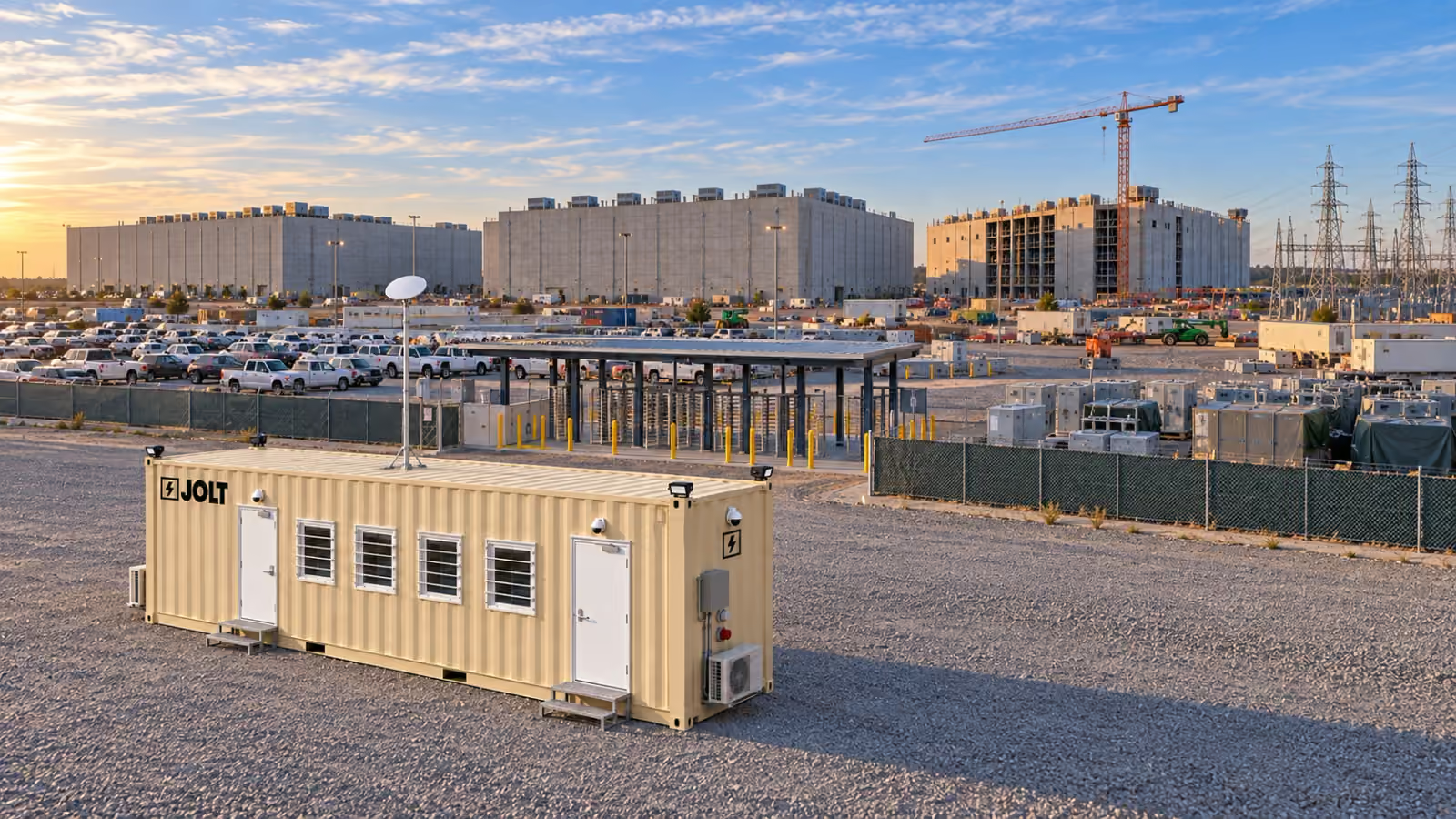
That is the demand JOLT built The Grid Command for: a 40 ft container office that lands in 6–8 weeks anywhere in the country for one price, stacks into a campus, and moves to the next building for $1,250.
How much data center construction started in 2025 by state?
By construction starts in 2025, Virginia led, followed by Louisiana, Mississippi and Texas, according to Dodge Construction Network figures reported by Equipment World. Louisiana and Mississippi sit in the top four because their projects are gigawatt-scale campuses rather than 20-megawatt colocation buildings: Meta's Hyperion in Richland Parish, Amazon's program in Madison County, and Compass's campus at Meridian.
Buildermuse, citing CBRE, put 2026 data center construction spending in the tens of billions, with 5.2 gigawatts of new capacity under construction nationwide and 8.1 gigawatts in planning and permitting. McKinsey's 2025 estimate describes trillions in global data center capital spending by 2030, more than 40 percent of it in the United States and about 70 percent of it by hyperscalers.
Which states are slowing or restricting data centers?
Eleven states were considering a moratorium or restrictions on new data center construction in early 2026, including Vermont, which has 1 operational data center and nothing planned, and New Hampshire, which has 6. Neither has a project under construction or announced. Loudoun County, Virginia, the largest data center market in the world, tightened its noise ordinance and setback requirements in 2025 and has become more cautious about new approvals. Arizona's permitting now weighs water use.
Power is the constraint that matters more than policy. Developers are securing dedicated generation, co-locating gas plants and solar with campuses, and buying disused industrial sites that already have grid connections. Where a utility can commit power on a schedule, the projects follow.
How JOLT serves each market
Every market in the lower 48 gets the same DC Deploy scope and on-site window; the price is quoted per campus in one business day. See nationwide delivery for what the package covers.
Method and sources
State counts are Aterio's U.S. data centers by state as of March 2026, reported by Visual Capitalist. Aterio classes a project as announced when a building permit, utility filing or public announcement exists and as under construction when ground is broken. Construction start dollars by state are Dodge Construction Network figures for 2025 as reported by Equipment World in February 2026. The six-month pipeline is ConstructConnect, February 2026. The active and pipeline counts are the American Edge Project, December 2025. Campus details are from Buildermuse's April 2026 tracker, Blackridge Research's August 2026 project list and Success Knocks' September 2026 rundown, checked against local reporting. Build timelines by state are Buildermuse's contractor-reported ranges. Other trackers count different universes: Electric Choice, for example, tracks 2,100-plus facilities and 620-plus under construction or planned across 47 states as of August 2026; the counts differ because the definitions do. This page is refreshed quarterly; the schema's dateModified is the last refresh.
Read the state counts as classifications, not schedules
The table follows one source and one definition set. The Visual Capitalist presentation of Aterio's March 2026 data says announced status can begin with a permit, utility filing or public announcement. Aterio moves a project to under construction when ground breaks.
That boundary is useful for a national comparison, but it does not tell a contractor when an office is needed. An announced campus may still be resolving power, land use or financing. A groundbreaking may cover early civil work before the building package.
Use the state rank to find markets worth investigating. Then verify the parcel through the permitting authority, utility record and developer announcement.
Monitor the signals that precede mobilization
A permit docket can reveal a real parcel before a public schedule becomes firm. Look for grading, erosion control, road access, utility or building applications under the project entity's legal name. Record the filing date and current disposition rather than treating application as approval.
Utility information needs similar care. A request, study, service agreement and energized load are different milestones. Regional operators also use different processes; consult the applicable operator and serving utility instead of comparing queue labels as though they were national.
Power deserves this scrutiny because national demand is changing quickly. The Department of Energy's data center electricity report uses 2023 as its baseline year. It says data centers consumed about 4.4 percent of national electricity. The projection year is 2028. Its lower estimate is 6.7 percent. The upper estimate is 12 percent.
For the field plan, watch for an awarded civil package, construction entrance, temporary power permit and named general contractor. Those signals are more actionable than a campus rendering. They indicate that gate, pad and office decisions are approaching.
Use a repeatable quarterly verification record
Keep the prior quarter's project list rather than overwriting it. For each campus, record state, county, parcel, developer, evidence URL and classification.
Open every cited source during the refresh. Search results and copied tracker summaries can outlive the underlying filing. If the source no longer supports a project status, mark it unresolved instead of carrying the claim forward.
Separate campus and building records. One campus announcement can contain several planned buildings, while one permit may cover only a specific phase. This distinction prevents a large master plan from being mistaken for simultaneous construction.
Finally, timestamp the dataset as a snapshot. The Aterio table excludes Alaska and includes the District of Columbia. Its rows should be compared within that stated universe, not presented as a permanent inventory of every facility.
Which state has the most data centers under construction?
Texas, with 140 under construction as of March 2026, narrowly leads Virginia with 136, according to Aterio.
Which state has the most announced data centers?
Texas, with 610 announced, then Virginia 498, Georgia 340, Pennsylvania 209, Illinois 153 and Arizona 136.
How many data centers are under construction in the U.S.?
About 620 tracked facilities were under construction or in active planning across 47 states as of August 2026 by one tracker; the American Edge Project counted 2,788 announced or under construction in December 2025.
How long does a data center take to build?
Roughly two years for a single building; 14–20 months in Indiana, Ohio and Iowa, 18–24 in Texas and Arizona, 24–36 in Northern Virginia where utility interconnection is the gate.
Which states received the most data center construction funding in 2025?
Virginia led 2025 construction starts, followed by Louisiana, Mississippi and Texas, according to Dodge Construction Network figures reported by Equipment World.
Where are the largest campuses?
Abilene, Texas (Stargate, 8 buildings); Richland Parish, Louisiana (Meta Hyperion); Effingham County, Georgia (OpenAI Project Camellia, 1,400 acres); Amarillo, Texas (Fermi HyperGrid); Mount Pleasant, Wisconsin (Microsoft Fairwater); New Carlisle, Indiana (Amazon).
Which states are restricting data centers?
Eleven states were considering moratoria or restrictions in early 2026, including Vermont and New Hampshire; Loudoun County, Virginia, tightened noise and setback rules in 2025.
How often is this page updated?
Quarterly, against the Aterio state counts and county filings. The dateModified in the page schema shows the last refresh.
Your delivered price
Pick the unit, rent or buy, and the job ZIP. Monthly rent and the route show as you go; we email the full delivered price with a 14-day lock.
Pick a length
Drawn to scale, side view.
Step 1: Unit
The Grid · Command
Which 40 ft?
Step 2: Rent or buy
12-month starting term for project quotes.
Step 3: Job ZIP
Delivery and pickup: quoted for your site.
Step 4: Send it
Request a written delivered quote from the project desk.
Step 5: Your project quote
- JOLTSite offices for data center construction. Nationwide.
- DataCenterProductNationwide Grid Command: badge-ready, connected, and ready the day it lands.
- DataCenterGuideNationwide data center site office pricing. All of it.
- DataCenterGuideDC Deploy for any campus in the lower 48.
- DataCenterMarketData center site offices in Texas: The Grid, nationwide.
- DataCenterMarketData center site offices in Virginia: The Grid, nationwide.
- DataCenterMarketData center site offices in Ohio: The Grid, nationwide.
- DataCenterGuideWhat a data center site office costs to rent in 2026.
Talk to a data center specialist.
DC Deploy covers any site in the lower 48.
A deposit holds your delivery window. Cancel free of charge more than 14 days before the first day of the window. Deposits from $85 are applied to your first invoice.