
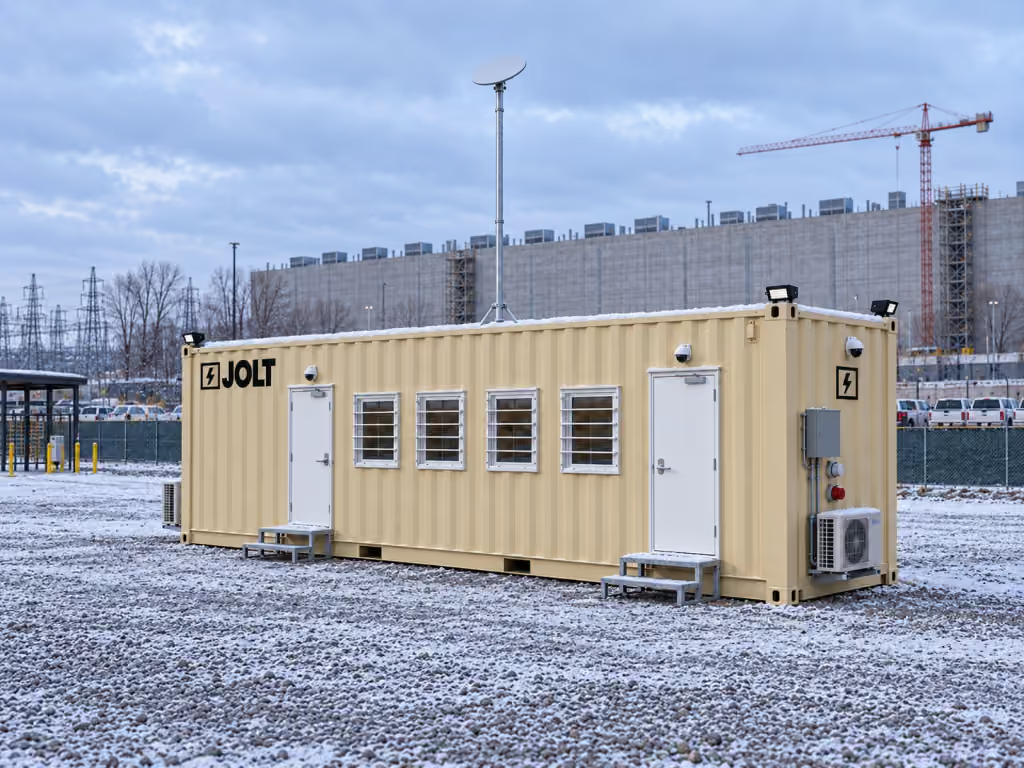
Southeast Wisconsin · Wisconsin
Data center site offices in Wisconsin: The Grid, nationwide.
Wisconsin projects can reserve Grid offices nationwide, with Core from $1,950/mo and DC Deploy to any lower-48 site.
- Market
- Southeast Wisconsin
- DC Deploy
- Quoted per campus
- On-site window
- 6–8 weeks
- Grid Command
- $2,750/mo
- Legal-width loadNo oversize permits
- On site in6–8 weeks
- One invoiceper unit
- Badge-ready
- Stackabletwo-high
- Moves withyour phases

Key facts
- Southeast Wisconsin is the named corridor for 1 Wisconsin market as of .
- The Command the Grid — 40 ft data center site office rents for $2,750 per month as of .
- The reservation deposit on the Command the Grid — 40 ft data center site office is $2,500 as of .
- DC Deploy is scheduled 6–8 weeks after the reservation as of .
Cite this page: "Data center site offices in Wisconsin: The Grid, nationwide." JOLT (Jolt Rents), https://joltrents.com/data-centers/wisconsin/. Last updated September 25, 2026.
Wisconsin has 12 data centers under construction and 28 announced as of March 2026, against 18 operating, a pipeline more than twice its current footprint, driven by Microsoft's Fairwater campus at Mount Pleasant in Racine County, its second campus at Kenosha, the Vantage and OpenAI campus at Port Washington, and Meta at Beaver Dam, according to Aterio.
Wisconsin's data center construction is concentrated in a 60-mile strip along Lake Michigan from Kenosha to Port Washington, on former factory sites and farmland that sit in the lake-effect snow belt, in a state where January reaches 20 below and the ground freezes four feet down. The office program for those campuses is a winter program.
Where are data centers being built in Wisconsin right now?
Mount Pleasant and Racine County. Microsoft's Fairwater campus, on the site originally cleared for Foxconn off Interstate 94, is one of the largest AI data center builds in the world, announced as a multi-billion-dollar project in 2024 and expanded since, with multiple buildings in construction and a substation program to match. It is the state's anchor and the reason the pipeline doubled.
Kenosha. Microsoft's second Wisconsin campus, south of Mount Pleasant on the same I-94 corridor, on We Energies' system.
Port Washington and Ozaukee County. The Vantage Data Centers campus north of Milwaukee, announced in 2025 as a Stargate site for OpenAI and Oracle, planned at about a gigawatt on former farmland near the lake.
Beaver Dam and Dodge County. Meta's campus at Beaver Dam, announced as a billion-dollar project, northwest of Milwaukee on Alliant's system.
Menomonee Falls, Dane County and the rest. Colocation and enterprise builds in the Milwaukee suburbs, and announced campus parcels near Madison and DeForest.
Wisconsin attracts the work with the lake's cooling water and cold air, a data center sales-tax exemption enacted in 2023, We Energies' willingness to build generation for it, and the I-94 corridor's proximity to Chicago's fiber. Phases and names change quarterly; JOLT checks each project against a county filing or local reporting at every refresh of this page.
Which hyperscalers, developers and general contractors are active in Wisconsin?
Microsoft at Mount Pleasant and Kenosha; Vantage, OpenAI and Oracle at Port Washington; Meta at Beaver Dam; QTS and the colocation operators in Dane County and the Milwaukee suburbs.
The general contractors with data center groups working in Wisconsin include Mortenson, which has built hyperscale campuses across the upper Midwest for a decade; Turner; Gilbane; Holder; Clayco; and the Wisconsin builders that grew up on the state's industrial work, JP Cullen, Miron, Findorff and CG Schmidt. A Wisconsin building runs 16 to 22 months from permit to energized, and at least one winter falls inside every one of them; the electrical contractor mobilizes its own office on a generator on a site that was plowed that morning, and the office has to be heated on the day it lands.
What does a Wisconsin data center site office need?
Cold, lake-effect snow, frost and wind off the lake.
Cold. Milwaukee and Racine average lows near 15 degrees in January and see minus 15 to minus 20 in a bad stretch; Beaver Dam and Madison are colder. The Grid carries two 12,000 BTU cold-climate mini-split heat pumps that heat to -13 F, behind R-19 closed-cell foam walls and an R-30 roof.
Lake-effect snow. The Kenosha-to-Port Washington strip sits in Lake Michigan's snow belt: 45 to 50 inches a year, arriving in bands that put a foot on a pad overnight. The customer should keep snow clear of the doors and include the office in the project's winter plan.
Frost. Wisconsin frost depths run 42 to 48 inches. The Grid is leveled on cribbing at its four corner castings, so the compacted bearing surface must drain away from the doors.
Wind. A northeast wind off the lake runs 30 to 45 mph for a day at a time. Every Grid receives four-point anchoring; the owner's engineer and the authority having jurisdiction set any project-specific criteria.
For the bearing surface, power and winter access, use the Grid site-requirements checklist.
How does The Grid get to a Wisconsin site?
The 40 ft high-cube Grid is a legal-width load, moving by flatbed without an oversize permit, route survey or pilot car.
For Wisconsin projects, DC Deploy includes freight, tilt-bed placement or crane set, cribbing and leveling, four-point anchoring, the rough-in walkthrough with the site's electrician and pickup after the term. Read about nationwide delivery.
What does a Grid cost on a Wisconsin data center site?
Wisconsin teams can find published Grid rents, the reservation deposit and available options on the data-center pricing page. DC Deploy is quoted per campus.
Wisconsin sales tax is added where it applies; the state's data center exemption covers the owner's equipment, not a rental office. DC Deploy is quoted for the specific campus.
What is the power picture in Wisconsin and when does temp power land?
We Energies, the WEC Energy Group utility, serves the entire Lake Michigan corridor, Mount Pleasant, Kenosha, Port Washington and the Milwaukee suburbs, and has proposed gas generation and a large-load tariff to carry gigawatts of data center demand; Alliant Energy serves Beaver Dam; Madison Gas and Electric and Alliant serve Dane County. Interconnection on the corridor is set by We Energies' generation program and the Public Service Commission's approvals, and campus schedules follow it.
For a site office, the utility's timeline matters on the day the office lands. On the Mount Pleasant campus, temporary construction service is usually live at the gate before the next building's office arrives; on a greenfield at Port Washington, Beaver Dam or DeForest, the GC's temporary service can trail the first mobilization by two to six weeks, in winter. Grid Command's 50 A generator inlet with a mechanical interlock lets a generator power the office until the electrician gets a 60 A circuit to the pad; the site electrician sizes the generator and confirms the load plan. JOLT's 25 kW standby generator is $1,850/mo plus fuel.
Do you need a permit for a temporary site office in Wisconsin?
In Racine, Kenosha, Ozaukee, Dodge and Dane counties, a temporary construction office is an accessory to the project's building permit and is shown on the site logistics plan with an anchoring detail on file. The Village of Mount Pleasant, the City of Kenosha and the City of Port Washington issue a temporary-structure permit under the Wisconsin Commercial Building Code with a fee, and some ask for the vendor's certificate of insurance. Beaver Dam and the Dane County municipalities fold the office into the project permit.
Confirm the requirement with the authority having jurisdiction named on your building permit before reservation, because a Wisconsin municipality's permit can take two weeks. Bring the municipality's anchoring and insurance requests to the data center specialist before the delivery window.
Coordinate the office pad with Wisconsin stormwater work
On a greenfield campus, the office pad is part of the construction site's drainage problem. The Wisconsin Department of Natural Resources construction stormwater overview says permit coverage applies to construction projects that disturb one acre or more.
That rule does not decide the office's local building approval, but it affects how the pad, access and runoff controls fit the approved site plan. Ask the civil team to mark the proposed office on its current grading and erosion-control drawings. Confirm that cribbing, anchors, electrical routing and pedestrian access do not conflict with a swale, inlet, stabilized entrance or future cut.
Review the pad again before a winter placement. Snow storage can redirect meltwater toward a door or hide a soft edge near a corner casting. Identify where plowed snow will go and keep that area separate from the queue, generator location and delivery approach.
Treat a later office move as another civil coordination point. The next pad may sit in a different drainage phase even when it is on the same campus. Recheck bearing surface, runoff controls, underground utilities and access rather than assuming the first placement decision transfers.
Ask the utility questions that affect mobilization
The permanent campus load and the temporary office circuit are different work streams. Put both on the mobilization agenda, but assign them separately. The project electrical lead should identify the temporary service source, the date it can be used and the licensed electrician responsible for the Grid connection.
Ask whether the selected office pad remains served after roads, substations or building feeders change phase. A connection that works for the first building may be removed when the compound shifts. Mark the future source on the relocation plan before the existing one is released.
For Command, the electrician should review the 60 A shore inlet and the generator-ready 50 A inlet with mechanical interlock against the site's source and load plan. The 25 kW generator is an available add-on, not a substitute for that review. Confirm fuel management and local operating requirements if it is selected.
Do not tie the office occupancy promise to an assumed utility milestone. Put the intended power source for delivery week in writing, then name the fallback chosen by the project team. Revisit the decision before each move because Wisconsin campus utility work can alter access and connection points.
Run a Wisconsin winter readiness review
Hold the winter review with site logistics and safety. Start with access from the plowed road to the doors. The route should not cross snow storage, an icy drainage path or equipment staging.
Assign snow and ice clearing around both means of egress. Rental Agreement section 12.2 excludes damage from a failure to clear snow or ice from the Damage Waiver. The site should name the responsible team and include the office in its ordinary storm checklist.
Keep exterior equipment and required access clear under the project's safety plan. Do not pile snow against doors, the electrical connection or equipment that needs inspection. Confirm any local fire-access expectation with the authority having jurisdiction.
Inside, Command and Core have two cold-climate mini-split heat pumps rated for heating to -13 F. The site team should still define what it does during an outage and which systems require an orderly shutdown. Product rating does not replace the project's cold-weather emergency plan.
Compare Wisconsin office proposals on one scope
Give every bidder the same county, municipality, site address, placement plan and requested occupancy window. Identify whether the office is for gate security, the general contractor, an owner team or a trade. Those users create different needs for records, visitors, meetings and access control.
Request separate lines for rent, deployment, recurring services, selected options, relocation and end-of-term work. Ask each bidder to identify the approvals that remain with the customer.
For winter work, require the offered building's insulation, heating equipment and utility requirements in writing. Compare those facts with the site electrical plan. Do not accept a generic cold-weather label without the actual offered equipment.
If the campus may move the office, give bidders the expected phase point and destination area. Capture teardown, transport, reset, reconnection and owner-system work. This prevents a stationary trailer price from being compared with a Grid plan that includes relocation.
Finish with exclusions. Snow clearing, sanitation, utility consumption, network administration, site restoration and permit fees can sit outside an office quote. Assign each item before award so the field team does not discover the gap during a January mobilization.
How long is a Wisconsin site office term?
A Wisconsin building runs 16 to 22 months from permit to energized, so a single-building placement is a 12-to-22-month term, and JOLT's 12-month minimum with month-to-month after it fits without a renewal. The Mount Pleasant campus runs years across many buildings, and on it the office moves every 15 to 20 months as a building turns over: one or two $1,250 relocations, not a new mobilization.
For a GC or an electrical contractor running three or more Wisconsin buildings, compare rental with the purchase and 36-month lease-to-own rows on the Grid buy page. For one building, rent.
How do multi-building Wisconsin campuses use a Grid Campus?
A Mount Pleasant campus is built two and three buildings at a time, and the GC's project office, the owner's rep, the electrical and mechanical contractors and the security office all move as buildings turn over. The Grid Campus combines 2 to 12 Grids in a row or stacked two-high, with a Stack Kit stair tower, landing and guardrail at $395/mo plus $1,500 setup for each pair. Relocating one on campus costs $1,250 per move and covers unplugging, unanchoring, lifting by the corner castings, landing, anchoring and reconnecting. A single order of at least 6 Commands receives a 5 percent monthly rent credit for its first 12 months.
Which Wisconsin counties and metros does JOLT serve?
All of them. The counties carrying data center construction today: Racine, which is Mount Pleasant; Kenosha; Ozaukee, which is Port Washington; Milwaukee and Waukesha, which are the Milwaukee suburbs and Menomonee Falls; Dodge, which is Beaver Dam; and Dane, which is Madison and DeForest. Other Wisconsin counties can be quoted too; DC Deploy is quoted per campus in one business day and the window is 6–8 weeks.
Nearby markets with their own JOLT pages: Illinois, Iowa, Indiana, Ohio.
How do I reserve a Grid for a Wisconsin project?
Select a build and submit the Wisconsin ZIP, quantity, target date and job details through the data-center reservation path to receive the delivery window on your confirmation. Cancel in writing more than 14 days before the first day of that window and there is no charge.
How many data centers are under construction in Wisconsin?
Aterio's March 2026 count shows 12 under construction, 28 announced and 18 operating, making the pipeline more than twice the state's current footprint.
Does JOLT deliver site offices anywhere in Wisconsin?
Yes. Wisconsin is covered by DC Deploy's lower-48 service, including freight, placement, leveling, four-point anchoring, the electrical rough-in walkthrough and end-of-term pickup.
How long does delivery to Wisconsin take?
The on-site window for a Wisconsin reservation is 6–8 weeks.
What does a Grid cost in Wisconsin?
Wisconsin rent is $1,950/mo for Core and $2,750/mo for Command, with a 12-month minimum. DC Deploy is quoted per campus in one business day.
Is The Grid built for a Wisconsin winter?
The Grid's R-19 closed-cell foam walls, R-30 roof and two cold-climate heat pumps that heat to -13 F support winter use. Every unit is leveled on cribbing and receives four-point anchoring.
Who is the utility and how does that affect the office?
We Energies serves the Lake Michigan corridor, Alliant serves Beaver Dam, and MGE and Alliant serve Dane County. Command's generator inlet can support the office when temporary power trails mobilization.
Where is Microsoft's Fairwater campus and can JOLT deliver there?
Fairwater is in Mount Pleasant in Racine County, off I-94 on the site originally cleared for Foxconn. The nationwide DC Deploy package covers that Wisconsin site.
How does the Grid handle lake-effect snow and a Racine County winter?
Two cold-climate heat pumps, R-19 closed-cell foam walls and an R-30 roof support cold-weather use. The site should keep snow clear of the doors, maintain a draining bearing surface and follow the project's anchoring requirements.
Your delivered price
Pick the unit, rent or buy, and the job ZIP. Monthly rent and the route show as you go; we email the full delivered price with a 14-day lock.
Pick a length
Drawn to scale, side view.
Step 1: Unit
The Grid · Command
Which 40 ft?
Step 2: Rent or buy
12-month starting term for project quotes.
Renting 12 months or more? Lease-to-own ends with the office yours: $2,795/mo for 36 months.
Step 3: Job ZIP
Wisconsin · Project quote
Delivery and pickup: quoted for your site.
Step 4: Send it
Step 5: Your project quote
- JOLTSite offices for data center construction. Nationwide.
- DataCenterProductNationwide Grid Command: badge-ready, connected, and ready the day it lands.
- DataCenterGuideNationwide data center site office pricing. All of it.
- DataCenterMarketData center site offices in Illinois: The Grid, nationwide.
- DataCenterMarketData center site offices in Iowa: The Grid, nationwide.
- DataCenterMarketData center site offices in Indiana: The Grid, nationwide.
- DataCenterMarketData center site offices in Arizona: The Grid, nationwide.
- DataCenterMarketData center site offices in Georgia: The Grid, nationwide.
Bring The Grid to Wisconsin.
DC Deploy covers freight, set and pickup.
A deposit holds your delivery window. Cancel free of charge more than 14 days before the first day of the window. Deposits from $85 are applied to your first invoice.