A rented generator, fuel runs and noise all day. Our estimate for a Base office run on a generator, with fuel runs, internet and a camera, is $2,308 a month.
What JOLT changes
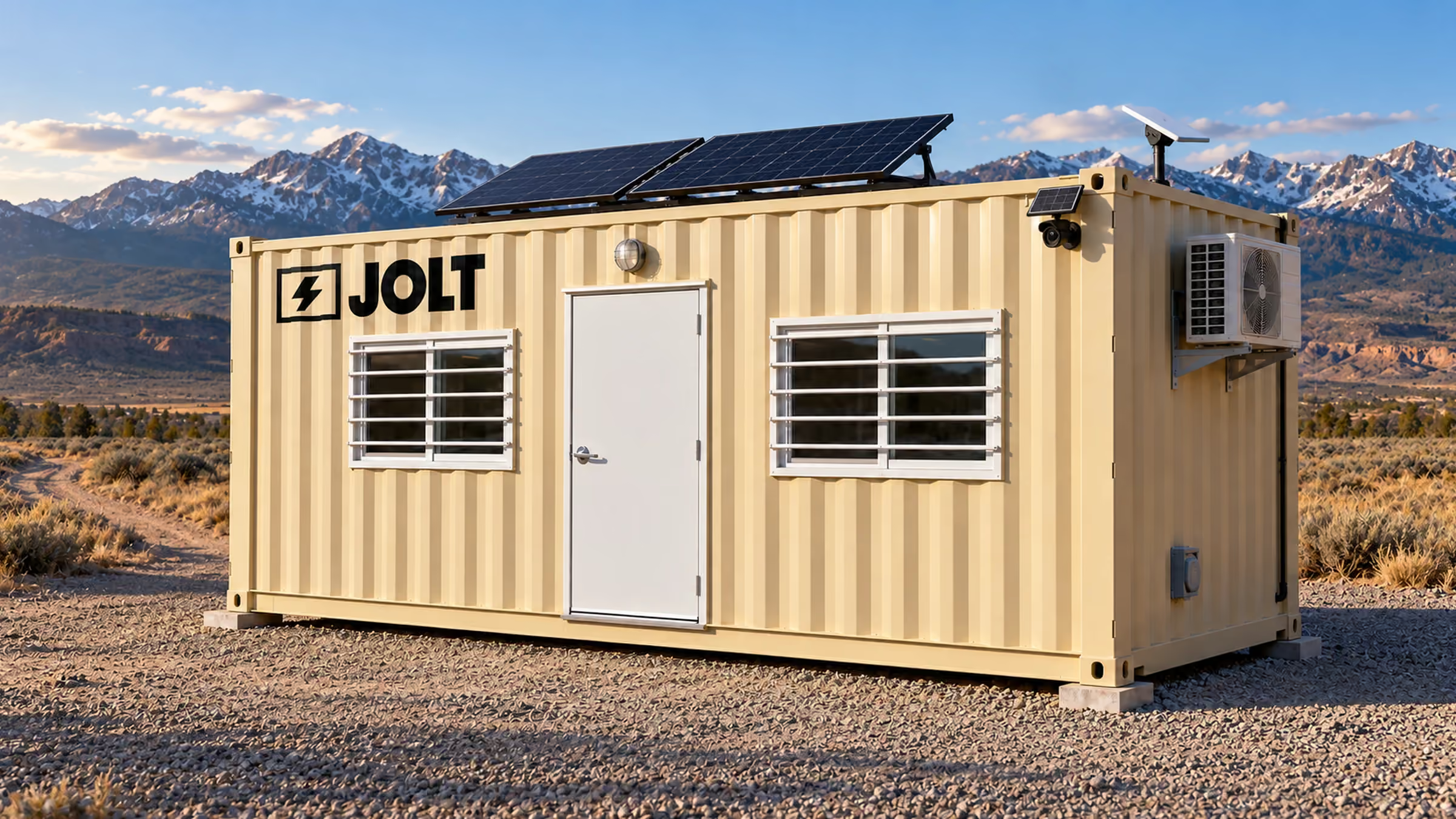
Grid-Free carries roof solar, a 10 kWh battery, Starlink and a camera. The battery runs the heat and A/C. $1,495 a month. Nothing to refuel.
Crews warm up in trucks. Snow buries tools left out. Light runs out early.
What JOLT changes
Mini-split heat in every office. Alpine adds backup heat, an over-roof and a covered entry deck. Steel storage keeps tools dry and locked.
Tools that walk off at night
What it costs you
Equipment theft costs U.S. contractors an estimated $300 million to $1 billion a year (National Equipment Register and NICB). Most of it is never recovered.
What JOLT changes
One-trip steel storage with a welded lockbox. WATCH adds a solar LTE camera with motion alerts for $129 a month. It comes built in on Grid-Free and Alpine.
Nowhere to meet the owner or the inspector
What it costs you
Walkthroughs happen on a tailgate. Plans ride on a truck seat.
What JOLT changes
A clean, lit office with a plan table (READY), Starlink for plans, email and video calls, and your logo on the door.
We help you plan the placement. Here is what Utah asks for. Begin with the legal parcel, not your firm's mailing address. A Salt Lake City office and a canyon construction site may have different authorities. Give us the intended footprint, project phase and receiving contact. We can help you choose an office that fits the approved position. Tell each reviewer whether staff will work inside. Describe a separate box as storage. Put the intended site duration on the drawing.
On a private lot
Utah's construction-code statute is a starting reference. Ask the reviewing building official about the adopted edition and local amendments. A municipal job and an unincorporated county job can reach different desks. Ask planning whether a construction office fits the parcel's zoning. Ask building about an occupied temporary structure, utilities, exits and fire access. Show where the office will stand relative to existing buildings. Note the active construction permit if the property has one. A locked storage box may receive a different review.
For a Salt Lake City postal address, confirm whether the parcel lies inside city limits. The Salt Lake City placement page explains city-specific street questions. Ask the city's Planning Division about land use on an actual city parcel. A neighboring county parcel needs its own land-use answer. Send the exact site sketch to whichever office governs. Include the proposed removal date and an occupied-use description. A permitted building project still may need separate review for a field office. Ask whether the approved site plan covers your chosen spot.
Private Utah sites vary sharply in available space. A Wasatch Front infill lot may have parking obligations. A rural highway staging parcel may need a landowner's written approval. On a residential driveway, ask planning about screening, setbacks and accessory use. For a commercial yard, show fire lanes and circulation. Include a utility plan if Base will use shore power. If you choose the bathroom office, describe its services to the reviewer. We can help translate those site constraints into a unit choice. Keep the official's written response with your project documents.
On a street or sidewalk
Identify who owns the Utah road beside the proposed pad. Ask Salt Lake City's Engineering and Transportation offices about a city curb. Describe the exact shoulder, street, sidewalk or alley occupation. Ask whether parking or traffic approvals apply to that use. The adjoining owner may approve its lot without controlling the street. For a state highway, contact its road authority. Another Utah municipality may have a different process. Include any crossing by the transport vehicle in your question. Make public pedestrian access visible on your site drawing.
A Utah highway contract does not itself designate a shoulder as storage. Near Parleys Canyon or Jeremy Ranch, ask UDOT about current restrictions. Ask the project manager where authorized receiving space begins. Temporary traffic measures can change between phases. Mark the contractor gate, not merely the highway interchange. The vehicle operator handles applicable road movement permissions. You and the property owner can identify the approved resting position. If an off-street pad is available, document its approach. We can review the proposed position before the crew stages materials around it.
HOA and deed restrictions
An HOA may have its own Utah appearance and duration conditions. Send its committee the drawing before marking a driveway pad. Ask a landlord for permission if the business leases its lot. Neither private consent nor a construction contract determines municipal zoning. Keep both responses in the site file. Show the Alpine office's matte-black exterior and cedar surrounds if appearance matters. Ask whether a covered entry affects the allowable location. If storage must be screened, show the screening on the plan. Check that the screening leaves the truck approach open.
An easement may cross a promising Utah placement area. Ask the easement holder before occupying that strip. A driveway can also meet a public sidewalk. Draw the transition between private and public ground. Ask the street office about any proposed public-space occupation. Get a specific answer for the intended season and work phase. A temporary office can remain through several changes in site circulation. Keep the unit position compatible with the next contractor's access. We can discuss another approved position if an HOA or owner rejects the first one.
Getting the site ready
Walk from the Utah road to the exact resting pad. Check gate width, overhead lines and space to turn. Prepare a level Utah pad that drains after summer rain. Mark the door orientation and daily pedestrian path. Reserve room around other construction operations. Make sure the Utah contact can direct the unit at the gate. Keep parked trades out of the marked approach. When excavation advances, preserve a way back to the office. Make the eventual retrieval path part of the same site plan.
A 10 ft rental storage unit can fit a constrained position. The 12 ft tool crib has a walk-in man door. A 20 ft cargo-door box suits a wider approved pad. The 40 ft high-cube needs a longer clear approach. An occupied 20 ft office requires another placement discussion. The 40 ft bathroom office calls for more usable length and services. Choose from real turning space, not vacant square footage on paper. Tell us which Utah trades will need the gate later.
Where JOLT fits best
A Utah contractor working through a full construction season may need more than desks. Place the workroom where supervisors can reach the permitted site. Put rental storage where crews can access tools. Arrange temporary fence around the approved working area. A Salt Lake airport-area project may need controlled access for each position. A canyon road project may have limited off-highway laydown. We can plan the office, box and fence around that distinction. Identify the authorized gate and landowner for each footprint.
For a Utah site with usable shore power, compare Base. The Grid-Free office needs no shore connection. Alpine adds a covered entry and backup heat for exposed jobs. A longer approved position may suit an office with a bathroom. These choices respond to different site constraints. A purchased office still needs permission on each new parcel. The 20 ft offices have lease-to-own options. A new project location calls for new placement approval. The rental agreement addresses arranging any rental move.
Built for Utah weather
Salt Lake City International Airport's NOAA 1991–2020 normals show a July average high of 94.0°F. That airport's January average low is 24.2°F. Annual precipitation measures 15.52 inches there. Annual snowfall averages 51.9 inches at that station. A Wasatch canyon pad may experience different conditions. Southern Utah desert work calls for a different site assessment. Ask the local reviewer about the actual parcel's design criteria. Keep snow storage away from doors and required access.
The Base office includes mini-split heating and cooling for a powered Utah pad. An electrician can assess the shore connection. Grid-Free brings solar, Starlink and a WATCH camera into the office. On a Utah pad, its 10 kWh battery runs the HVAC without shore power. Canyon shade and office loads affect solar output. Discuss shaded canyon positions with your site team. Alpine adds a standing-seam over-roof and a covered entry deck. Its backup heat can matter during repeated winter arrivals. Ask the local building official about structural review for the proposed position.
The Salt Lake airport construction timeline describes Phase 4 work on Concourse B-east. It describes a 2026 opening sequence. Contractors on controlled airport land need the facility's gate instructions. Choose an office location that remains approved as phases change. A separate storage box may need its own authorized position. A Base office can serve a prepared powered pad. A Grid-Free office can work where shore power is pending. Neither choice replaces approval from the airport property operator.
Near Parleys Canyon, winter access can shape the office plan. Choose a position where plowing can preserve the entry. Put material storage away from the snow accumulation area. Check whether the contractor gate remains accessible during weather. Ask UDOT about a current traffic plan for a highway assignment. Keep the project owner's authorized laydown boundary visible. A covered Alpine entry is useful to discuss for frequent visits. A 12 ft tool crib can occupy a smaller approved space. Put its man door toward the cleared walking path.
For a Wasatch Front renovation, begin with the usable parcel rather than a statewide forecast. A summer crew may value the Base mini-split on a powered lot. A fall start may reach winter before the work finishes. Reserve a plowed route to the office and storage. If a shared parking lot serves other tenants, sketch their access. Ask the HOA about any visible unit from the street. If the office moves to another Utah project, revisit zoning there. Keep the receiving team informed about any phase change. We can adjust the unit choice to that confirmed site plan.
How we built this page: rent, upgrade and delivery figures come from the JOLT catalog at build time. Permit, street, HOA and weather facts are linked to their sources in the text. Written and reviewed by Lisa Tanner.
Every 20 ft office has heat and A/C, lights, outlets, a vinyl-plank floor, a 36-inch steel door and two barred windows. Grid-Free adds roof solar, a 10 kWh battery, Starlink and a camera. Offices rent from $795 a month.
Can the office run before the site has power?
Yes. Grid-Free runs its heat and A/C, lights, outlets and Starlink from roof solar and a 10 kWh battery. Output depends on sun and load. It rents for $1,495 a month.
Can we put our logo on it?
Yes. BRAND applies your logo in 24 by 48 inch vinyl on two sides of the unit. $450, one time.
Do I need a permit for a jobsite office in Utah?
Possibly; the Utah building official and planning desk for your parcel can identify the approvals. Utah's construction-code statute provides the starting code framework, while local amendments and land use require an address-specific answer. Tell the reviewers whether people will work inside, how long the office stays, and which utilities are planned.
Can the office sit on a Utah street?
Only with permission from the Utah road owner for that exact public-space use. In Salt Lake City, ask Engineering and Transportation about the proposed curb, sidewalk, shoulder or alley. A planning answer for the adjacent private parcel addresses different land. We can help you show each office the footprint and intended access.
What does the site need before delivery?
A firm, level pad, a clear path for the truck, and a person on site to show the driver where it goes. Tell us about gates, slopes and overhead lines when you ask for the quote.
How much does delivery to Utah cost?
Delivery to Utah is $3,495 per 10,12 or 20 ft unit and $5,495 per 40 ft unit, each way (Mountain West). Pickup is the same fee, and both legs are billed with the first invoice. Rent is published: offices from $795 a month, storage from $225.
How long can we rent, and can we buy?
Rentals delivered outside Colorado start at 12 months. You can also buy an office outright or lease-to-own a 20 ft office over 24 or 36 months.
Reserve your Utah office.
Offices from $795 a month
A deposit holds your delivery window. Cancel free of charge more than 14 days before the first day of the window. Deposits from $85 are applied to your first invoice.