A rented generator, fuel runs and noise all day. Our estimate for a Base office run on a generator, with fuel runs, internet and a camera, is $2,308 a month.
What JOLT changes
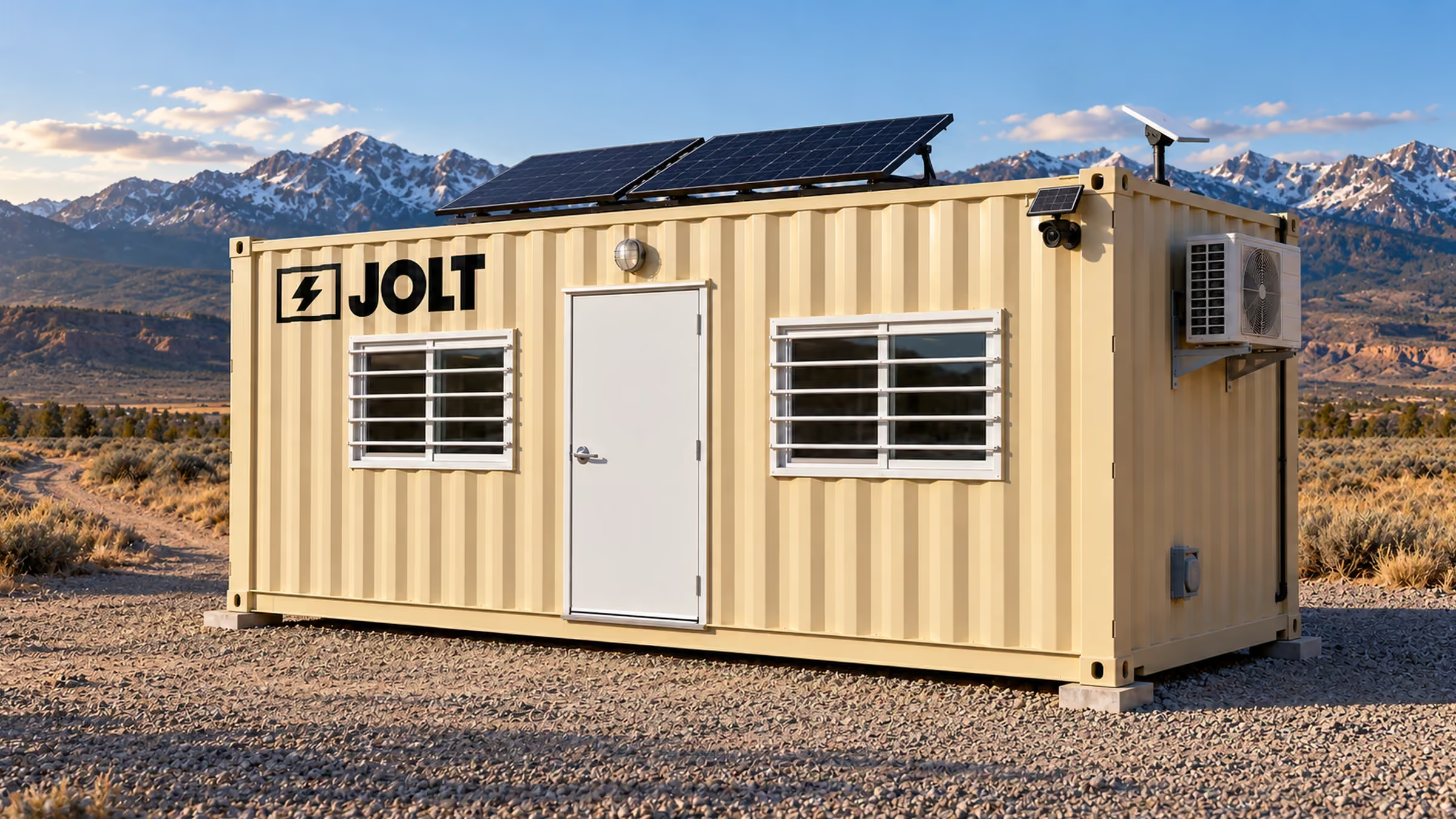
Grid-Free carries roof solar, a 10 kWh battery, Starlink and a camera. The battery runs the heat and A/C. $1,495 a month. Nothing to refuel.
An uncooled container gets hotter than the air outside. Crews retreat to idling trucks.
What JOLT changes
Every JOLT office has a mini-split. Grid-Free runs it from solar and a 10 kWh battery; output depends on sun and load.
Tools that walk off at night
What it costs you
Equipment theft costs U.S. contractors an estimated $300 million to $1 billion a year (National Equipment Register and NICB). Most of it is never recovered.
What JOLT changes
One-trip steel storage with a welded lockbox. WATCH adds a solar LTE camera with motion alerts for $129 a month. It comes built in on Grid-Free and Alpine.
Nowhere to meet the owner or the inspector
What it costs you
Walkthroughs happen on a tailgate. Plans ride on a truck seat.
What JOLT changes
A clean, lit office with a plan table (READY), Starlink for plans, email and video calls, and your logo on the door.
We help you plan the placement. Here is what Arizona asks for. In the Valley, establish parcel jurisdiction before consulting a municipal permit desk. Phoenix, Tucson and neighboring Valley municipalities each review their own land. Ask the project owner who issued the active construction permit. Show that office a drawing of the proposed occupied unit. We can help compare footprints against the approved work area. Tell the desk whether storage will occupy another position. Keep the answers beside the site drawing as construction advances.
On a private lot
Phoenix's 2024 building construction code took effect August 1,2025. Ask Phoenix's building official how an occupied temporary office is reviewed. Bring its proposed location, intended use and electrical plan. The Phoenix temporary-use guide describes administrative applications and written stipulations. It says temporary uses cannot reduce required parking. Draw existing parking spaces before allocating an office pad. Show Planning where people already enter and leave the Phoenix parcel. Ask whether the site's current permission covers a separate storage box. A service yard and a residential driveway can raise different questions.
For Tucson, ask the Planning and Development Services building-code desk for the adopted provisions. Ask about the occupied office rather than treating a tool box as identical. Tucson's portable-storage interpretation concerns storage and accessory structures. Ask whether that interpretation reaches the proposed parcel and use. Explain any planned relocation within the property. Give the desk the precise placement and length of use. We can compare a 12 ft crib with a 20 ft storage box after those limits are clear.
The other Valley cities have their own decisions. A site in Mesa needs Mesa's review, even when its crew also works in Phoenix. The same separation applies in Chandler, Gilbert, Glendale and Scottsdale. Ask the parcel's building desk about occupied use. Ask its planning desk about the pad, parking and temporary use. For an Arizona county parcel, identify the actual governing office first. A city-name mailing address cannot settle the jurisdiction. Keep the owner's parcel number handy during those conversations.
On a street or sidewalk
Phoenix Street Transportation's revocable-permit guidance discusses small removable temporary structures. It considers encroachments individually. Describe the proposed occupied unit, curb location and duration to Phoenix staff. An unloading stop and a stationary office are separate requests. Mark the sidewalk and travel lane beside the proposed position. Keep the authorized private pad on the drawing as another option.
In Tucson, ask Transportation and Mobility about public-space approvals. Explain whether work affects a city street, sidewalk or alley. Give Traffic Engineering the actual road segment and expected activity. Ask Phoenix separately about any Phoenix street proposal. Ask Glendale about the particular Glendale sidewalk. Ask the city controlling the surface before reserving any public space. For I-10 work, ask the project owner about authorized staging outside active traffic. Ask the Arizona parcel's building official about occupied office placement.
HOA and deed restrictions
An Arizona property owner may impose separate limits on a temporary building. Ask the owner about a commercial park's covenants before marking the pad. On a Phoenix subdivision job, review the association's appearance requirements. On a Tucson driveway, ask whether the deed limits visible storage. Keep any landlord's written consent alongside municipal approvals. Show the actual Alpine exterior if an Arizona design board asks. For an Arizona design review, describe Alpine's matte-black mountain envelope and cedar surrounds. Its covered entry deck also occupies space on the placement drawing. An approved appearance still leaves the occupied-use decision with the local authority.
Ask about easements before selecting the quietest corner of a Valley lot. A parking agreement may reserve a space the contractor expected to use. A Glendale business park may control shared access independently of the city. In Phoenix, temporary use cannot reduce zoning-required parking under the city guide. Sketch both existing parking and the proposed office rectangle. Ask the property manager whether materials may remain beside it. We can help choose a smaller storage box when the permitted area is narrow. Record any association deadline separately from the construction schedule.
Getting the site ready
Mark a firm, level, drained pad at the Arizona worksite. Show the pad on the same drawing used for permit questions. Leave a clear approach through the property's authorized gate. Note overhead lines, tight turns and nearby parked vehicles. Check where summer runoff crosses the intended landing area. Ask the site electrician about a 50-amp connection for Base. An Arizona bathroom-office pad also needs service planned around its 50-amp inlet. Draw its larger position without crowding required parking. Note the contact authorized to point out the marked spot. Preserve access as trenches, paving or material piles shift during the project.
Choose storage around the actual room left on the parcel. For a Valley lot, the 10 ft box brings a long-side man door and barred window. The 12 ft crib also has a man door and barred window. A 20 ft one-trip unit gives a Valley materials site cargo doors, four lock bars and a welded lockbox. The Arizona 40 ft high-cube, 9 ft 6 in tall, needs its own marked pad. In an Arizona service yard, mark each separate rectangle before deciding on size. Keep circulation paths visible beside the boxes. Check the property's drainage after a summer storm changes the ground.
Where JOLT fits best
An extended Phoenix airport-area job needs a stable place for field administration. Its materials also need an authorized storage position. We can discuss an office and locked storage from the same fleet. At Tucson's I-10 work, ask the owner which staging parcel lasts across phases. Choose the office pad around that approved location. A Valencia Road crew may prefer a walk-in tool crib near its work area. A long Valley subdivision build could pair Base with a 20 ft lockbox. Tell the project desk which units the Tucson and Phoenix portions each need. Plan their separate footprints before a future phase changes access.
Phoenix Sky Harbor's Terminal 3 second north concourse is a useful example of multi-phase work. The airport describes roughly 173,000 square feet and six additional gates. It expected completion in 2027. An airport contractor can ask its operator about the assigned work parcel. ADOT's I-10 Kino-to-Country Club project includes interchange and widening work. Tucson's Valencia Road improvements include drainage and pedestrian facilities. These projects call for different authorized staging positions. The published project names alone cannot identify your own pad.
Outside the metros, ADOT's State Transportation Improvement Program lists federally funded projects. Ask the owner for the actual current phase and construction address. A planned Arizona program may not yet have an occupied staging parcel. We can compare a Grid-Free office with Base once power is known. A bathroom office can suit a longer program with space for utilities. Choose the storage size after the owner identifies the permitted area.
Built for Arizona weather
Arizona work spans different outdoor conditions. NOAA's Phoenix Sky Harbor normals put July's average high at 106.5 °F. The same series gives a January average low of 46.0 °F. Its annual precipitation normal is 7.22 inches. Those airport figures help plan Phoenix-area work, not every Arizona parcel. The National Weather Service's Tucson monthly normals put July's average high at 100.2 °F. Tucson's January average low is 40.8 °F. Its annual rainfall normal is 10.61 inches. A Tucson summer pad therefore deserves particular drainage attention.
For a powered Phoenix-area site, Base has mini-split heat and cooling. On that Phoenix pad, the 50-amp shore-power inlet needs a planned connection. Ask the electrician to consider the office's expected use. On an Arizona parcel awaiting shore power, Grid-Free includes POWER solar. It also includes a WATCH camera and CONNECT Starlink. Grid-Free's 10 kWh battery pack runs HVAC at that Arizona parcel. For an Arizona solar office, output depends on sun and load. Compare that operating plan with the site's daily schedule. Keep the outdoor access route usable during July work.
Tucson's rainfall pattern deserves a different plan from Phoenix's annual total. Draw a path around low spots on a Tucson staging parcel. Keep materials away from the runoff route. For southern Arizona road crews, the 12 ft crib can offer walk-in tool access. A 20 ft lockbox suits a larger approved materials area. Neither choice changes the site's drainage requirements. Check where construction grading will send water as each phase ends.
For a colder Arizona project, Alpine adds backup heat to Grid-Free. It also adds a standing-seam over-roof and covered entry deck. Discuss the actual pad with the local building official. A covered entry still needs room within the approved position. The 40 ft bathroom office brings mini-split heating and cooling to a larger office. Ask the project owner about its utility plan and placement space. Across Arizona, use the airport weather figures as planning context. Match the unit to the power arrangement and the parcel's approved location.
Arizona's two airport weather records point to different summer planning conversations. In Phoenix, ask when the site's electrical connection becomes available. In Tucson, ask where July rain leaves standing water. At a Phoenix service lot, mark shade along the pedestrian approach. At a Tucson road site, mark the higher ground for foot access. Check which gate remains usable after a Tucson monsoon storm. Tell the Arizona project owner when changing grades affect that gate. Ask the Phoenix superintendent to revisit the pad after paving. Show Tucson Planning a revised position if the office must move. Keep the Valencia materials box away from a new drainage cut. Compare a Phoenix Base position with its planned shore connection. Compare a Tucson Grid-Free position with its expected solar exposure. Use the Sky Harbor temperature figures to discuss work schedules, not office ratings. Use the Tucson rain figures to inspect the walking approach. Both Arizona reviews start with the parcel's actual conditions.
How we built this page: rent, upgrade and delivery figures come from the JOLT catalog at build time. Permit, street, HOA and weather facts are linked to their sources in the text. Written and reviewed by Lisa Tanner.
Every 20 ft office has heat and A/C, lights, outlets, a vinyl-plank floor, a 36-inch steel door and two barred windows. Grid-Free adds roof solar, a 10 kWh battery, Starlink and a camera. Offices rent from $795 a month.
Can the office run before the site has power?
Yes. Grid-Free runs its heat and A/C, lights, outlets and Starlink from roof solar and a 10 kWh battery. Output depends on sun and load. It rents for $1,495 a month.
Can we put our logo on it?
Yes. BRAND applies your logo in 24 by 48 inch vinyl on two sides of the unit. $450, one time.
Do I need a permit for a jobsite office in Arizona?
An Arizona jobsite office may need local approval for its occupied use. Phoenix Planning and Development reviews temporary uses and building questions under its adopted code; Tucson Planning and Development Services can explain its own rules. Give the appropriate parcel's building official the proposed position and electrical plan.
Can the office sit on a Arizona street?
Only the authority controlling an Arizona street can authorize an office there. Phoenix Street Transportation considers removable encroachments individually; Tucson Transportation and Mobility can answer Tucson street-use questions. Tell that office whether your proposal involves a brief unloading stop or a stationary occupied unit.
What does the site need before delivery?
A firm, level pad, a clear path for the truck, and a person on site to show the driver where it goes. Tell us about gates, slopes and overhead lines when you ask for the quote.
How much does delivery to Arizona cost?
Delivery to Arizona is quoted per project. We route the unit from the nearest JOLT source yard and send a written delivered quote within one business day. It holds for 14 days. Rent is published: offices from $795 a month, storage from $225.
How long can we rent, and can we buy?
Rentals outside the Rockies start at 12 months. You can also buy an office outright or lease-to-own a 20 ft office over 24 or 36 months.
Start your Arizona project quote
Offices from $795 a month
Pick the office, the term and the job ZIP. You get a written delivered quote within one business day, and it holds for 14 days.