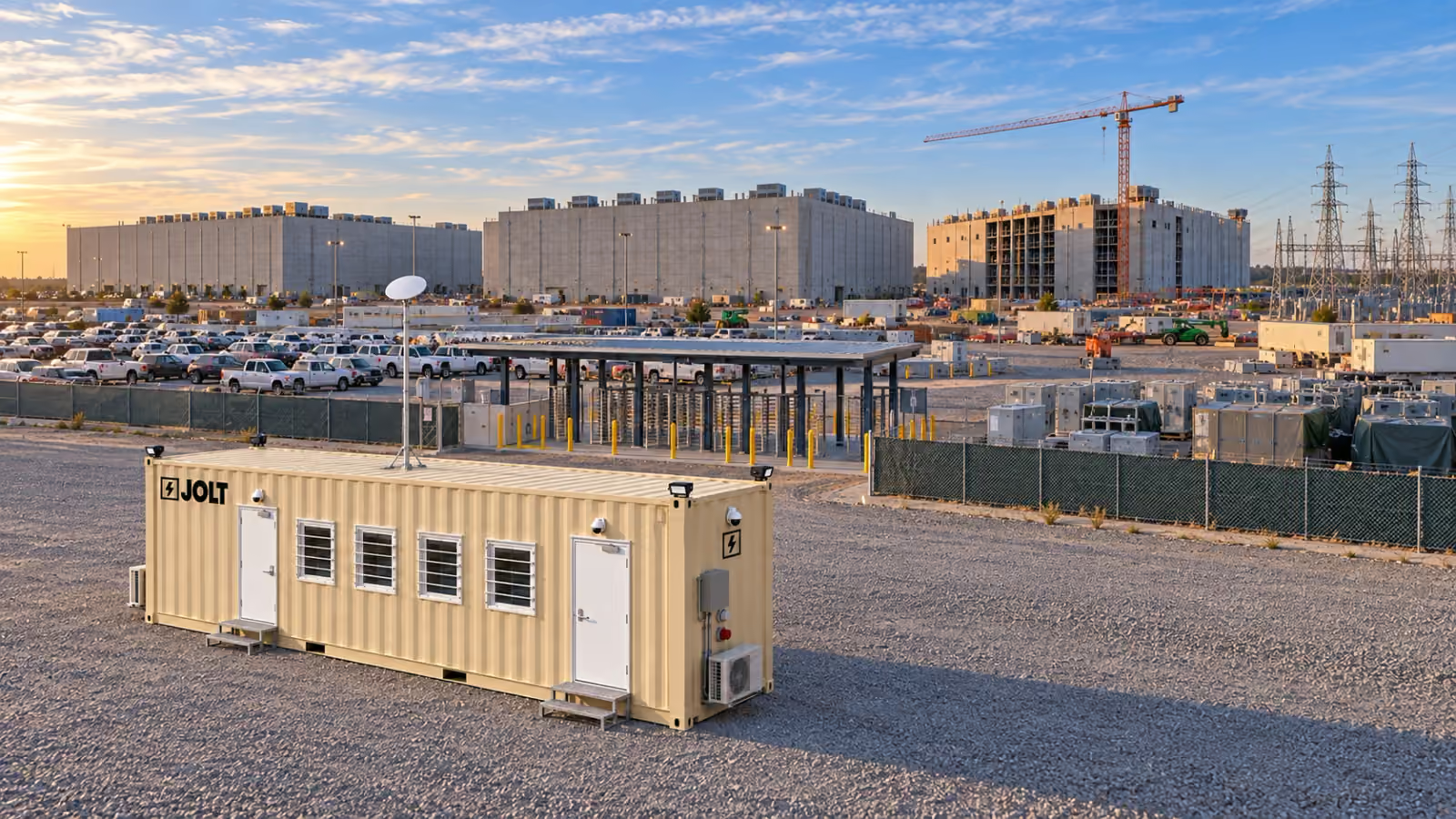
JOLT rents The Grid, a 40 ft high-cube container site office, to data center construction sites in all lower-48 states. One chassis comes in two builds, Grid Core and Grid Command.
That is the whole offer. One chassis. Two builds. Every rent is on the pricing page. DC Deploy is quoted per campus.
What does a data center construction site need from a site office?
A data center campus is not a normal jobsite. A single hyperscale building runs 18 to 36 months. A campus runs five years. At peak, thousands of workers badge through one gate every morning. The owner has a security program. The general contractor has a logistics plan. Every trade has its own office, and the offices move as the work moves from Building 1 to Building 4.
The office has to do six things on day one. It has to lock, with door hardware the owner's access-control vendor can use. It has to have eyes on both doors. It has to be online before the site fiber exists. It has to hold heat at 10 below in Wisconsin. It has to run when the only power on site is a generator. And it has to move, on a truck or under a crane, without a rebuild.
A standard office trailer does none of those things without four vendors and a month of phone calls. Grid Command does all six as delivered.
What is The Grid?
The Grid is a one-trip 40 ft high-cube ISO container, 40 ft long, 8 ft wide and 9 ft 6 in tall, built into a 320-square-foot site office.
The envelope is R-19 closed-cell foam in the walls and R-30 in the roof, behind FRP-over-gypsum interior walls and a luxury vinyl plank floor. Two steel personnel doors provide two means of egress, and four slider windows carry steel security grates.
Power comes through a 100 A panel and shore inlet. Two cold-climate mini-split heat pumps serve the room. Cat6A runs to workstation drops from a wall rack with a patch panel and a Wi-Fi 6 access point.
That is Grid Core. It ships with four workstations, an 8 ft plan table, a whiteboard wall, a plan rack, four chairs, exit signs, emergency lighting, smoke and CO detection, an extinguisher and a first-aid kit.
Grid Command is the same chassis with the things a data center GC otherwise buys from several vendors. Both doors are ready for the owner's badge vendor. Four IP cameras record to an onboard NVR and send motion alerts over LTE. Starlink gives the office internet when it lands, then becomes the failover when site fiber goes live. A generator inlet lets a generator power the unit before temp power exists. Inside are six workstations, a conference and plan table, a display, lockers, and a coffee counter with a mini-fridge and microwave. Your logo goes on two sides.
Why a 40 ft container instead of an office trailer on a data center campus?
Width. A Grid is a legal-width load. It moves on a flatbed, with no oversize permit, pilot car or daylight-only restriction. A 12 ft wide office trailer needs an oversize permit, and a 24 ft double-wide moves as two permitted loads and gets joined on site.
Setup. A tilt-bed truck or crane sets a Grid on cribbing, anchored at the four corner castings. There is no skirting, no tie-down straps, no steps to build and no piers to pour. It sits on a compacted pad and needs no foundation.
Steel. The walls, roof, floor and doors are steel. On a campus with thousands of workers and a laydown yard full of copper, the office is a building controlled by its locks and, on Command, the owner's badge system.
Stacking. Grids stack two high on twist-locks with a Stack Kit, a stair tower, landing and guardrail at $395/mo plus $1,500 per stacked pair. A 12-unit Grid Campus fits in the footprint of three double-wides.
Moving. When the work leaves Building 1, the office lifts by its corner castings and lands beside Building 3. On-campus relocation is $1,250 per move. A trailer complex is torn down, re-permitted, re-hauled and re-set.
The trailer wins on one thing: floor area per unit. A 12 by 60 trailer is 720 square feet. A Grid is 320. For a 40-person project team, that is why the answer is a Grid Campus, not a single Grid. For a four-to-six-person office, the Grid is the right size.
How much does a data center site office cost from JOLT?
Core, Command, deposits, terms and add-ons are listed together on the data center pricing page.
How does JOLT deliver to every state from Colorado?
DC Deploy covers freight, placement, setup walkthrough and pickup to any lower-48 site; see nationwide delivery.
Who on a data center build reserves a Grid?
The general contractor reserves a Grid Campus for the project team, usually four to twelve Command units stacked two high beside the main gate, and assigns units to the owner's rep and the trades. The electrical contractor, the largest trade on any data center build, reserves its own Command with a generator, because it mobilizes before the first temp panel is energized. The mechanical contractor reserves a Command near the central plant. The owner's representative and the commissioning agent reserve a Command of their own so the owner's network and drawings stay on the owner's side of the fence. The security contractor runs the gate out of a Command with its four cameras and LTE alerts.
Each unit is its own subscription with its own invoice. The GC does not carry the subs' offices on its job cost, and a sub does not wait for the GC to order.
Where is JOLT delivering right now?
Everywhere in the lower 48, and first to the places where the work is. Aterio's March 2026 count shows active construction across the leading markets, including Texas, Virginia, Georgia, Ohio, Arizona, Nevada, Indiana and Mississippi.
If your project is in another state, the lower-48 delivery coverage and standard window are the same.
What happens between reservation and delivery day?
Before delivery, confirm the pad, truck approach and power drop with the data center specialist; the site requirements page lists what the pad needs, and the on-site window is 6–8 weeks.
On delivery day, the unit is placed, leveled and anchored, and the electrical rough-in is reviewed with your electrician. The monthly subscription starts the day of delivery.
After month 12, the unit can stay as long as the project does, at 5% more per year. When the work changes buildings, you can request relocation. End-of-term pickup is included in DC Deploy.
What does one invoice per unit look like?
One subscription per Grid includes rent, any add-ons, the 12% damage waiver and the 5% environmental fee, on ACH auto-pay, with a 12-month minimum term and a 5% escalator written into the schedule. The alternative protection is a refundable deposit of one month's rent plus a COI naming the lessor of record as loss payee.
After credit approval, a general contractor with a signed master rental agreement may use a PO and net-30. Other accounts use ACH auto-pay.
Choose Core or Command from the site-services plan
The choice begins with what is ready at the proposed pad. Core fits a four-person team when the site already supplies power, fiber, network administration and perimeter security. Command fits a six-person team when the office needs badge-ready doors, built-in WATCH, CONNECT as backup to site fiber, or the dedicated generator inlet.
Ask four owners for a written answer. The electrician should identify the source and readiness date for power. The network lead should describe the fiber handoff and active equipment. Security should say whether the proposed pad is inside existing coverage. Site logistics should approve the placement and delivery approach.
If any answer depends on a future campus milestone, compare that milestone with the target office date. Command can resolve specific gaps that are in its included scope. It cannot replace the customer's site planning, utility work, network governance or access-control vendor.
Use a first-office and second-office decision path
The first office usually arrives while the site is still becoming a workplace. Roads, gates, temporary electrical distribution and communications may all be moving targets. Procurement should select that first unit against the mobilization condition, not against the services shown for the completed campus.
Command is the stronger first-office candidate when site fiber is not available, the office must participate in the access-control plan, the team needs the included cameras or the electrician needs the dedicated generator connection. Confirm the load plan and connection with the site electrician. Confirm reader hardware and programming with the access-control vendor.
The second office deserves a fresh decision. If the gate now controls the work zone and fiber and shore power reach the new pad, Core may cover the next team's needs without duplicating Command systems. If the second unit is remote from those established services, Command may still be the appropriate build.
List the selected options separately. Accessibility needs belong in the request rather than in a note added after placement. A Stack Kit applies to a full stacked pair. A workstation pack changes the interior use, so the team should approve the working arrangement before it is ordered.
Include the expected phase duration without guessing an end date. The minimum term is 12 months, and the Rental Agreement term provisions govern renewal, early termination and anniversary adjustments. Procurement can then compare a common period across written offers.
Separate recurring charges from one-time items and refundable protection alternatives. Use the pricing page for current Grid lines rather than carrying a copied figure into a bid sheet. Ask every other supplier to identify delivery, placement, setup, furniture, data cabling, protection and pickup on the same basis.
A complete packet also states what the customer supplies. Typical headings include pad and access, temporary power, upstream network, permits, site security and project-specific engineering criteria. This prevents an office quote from being mistaken for a complete temporary-facilities plan.
Place offices according to the phase plan
Start with a simple map of people, decisions and traffic. The project executive may need proximity to the owner. The field superintendent may need a view of daily operations. A commissioning group may need quiet document-review space. The gate team has a different relationship to visitors and deliveries.
Mark the first useful location and the likely next location. Check both for approved access, bearing surface, drainage, power and network routes. A move that looks short on a campus drawing can cross a controlled gate, an active haul road or a utility work area.
Then identify the trigger for moving. It might be turnover of a building, loss of the current laydown area or a team shifting to another phase. Tie the decision to a project milestone so logistics can plan the requested on-campus relocation before the old pad becomes unavailable.
For a group of units, decide whether a row or stacked arrangement fits the current constraint. A row simplifies direct ground-level access to each office but uses more land. Stacking uses a Stack Kit for each full pair and concentrates circulation at the stair tower and landing. The project should review accessibility, egress and AHJ requirements for the selected arrangement.
Keep department assignments current. A unit that began as the GC conference room may become an owner closeout room later. Record any change in users, keys, badge access, network policy and document custody instead of treating relocation as only a physical move.
Build an office scope sheet before comparing vendors
Use one page with five boundaries: unit, deployment, site work, technology and commercial terms. Under unit, record floor area, workstation count, doors, windows, comfort equipment, electrical distribution, data cabling, furniture and life-safety items that must be included.
Under deployment, ask who provides freight, placement, leveling, anchoring, the electrical rough-in discussion and end-of-term pickup. DC Deploy includes those listed services for a Grid. A competing quote should say whether each item is included, excluded or separately priced.
Under site work, assign the prepared location, route access, utilities, permitting and any local review. Under technology, separate the included cabling and rack from the customer's fiber, active network and security administration. For Command, record how the access-control vendor will use the badge-ready pathways and included door hardware.
Under commercial terms, compare the same use period, protection choice and selected options. Read cancellation timing against the written-notice rule, not a sales summary. Read site access and customer preparation duties in the delivery provisions.
The result should let an approver find every responsibility without searching email. It also gives the superintendent a field reference for the pad, service owners and selected configuration after the purchase order is complete.
How do I reserve a Grid?
- 01
- 02
Enter the project
Enter the site ZIP, quantity, target date and project details.
- 03
Choose the configuration
Select add-ons and protection for each unit.
- 04
Pay the deposit
Pay $2,500 per unit, applied to the first invoice.
- 05
How much does a data center site office cost to rent from JOLT?
Grid Core is $1,950/mo and Grid Command is $2,750/mo on a 12-month minimum. DC Deploy covers freight, set, leveling, anchoring, an electrical walkthrough and pickup. It is quoted per campus in one business day.
What is The Grid?
The Grid is a one-trip 40 ft high-cube shipping container, 40 ft by 8 ft by 9 ft 6 in and 320 square feet, built into a site office. Core has four workstations, while Command adds badge-ready doors, four cameras and Starlink.
Does JOLT deliver to every state?
JOLT delivers to all lower-48 states. DC Deploy includes freight, tilt-bed placement or crane set, leveling, four-point anchoring, an electrical rough-in walkthrough and end-of-term pickup.
How fast can a Grid be on site?
The standard on-site window is 6–8 weeks from reservation.
Can Grids be stacked or joined?
Yes. Grid Campus places 2 to 12 units in a row or stacked two-high with a Stack Kit at $395/mo plus $1,500 per stacked pair.
What does a Grid need from the site?
A Grid needs a suitable level pad, clear truck or crane access and the specified shore-power connection. Command can use its generator inlet before temp power lands.
Can the site office move when the project moves to the next building?
Yes. On-campus relocation is $1,250 per move. A Grid lifts by its corner castings, so it moves with the project phases instead of being rebuilt.
Do you offer PO and net-30 terms for general contractors?
Yes. PO and net-30 are available to general contractors on a signed master rental agreement after credit approval; otherwise payment is by ACH auto-pay.