
Data center guide · Nationwide
Hyperscale, colocation, edge: what each build needs from a site office.
What hyperscale, colocation and edge builds need from a site office, with Core $1,950/mo and Command $2,750/mo.
- Grid Core
- $1,950/mo
- Grid Command
- $2,750/mo
- DC Deploy
- Quoted per campus
- On-site window
- 6–8 weeks
- Legal-width loadNo oversize permits
- On site in6–8 weeks
- One invoiceper unit
- Badge-ready
- Stackabletwo-high
- Moves withyour phases

Key facts
- The Core the Grid — 40 ft data center site office rents for $1,950 per month as of .
- The reservation deposit on the Core the Grid — 40 ft data center site office is $2,500 as of .
- The minimum rental term on the Core the Grid — 40 ft data center site office is 12 months as of .
- Grid delivery window is 6–8 weeks after the reservation as of .
Cite this page: "Hyperscale, colocation, edge: what each build needs from a site office." JOLT (Jolt Rents), https://joltrents.com/data-centers/hyperscale-colocation-edge/. Last updated September 17, 2026.
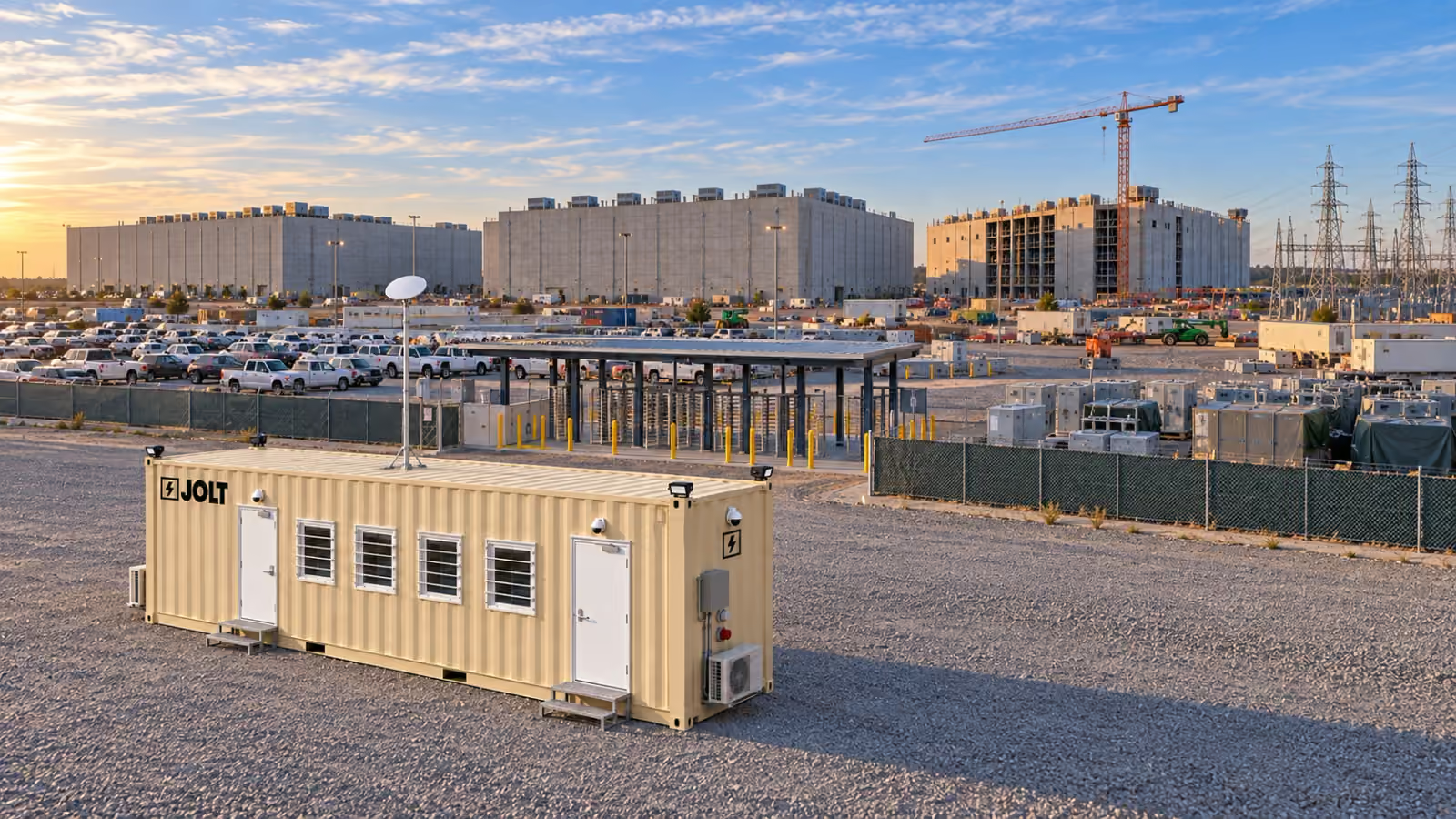
A hyperscale campus, 100 megawatts and up with two thousand to five thousand workers at peak, runs a Grid Campus beside the gate plus the trades' own offices; a colocation build, 10 to 60 megawatts with 400 to twelve hundred workers, runs one or two Grid Commands; an edge or modular deployment, 1 to 10 megawatts with 30 to 150 workers, runs one Grid Core. All three can deploy to any lower-48 site.
"Data center" covers a fourteen-hundred-acre campus with its own gas plant and a prefabricated module on a slab behind a cell tower. The site office program for each is different by an order of magnitude, and the mistake most site logistics managers make is to size the office to the building instead of to the crew and the schedule. This page sizes it to the crew and the schedule.
What are the three kinds of data center build?
Hyperscale. A campus owned or leased long-term by one operator, Amazon, Microsoft, Google, Meta, Oracle, OpenAI through Stargate, at 100 megawatts to several gigawatts, in buildings of 200,000 to a million square feet, four to twelve of them, built two at a time over four to six years. The 2026 gigawatt sites, Abilene, Amarillo, Richland Parish, Effingham County, Mount Pleasant, New Carlisle, are hyperscale. So are the Loudoun County campuses that have been in phase since 2015.
Colocation. A building or small campus owned by a developer, QTS, Digital Realty, CyrusOne, Equinix, Vantage, Compass, Aligned, that leases halls to many tenants, at 10 to 60 megawatts in 100,000 to 300,000 square feet, built one building at a time in 14 to 20 months. Most of the 56 projects under construction in Georgia and the 51 in Ohio are colocation.
Edge and modular. A small facility close to the users, 1 to 10 megawatts, often prefabricated modules set on a slab at a substation, a cell tower, a hospital campus or a factory, built in 4 to 9 months by a crew of 30 to 150. Edge programs are rolling: the same crew builds ten of them across three states in two years.
A fourth category, the substation, generation and utility work that feeds all three, has its own office needs and is covered below and on the electrical contractors page. The distinction that matters for the office is not the building; it is the crew count, the schedule and how many times the office will move, and those three numbers are what the rest of this page is built on.
How many workers, how long, how many offices?
| Planning line | Hyperscale campus | Colocation building | Edge or modular site |
|---|---|---|---|
| IT capacity | 100 MW to multiple GW | 10 to 60 MW | 1 to 10 MW |
| Building size | 200,000 to 1,000,000 sq ft, 4 to 12 buildings | 100,000 to 300,000 sq ft | Modules on a slab, under 20,000 sq ft |
| Workers at peak | Two thousand to five thousand | 400 to twelve hundred | 30 to 150 |
| Schedule per building | 18 to 36 months; 4 to 6 years per campus | 14 to 20 months | 4 to 9 months; rolling programs of many sites |
| Offices on site at peak | 8 to 15: GC campus, owner's rep, commissioning, electrical, mechanical, security and second-tier trades | 3 to 5: GC, owner's rep or developer, electrical and mechanical | 1 to 2: the crew, sometimes the developer |
| JOLT configuration | Grid Campus of 4 to 12 Commands beside the gate; trades reserve their own Commands | 1 Command for the GC; a second stacked for the trades or developer | 1 Core; a Command where the crew mobilizes before temporary power |
What does a hyperscale campus need from its site offices?
Eight to fifteen offices at peak, and a way to move them. A hyperscale campus at peak has the general contractor's project team of 20 to 40, an owner's representative team, a commissioning team that swells to fifteen for the integrated systems test, an electrical contractor with 300 to 800 electricians and its own office program, a mechanical contractor with 150 to 400, a security contractor at the gate, and second-tier trades who arrive for the fit-out. Every one of those has an office, and every office moves as the buildings turn over.
The GC's answer is a Grid Campus: 4 to 12 Commands in stacked pairs beside the main gate. The gatehouse sits nearest the turnstiles; the project office and superintendents take the ground floor; the owner's rep and trades' project teams take the upper row, each behind its own badged door. Six Commands in three stacks seat 36 at desks, while electrical and mechanical contractors can reserve their own Commands beside their scopes.
A hyperscale program is also where buying wins. A GC on a five-year campus, or on a national account that moves from Virginia to Ohio to Texas, buys six Commands at $64,000 each and rides them from building to building and campus to campus with no rent, no minimum and no escalator. The buy page has the purchase and lease-to-own options.
What does a colocation building need?
One office for the GC and one for everyone else. A colocation build is a 14-to-20-month job with a 400-to-twelve-hundred-person peak, on a site that often already has fiber, cameras and a badging system from the developer's operating buildings next door. The GC reserves a Command at $2,750/mo for its project team, the gatehouse function and the orientation display; the electrical and mechanical contractors share a second Command stacked on top with a Stack Kit at $395/mo plus $1,500 setup, or reserve their own beside it; the developer's construction manager takes a Core at $1,950/mo on the campus's existing network when the developer wants its own room.
Two units stacked, seating twelve at desks and sixteen at meetings, cover most colocation builds from mobilization to turnover with one relocation or none. When the developer breaks ground on the next building 18 months later, the same units move across the campus for $1,250 each.
What does an edge or modular site need?
One Core, and a program that keeps it moving. An edge deployment is a 4-to-9-month job on a small pad with a crew of 30 to 150 that installs prefabricated modules, a generator, a switchboard and a fiber vault. The crew needs a locked, heated, connected room with four desks and a plan table, on a site that usually has a temporary power drop from the utility or the host facility and no fiber.
The 12-month minimum is longer than one edge site and shorter than an edge program. A developer building ten edge sites across three states in two years can keep one Core on rent for the program and arrange delivery for each new site. Crews that mobilize before the host's temporary power is live reserve a Command instead, for the generator inlet and built-in Starlink.
Edge programs are also the second place buying wins. A purchased Core at $48,000 rides to ten sites on its own flatbed with no rent, and a crew that owns its office sets it the morning it arrives.
Who occupies each unit on a hyperscale campus?
| Unit | Occupant | Build | Why |
|---|---|---|---|
| Gatehouse at the stair | Security contractor | Command | Badge readers, cameras on the turnstiles, orientation display and lockers |
| Project office | GC project executive, PMs and engineers | Command | Six desks, conference table, display and badge control |
| Superintendents' room | GC superintendents, safety and QC | Command | Plan table, whiteboards and the morning huddle |
| Owner's office | Owner's rep and commissioning agent | Command | Own network, badge platform and door |
| Electrical project team | Electrical contractor | Command | Prefab coordination display and own network |
| Mechanical project team | Mechanical contractor | Command | BIM coordination display and own network |
| Beside the substation | Electrical field team | Command | Generator inlet; moves with the switchgear |
| Beside the plant | Mechanical field team | Command | Moves with the piping |
| Fit-out office | Second-tier trades | Core | Uses campus fiber, cameras and badging |
| Orientation room | Security contractor | Core | Room for daily new-hire orientation |
What about the power plant, the substation and the utility work?
The 2026 gigawatt campuses come with generation and a substation program. That work is a fourth build on the same site, run by a different contractor on a different schedule, with its own crew and gate. The power contractor's office belongs beside the switchyard and benefits from the Command generator inlet because that crew will eventually turn the power on.
One or two Commands beside the switchyard, on the power contractor's own invoice, is the usual configuration. When the substation is energized and the crew moves to a second campus, the office can go with it.
What does each build type mean for the office term?
A hyperscale building runs 18 to 36 months and a campus runs four to six years, so a hyperscale office is a multi-year placement with relocation as buildings turn over. A colocation building runs 14 to 20 months, so the office is usually a single-building placement. An edge site runs 4 to 9 months, shorter than the minimum, which is why edge is priced as a program: one unit on rent for the whole program and moved site to site.
The month-to-month tail after the minimum has no renewal paperwork on any of the three.
How is a campus laid out for each type?
On a hyperscale site, the Grid Campus sits beside the pedestrian turnstiles, with stair towers on the gate side and the row running along the gate road. Trades' field offices sit beside the substation and plant, outside the tower crane's swing.
On a colocation site, the stacked pair sits at the entrance, doors toward the gate, in a corner of the parking lot the developer will pave last. On an edge site, the Core sits on the host's prepared pad clear of the crane that sets the modules.
The site-requirements page has the current access, pad and utility checklist.
When should each type reserve?
Hyperscale teams reserve before the first mobilization so the gatehouse and GC campus are running before the electrical contractor's crew arrives. Colocation teams reserve before mobilization for the same reason with less at stake. Edge teams reserve the first site around the DC Deploy window and coordinate later sites on the program calendar.
DC Deploy gives each project an on-site window of 6–8 weeks; see nationwide delivery for what the package includes.
Define the operating model before selecting offices
Labels are useful only when they explain who controls the project. IBM defines a hyperscale data center by its capacity for extreme scalability and large-scale workloads. For a construction buyer, the practical clue is one operator governing a repeatable campus program rather than a particular power threshold.
On a project organized around multiple customer spaces, the developer team, tenant representatives and construction groups can have different information rights. An office plan should follow those boundaries instead of treating every badge holder as part of one project organization.
A distributed program may repeat a design across many sites, but each host can impose different access, power and network rules. Procurement therefore needs a repeatable office scope with a site-specific readiness sheet rather than an assumed building-size category.
Write the operating model at the top of the request: single operator campus, multi-tenant facility or repeatable distributed program. Then name who owns the site, who holds the construction contract, who controls access and who accepts the office. Those answers are more durable than an assumed megawatt band.
Match procurement to the decision structure
On a hyperscale program, standardization has value across phases. Procurement can approve Core and Command use cases, add-on authority and campus allocation once, then require each phase team to submit only its quantity, location and timing. The project executive still approves exceptions.
For colocation, include the developer's construction manager in the scope review. A tenant may require a separate room or network even when the GC has spare seats. Keep the party paying for an office distinct from the party setting badge, camera and document rules.
For edge, make the site-readiness form portable. It should capture the host contact, site ZIP, pad, access, temporary power, network handoff, permit owner and target date. Repeat the check at every location instead of assuming the first host's approval applies to the next.
Across all three models, compare written quotes on the same basis. Record the build, quantity, term, delivery scope, protection, add-ons and end-of-term responsibility. Do not compare a monthly rent line with another proposal that includes placement or equipment the first one excludes.
Assign security and network ownership explicitly
Command provides badge-ready doors, not the customer's complete access-control system. The access vendor owns reader selection, credentials, platform configuration and its connection to the prepared pathways. The customer decides who may enter and how access is removed at demobilization.
Command's CONNECT package includes Starlink as backup to site fiber, a router and priority data. Core is site-fiber ready. In either build, IT should document the approved network, the fiber handoff party, device policy and what happens when the office moves.
The operating model changes who approves those decisions. A hyperscale operator may impose one campus standard. A colocation developer and tenant may each have controls. An edge crew may encounter a new host policy at every stop.
WATCH combines its NVR and cameras with cloud clips, motion alerts and LTE backhaul. The customer must address lawful monitoring, notices and consent under Rental Agreement section 13.3. Put camera views and account access in the security plan before occupancy.
Use phase gates for adding or moving an office
Link office decisions to work events rather than a rough percentage complete. A new building start, separate gate activation, major trade mobilization, commissioning access change or host-site turnover can each trigger a review.
At the review, ask whether the current rooms still fit headcount at desks, meeting demand and information separation. Confirm whether the next phase changes the gate, pad, power source, network or crane restrictions. A change in any one can justify moving a unit even when the occupants stay the same.
For a rolling edge program, use a departure gate as well. The crew clears records and customer property, the electrician handles the utility connection, and the next host completes its readiness review. Rental pickup and relocation remain controlled activities rather than informal field moves.
Keep the trigger register with the schedule and procurement record. It gives the buyer time to use the 6–8 weeks on-site window and prevents a department from claiming space only after its crew has arrived.
How do I reserve for my kind of build?
Choose a Grid Campus for a hyperscale gate, one or two Commands for a colocation building, or a Core for an edge site, then use the data-center reservation path to send the site ZIP, quantity, target date and project details.
Cancel free, in writing, more than 14 days before the first day of your delivery window.
What is the difference between hyperscale, colocation and edge?
Scale and owner distinguish them. Hyperscale is one operator's campus at 100 MW and up; colocation is a developer's 10-to-60-MW building leased to many tenants; edge is a 1-to-10-MW site of prefabricated modules.
How many site offices does a hyperscale campus run?
Eight to fifteen offices at peak is typical: a GC campus beside the gate, the electrical and mechanical contractors' field offices beside their scopes, and Cores for second-tier trades during fit-out.
What does a colocation build need?
One Command serves the GC, and a second can stack on top for trades or the developer. The written quote confirms the selected configuration and its complete charges.
What does an edge site need?
One Grid Core suits a powered site, with a Command instead where the crew mobilizes before the host's temporary power. Edge programs can move one unit from site to site.
Does the 12-month minimum fit a 6-month edge build?
It fits an edge program. A developer building multiple sites can keep one Core on rent for the program and move it, while a buyer can carry an owned Core to the next job.
Which type should buy instead of rent?
Hyperscale GCs on multi-building or multi-campus programs and edge developers on rolling programs are the strongest candidates. The buy page lists the purchase and lease-to-own options.
How far ahead should a hyperscale GC reserve?
Reserve early enough to place the gatehouse and electrical contractor's office before crews arrive. The standard on-site window is 6–8 weeks.
Can trades on a hyperscale campus reserve their own units?
Yes. Electrical and mechanical contractors can reserve their own Commands on their own invoices and move them with their scopes.
Your delivered price
Pick the unit, rent or buy, and the job ZIP. Monthly rent and the route show as you go; we email the full delivered price with a 14-day lock.
Pick a length
Drawn to scale, side view.
Step 1: Unit
The Grid · Command
Which 40 ft?
Step 2: Rent or buy
12-month starting term for project quotes.
Step 3: Job ZIP
Delivery and pickup: quoted for your site.
Step 4: Send it
Request a written delivered quote from the project desk.
Step 5: Your project quote
- JOLTSite offices for data center construction. Nationwide.
- DataCenterProductNationwide Grid Command: badge-ready, connected, and ready the day it lands.
- DataCenterGuideNationwide data center site office pricing. All of it.
- DataCenterGuideDC Deploy for any campus in the lower 48.
- DataCenterMarketData center site offices in Texas: The Grid, nationwide.
- DataCenterMarketData center site offices in Virginia: The Grid, nationwide.
- DataCenterMarketData center site offices in Ohio: The Grid, nationwide.
- DataCenterGuideThe site office program for data center general contractors.
Talk to a data center specialist.
DC Deploy covers any site in the lower 48.
A deposit holds your delivery window. Cancel free of charge more than 14 days before the first day of the window. Deposits from $85 are applied to your first invoice.