
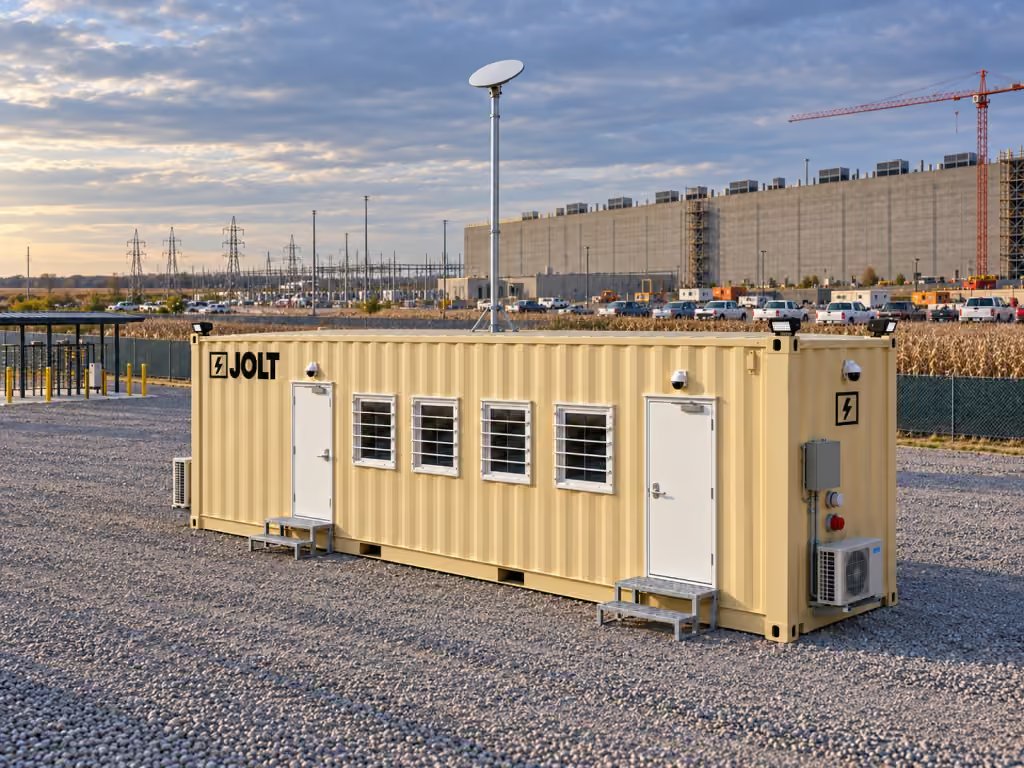
Central Ohio · Ohio
Data center site offices in Ohio: The Grid, nationwide.
Ohio Grid offices rent from $1,950/mo for Core and $2,750/mo for Command. DC Deploy is quoted per campus in one business day.
- Market
- Central Ohio
- DC Deploy
- Quoted per campus
- On-site window
- 6–8 weeks
- Grid Command
- $2,750/mo
- Legal-width loadNo oversize permits
- On site in6–8 weeks
- One invoiceper unit
- Badge-ready
- Stackabletwo-high
- Moves withyour phases

Key facts
- Central Ohio is the named corridor for 1 Ohio market as of .
- The Command the Grid — 40 ft data center site office rents for $2,750 per month as of .
- The reservation deposit on the Command the Grid — 40 ft data center site office is $2,500 as of .
- DC Deploy is scheduled 6–8 weeks after the reservation as of .
Cite this page: "Data center site offices in Ohio: The Grid, nationwide." JOLT (Jolt Rents), https://joltrents.com/data-centers/ohio/. Last updated September 25, 2026.
Ohio has 51 data centers under construction and 98 announced as of March 2026, with 101 already operating, according to Aterio's March 2026 count. Construction is concentrated in Columbus and its northeastern suburbs, New Albany, Hilliard and Dublin, with Cincinnati and Cleveland behind.
Ohio builds data centers faster than almost anywhere. Indiana, Ohio and Iowa report permit-to-completion timelines of 14 to 20 months, against 24 to 36 in Northern Virginia, and that speed is why hyperscalers under pressure to bring AI capacity online are routing projects to Columbus. For a site office, a fast build means a shorter term and more moves: the office that lands with the first crew moves to the next building inside 18 months.
Where are data centers being built in Ohio right now?
Columbus and New Albany. The state's center of gravity is the northeast corner of Franklin County and the western edge of Licking County, where Amazon Web Services has operated a major campus for a decade and keeps building, and where Google, Meta and Microsoft have all taken land at campus scale. New Albany's business park along State Route 161 carries the largest single cluster of hyperscale construction between Virginia and Texas, and the parcels along Route 161 into Licking County are the next phase.
Hilliard, Dublin and the west side. AWS and the colocation operators have campuses on the west side of Columbus, in Hilliard and Dublin, on the older fiber routes into the city. These are multi-building sites in their third and fourth phases.
Lancaster and Fairfield County. Google's campus southeast of Columbus is the anchor for Fairfield County, on farmland along U.S. 33.
Cincinnati and Cleveland. Cincinnati carries colocation and enterprise builds in Hamilton, Butler and Warren counties on Duke Energy Ohio's system; Cleveland and Cuyahoga County carry a smaller set on FirstEnergy's. Neither is a hyperscale market yet; the announced column says both are growing.
Ohio's data center tax exemption on qualifying equipment, competitive industrial electricity rates and a central location that reaches most of the eastern United States at low latency are the reasons the state keeps winning projects. Phases and names change quarterly; JOLT checks each project against a county filing or local reporting at every refresh of this page.
Which hyperscalers, developers and general contractors are active in Ohio?
Amazon Web Services, Google, Meta and Microsoft at campus scale in the Columbus area; QTS, Compass, Vantage, Cologix, DataBank and the regional colocation operators around them.
The general contractors with data center groups working in Ohio include Turner, with a large Columbus office; Holder; Mortenson; Whiting-Turner; DPR; Clayco; Gilbane; and the Ohio builders that grew up on these campuses, Elford, Messer and Corna Kokosing. A 14-to-20-month Ohio schedule means the GC mobilizes hard in the first 60 days, and the electrical contractor, the largest trade on any data center build, is on site with its own office before the GC's temporary service is energized, running on a generator in a Columbus February. Command's generator inlet and cold-climate heat pumps suit that crew.
What does an Ohio data center site office need?
Cold, snow and frost.
Cold. Columbus averages lows near 20 degrees in January and sees nights to minus 10. The Grid carries two 12,000 BTU cold-climate mini-split heat pumps, heating to minus 13 F, behind R-19 closed-cell foam walls and an R-30 roof.
Snow. Snow management is mainly an access and egress issue. Keep the delivery approach usable, preserve clear paths at both personnel doors and do not pile plowed snow against the unit.
Frost. Frost heave can move one corner of a cribbing stack over winter. A compacted, draining gravel bearing surface reduces movement, and the site should inspect the office after seasonal changes. DC Deploy includes four-point anchoring.
Summer. The same heat pumps cool and dehumidify, while the closed-cell foam limits condensation against the steel envelope.
Use the Grid site-requirements checklist to coordinate bearing, access, power and anchoring.
How does The Grid get to an Ohio site?
DC Deploy serves any Ohio project with freight, tilt-bed placement or crane set, leveling on cribbing, four-point anchoring, an electrical rough-in walkthrough and pickup; see nationwide delivery.
What does a Grid cost on an Ohio data center site?
Ohio uses the published Grid rents and reservation deposit on the data-center pricing page. DC Deploy is quoted per campus.
What is the power picture in Ohio and when does temp power land?
AEP Ohio serves Columbus, New Albany, Hilliard, Dublin and Lancaster, which is to say almost all of the state's hyperscale construction. In 2025 the Public Utilities Commission of Ohio approved AEP Ohio's data center tariff, which requires large new loads to pay for a high share of their contracted capacity over a multi-year term whether or not they use it, a response to a large-load pipeline measured in gigawatts. Duke Energy Ohio serves Cincinnati and FirstEnergy serves Cleveland; the cooperatives serve the rural parcels in Licking and Fairfield counties where the newest campuses sit.
The tariff shapes the campus, not the site office. Temporary construction service on a Columbus-area campus is ordered months ahead and is usually live at the gate before the office arrives; on a greenfield parcel in Licking County or Fairfield County the GC's temporary service can trail the first mobilization by two to six weeks, in winter. Grid Command's 50 A generator inlet with a mechanical interlock lets a generator power the office until the electrician gets a 60 A circuit to the pad; the site electrician confirms the generator's load plan. JOLT's 25 kW generator is $1,850/mo plus fuel and is cancelled the day the shore cord goes on.
Do you need a permit for a temporary site office in Ohio?
In most Ohio jurisdictions a temporary construction office is an accessory to the project's building permit and is shown on the site logistics plan under the Ohio Building Code's treatment of temporary structures. The City of Columbus issues a temporary-structure permit with a fee and an anchoring detail; New Albany, Hilliard, Dublin and Lancaster follow the county building departments' practice of folding the office into the project permit with an anchoring detail on file.
Ask the Ohio authority having jurisdiction named on your building permit to confirm its temporary-office requirement. Four-point anchoring is part of every DC Deploy; bring the AHJ's or the GC's anchoring and insurance requests to the data center specialist ahead of the delivery window.
How long is an Ohio site office term?
Shorter and busier than Virginia's. An Ohio building runs 14 to 20 months from permit to energized, so a single-building placement is a 12-to-18-month term. A New Albany campus program runs four years across several buildings, and on those the office moves every 12 to 15 months as a building turns over: one or two $1,250 relocations, not a new mobilization.
An Ohio contractor moving the same office from campus to campus can compare rent with the purchase and 36-month lease-to-own choices on the Grid buy page.
How do multi-building Ohio campuses use a Grid Campus?
A New Albany campus with six buildings is built two at a time. The GC's project office, the owner's rep, the electrical and mechanical contractors and the security office all move as buildings turn over, and on a 15-month cycle they move often.
Ohio project teams can arrange 2 to 12 units as a Grid Campus, either in a row or stacked two-high. Each stacked pair uses a Stack Kit at $395/mo with $1,500 setup, while an order of at least 6 Commands receives a 5 percent rent credit each month for the first 12 months.
Which Ohio counties and metros does JOLT serve?
DC Deploy serves every Ohio county. Active areas include Franklin, Licking, Delaware, Union, Fairfield, Pickaway and Madison around Columbus; Hamilton, Butler and Warren around Cincinnati; and Cuyahoga, Lorain and Summit around Cleveland and Akron.
Nearby market pages cover Indiana, Pennsylvania, Illinois and Virginia.
Read the AEP Ohio large-load decision without confusing two power scopes
The Public Utilities Commission of Ohio adopted AEP Ohio's data-center tariff settlement in July 2025. AEP Ohio's data-center tariff page explains its application process, load studies, collateral requirements and minimum-demand charges.
That decision concerns the permanent campus load. The construction office needs a separate temporary-service plan. Ask the electrical contractor for the serving utility, temporary account status, panel location, available connection and date that service can support the office. Keep that answer distinct from the developer's substation and permanent-load milestones.
The distinction matters in procurement. A project may have a signed campus power agreement while the laydown area remains without usable construction service. Conversely, a temporary panel may be ready while later building-load dates remain unresolved. Put both milestones on the logistics schedule so a project executive can see which one controls office mobilization.
For Command, the included generator inlet is a connection feature, not the site's load plan. The licensed electrician should verify the source, cord, protection, grounding and connected loads under the applicable code and project rules. Fuel is billed separately when the optional generator is selected.
Confirm the Ohio permit desk before choosing the pad
Ohio's statewide building-code system does not mean every project calls the same counter. Ohio Administrative Code rule 4101:7-3-01 sets out certification requirements for local building departments and their personnel.
Start with the jurisdiction printed on the primary building permit. For a parcel near New Albany, confirm whether the address falls inside municipal limits and which certified department has authority. Do the same for projects marketed with a Columbus, Dublin, Hilliard or Lancaster name, because a campus name is not a permit boundary.
Send the permit desk a concise description of the temporary construction office. State that it uses a 40 ft high-cube ISO container, then show the intended placement, utility connection, access points and anchoring approach. Ask whether it belongs on the master site plan, needs a separate temporary approval, or requires electrical review. Record the official's name and written response in the mobilization file.
Do not select the final pad solely from an early logistics sketch. Fire access, utility corridors, future excavation and gate circulation can change during review. A location accepted for the first civil phase may conflict with the next building package, so identify a relocation trigger and the person authorized to call it.
Make winter access an operating plan
The National Weather Service winter-safety page provides winter alerts and hazard resources. On an Ohio construction site, translate that information into named responsibilities for the approach, walking paths and office equipment.
Assign snow clearing around both personnel doors and preserve access to the exterior disconnect and HVAC equipment. Keep plowed material away from drainage paths and the bearing surface. After freeze-thaw or a major weather event, inspect the cribbing, doors and visible anchors before treating the office as unchanged.
The delivery plan needs a weather decision owner. That person should check the access route, staging area and receiving pad before the carrier is released to the gate. The check is especially important when civil work leaves mud beneath a fresh layer of stone or when plowing narrows the intended approach.
Keep the weather discussion separate from product ratings. The Grid's published insulation and heat-pump specifications describe included equipment. They do not replace the site's electrical review, snow plan, drainage work or the authority's requirements.
Add a communications check for overnight freezes. The day-shift team should know whether the pad or access route changed after it was last inspected. Update the current logistics drawing when snow storage closes a route or forces a different gate.
Compare Ohio office quotes on one written scope
Require each bidder to price the same build, term and delivery location. Identify the number of workstations, badge preparation, camera hardware, backup connectivity, generator connection, display and branding needed by the actual users. Core and Command differ on those items, so a low quote for a different scope is not a saving.
Separate recurring rent from one-time deployment and optional work. State who supplies temporary power, ongoing connectivity, access-control integration, permits and site preparation. Ask how a later move is authorized and priced rather than assuming it is included.
Finally, align the office decision with the Ohio phase schedule. Note the first trade mobilization, temporary-service milestone, building turnover and likely office release. A written sequence gives procurement a defensible term and gives the superintendent a date for pad readiness. Keep assumptions labeled until the responsible project lead accepts them in the current schedule.
How do I reserve a Grid for an Ohio project?
Choose Core or Command, then provide the Ohio site ZIP, quantity, target date, details, add-ons and protection through the data-center reservation path.
How many data centers are under construction in Ohio?
Ohio has 51 under construction, 98 announced and 101 operating as of Aterio's March 2026 count.
Does JOLT deliver site offices anywhere in Ohio?
Yes. DC Deploy covers any site in the lower 48, including every Ohio county, and includes freight, placement, leveling, four-point anchoring, an electrical rough-in walkthrough and pickup.
How long does delivery to Ohio take?
Plan on a 6–8 weeks DC Deploy window for an Ohio site. The reservation confirmation states the scheduled window.
What does a Grid cost in Ohio?
In Ohio, Core rents for $1,950/mo and Command for $2,750/mo. Each unit has a 12-month minimum. DC Deploy is quoted per campus in one business day.
Is The Grid built for Ohio winters?
The Grid has two cold-climate heat pumps rated to heat at -13 F behind R-19 closed-cell foam walls and an R-30 roof. The site must maintain access and egress through snow and inspect cribbing after frost movement.
Who is the utility and how does that affect the office?
AEP Ohio for the Columbus-area campuses, Duke Energy Ohio in Cincinnati, FirstEnergy in Cleveland. Temp power on a greenfield parcel can trail mobilization by 2–6 weeks in winter, which Command's generator inlet covers.
What is AEP Ohio's large-load tariff and does it affect temp power?
A 2025 PUCO-approved tariff that requires large new data center loads to pay for a high share of their contracted capacity over a multi-year term. It shapes the campus's utility contract, not the GC's temporary construction service, which is ordered separately and is usually live before the office lands.
Which Columbus suburbs have data centers under construction?
New Albany and the Route 161 corridor into Licking County carry the largest cluster; Hilliard and Dublin on the west side and Lancaster in Fairfield County carry the rest.
Your delivered price
Pick the unit, rent or buy, and the job ZIP. Monthly rent and the route show as you go; we email the full delivered price with a 14-day lock.
Pick a length
Drawn to scale, side view.
Step 1: Unit
The Grid · Command
Which 40 ft?
Step 2: Rent or buy
12-month starting term for project quotes.
Renting 12 months or more? Lease-to-own ends with the office yours: $2,795/mo for 36 months.
Step 3: Job ZIP
Ohio · Project quote
Delivery and pickup: quoted for your site.
Step 4: Send it
Step 5: Your project quote
- JOLTSite offices for data center construction. Nationwide.
- DataCenterProductNationwide Grid Command: badge-ready, connected, and ready the day it lands.
- DataCenterGuideNationwide data center site office pricing. All of it.
- DataCenterMarketData center site offices in Indiana: The Grid, nationwide.
- DataCenterMarketData center site offices in Pennsylvania: The Grid, nationwide.
- DataCenterMarketData center site offices in Illinois: The Grid, nationwide.
- DataCenterMarketData center site offices in Arizona: The Grid, nationwide.
- DataCenterMarketData center site offices in Georgia: The Grid, nationwide.
Bring The Grid to Ohio.
DC Deploy covers freight, set and pickup.
A deposit holds your delivery window. Cancel free of charge more than 14 days before the first day of the window. Deposits from $85 are applied to your first invoice.