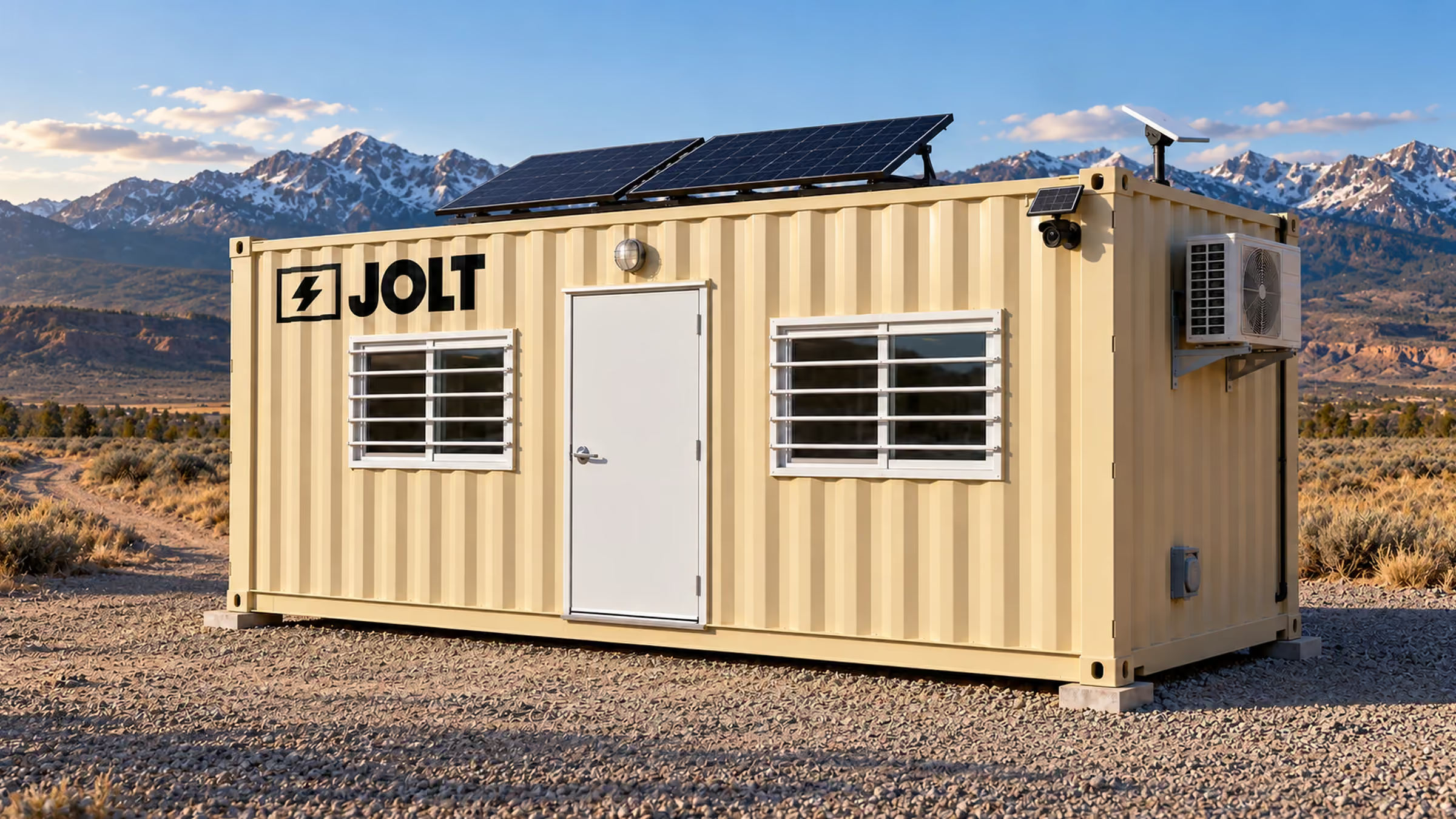
A rented generator, fuel runs and noise all day. Our estimate for a Base office run on a generator, with fuel runs, internet and a camera, is $2,308 a month.
What JOLT changes
Grid-Free carries roof solar, a 10 kWh battery, Starlink and a camera. The battery runs the heat and A/C. $1,495 a month. Nothing to refuel.
Crews warm up in idling trucks. Mornings start late. Wet gear stays wet.
What JOLT changes
Mini-split heat in every office. READY adds a 1,500 W heater. Alpine adds backup heat and a covered entry deck.
Tools that walk off at night
What it costs you
Equipment theft costs U.S. contractors an estimated $300 million to $1 billion a year (National Equipment Register and NICB). Most of it is never recovered.
What JOLT changes
One-trip steel storage with a welded lockbox. WATCH adds a solar LTE camera with motion alerts for $129 a month. It comes built in on Grid-Free and Alpine.
Nowhere to meet the owner or the inspector
What it costs you
Walkthroughs happen on a tailgate. Plans ride on a truck seat.
What JOLT changes
A clean, lit office with a plan table (READY), Starlink for plans, email and video calls, and your logo on the door.
We help you plan the placement. Here is what Wisconsin asks for. Start with the address and parcel boundary. A Milwaukee bridge job and a Madison causeway job require different local conversations. Tell us which space serves workers and which holds tools. Mark both footprints on a site drawing. Identify the property owner and the person managing access. Give the reviewing office a description of the occupied unit. Wisconsin rules start with the site, not a contractor's mailing address. Keep the reply alongside the project's approved plans. Revisit the drawing whenever the compound changes shape.
On a private lot
The Wisconsin Department of Safety and Professional Services' commercial-buildings page assigns plan review for employment premises and public buildings to its Division of Industry Services. Certified municipalities also participate in certain reviews and inspections. For submissions beginning November 1,2025, DSPS specifies its revised commercial code. Wisconsin's revision draws upon the 2021 ICC editions. Ask the local building official who reviews your particular Wisconsin employment site. Show the intended use, dimensions, occupancy and utility plan. Ask about construction, electrical and fire review. Record whether a municipal or state reviewer handles the plan.
The International Building Code temporary-structure provision discusses permits in section 3103.1.2. It includes a 120-square-foot threshold. Ask the Wisconsin reviewer how the adopted, amended rules apply to your office. An occupied workspace needs its own explanation. Describe an unoccupied storage unit separately. The city or county planning desk can discuss parcel use and duration. Bring the approved site plan and mark parking, setbacks and fire access. Ask whether adding a construction office changes that plan. A Milwaukee residential lot may need a different answer from a Dane County commercial parcel.
In Milwaukee, the city clerk's ordinance explanation identifies residential zoning ordinance 295-505-3-m. Portable moving and storage containers cannot remain on a residential lot beyond 30 days under that provision. Ask the Department of Neighborhood Services how it classifies your particular construction office or storage box. Explain whether staff will work inside it. A 30-day moving-box rule gives the desk a specific starting point. It does not describe every Wisconsin industrial construction yard. Write down which parcel and proposed dates the Milwaukee answer covers.
For a Dane County site, Madison zoning can discuss temporary construction use. Madison Building Inspection can address the occupied workspace. Ask both offices about a proposed bathroom office's utilities if you need that build. Elsewhere in Wisconsin, start with the city or county whose boundary contains the parcel. Map the legal lot instead of relying on a postal city name. Show an authorized office position and a separate storage position. Ask whether either position displaces required parking. A rural job's open acreage still needs an approved work area. Put the office entrance on the sketch.
On a street or sidewalk
Milwaukee's public-way dumpster instructions discuss permits for dumpsters on streets, sidewalks and alleys. Ask its public-way authority how it classifies a container office instead. Show the exact curb, length and proposed duration. Tell staff whether people will occupy the unit. Ask separately about pedestrian space and an alley shared with businesses. A Milwaukee private-lot answer applies behind the property line. The public-way desk addresses the area beyond it. Keep the two decisions visible on the same Wisconsin site drawing.
Madison Traffic Engineering's occupancy instructions direct moving containers and detached trailers in metered or unmetered street space to a parking-related Street Occupancy Permit. Ask Traffic Engineering about an occupied office at the proposed Madison curb. Explain any travel lane or walking path affected. Madison's parking process differs from zoning for a private Dane County parcel. For another Wisconsin municipality, find the road owner before marking a public-space footprint. Show that office the street segment and dates. Mark where pedestrians continue around the work area. Get the answer for the actual unit, not just the worksite address.
HOA and deed restrictions
Ask a Wisconsin landowner whether the construction office may stand on the selected pad. A leased industrial lot may have a landlord's loading or access conditions. An HOA may regulate a visible driveway or storage unit. Share the exterior, dimensions, duration and location with its reviewer. Keep the written consent with the municipal answer. Ask about any easement across the proposed space. Ask a Milwaukee association where a storage box may stand. Maintain the fire access shown on the approved drawing. An owner may control the interior lot while a city controls its adjoining sidewalk.
For a Wisconsin office visible from neighboring property, discuss appearance before choosing Alpine. Its matte-black exterior and cedar surrounds may suit a reviewed frontage. Its covered deck occupies part of the usable position. Show the full footprint to a landlord or architectural committee. Ask whether the construction schedule affects the approved duration. Note which party can approve a revised pad if grading changes. An HOA's approval for a tool crib may differ from approval for daily office occupancy. Tell us which size the private agreement accommodates. We can compare that space with the proposed office and storage units.
Getting the site ready
Prepare a firm, level, well-drained Wisconsin pad. Mark gates, slopes, overhead lines and utility locations. Keep an accessible walking approach to the office. Milwaukee alleys may also serve neighboring loading areas. Madison bikeways may change during street construction. Check the project drawing for both conditions. Locate snow storage away from the doorway and approved access. For Base in Wisconsin, discuss its 50-amp inlet with your site electrician. For a pad awaiting service, consider Grid-Free's no-shore-power arrangement. Discuss the selected occupied unit with the building official.
A 10 ft walk-in storage box can use a compact approved Wisconsin position. The 12 ft version has a man door and barred window. The 20 ft storage box uses cargo doors, four lock bars and a welded lockbox. Mark the door clearance for the actual selection. A 40 ft high-cube needs longer clear space and height assessment. Sketch the space around a bathroom office separately. At a farm or industrial driveway, check grade and overhead obstructions. Recheck the usable position after paving or building work changes the site.
Where JOLT fits best
Wisconsin projects with long, changing work phases can use an office and locked storage together. One approved pad can serve daily planning. Another can hold tools away from meeting space. A Milwaukee bridge compound may change as the road work advances. A Madison isthmus parcel may favor a shorter walk-in crib. We can help compare those Wisconsin footprints. Match the office to available power and staffed use. Keep the property authority's answer attached to the exact positions. Seek a fresh placement answer for each Wisconsin county.
On a powered parcel, Base offers mini-split heating and cooling. Grid-Free suits a Wisconsin work area without shore power. Its battery has 10 kWh capacity and operates the HVAC. Consider the Wisconsin pad's sunlight and electrical demand when choosing solar. Alpine brings a covered deck and backup heat for wintry site visits. The 40 ft bathroom office needs a longer approved position. Ask which crew actually needs the enclosed bathroom. If your Wisconsin company plans to retain a 20 ft unit, see the purchase choices. A new worksite still calls for its own placement review.
Wisconsin DOT's September 2026 WIS 100 release describes Mayfair Road bridge replacements over the Menomonee River. The work also includes resurfacing between Burleigh Street and Silver Spring Drive. Its bridge schedule starts near the end of September 2026. The published overall schedule runs through fall 2027. Ask the Milwaukee project authority where an office fits among those phases. Madison Engineering's John Nolen Drive update describes causeway reconstruction and six bridges. Stage 3 began July 14,2026, with late spring 2027 anticipated for completion. Compare each project's approved compound rather than treating the two schedules alike.
Built for Wisconsin weather
The NOAA 1991–2020 Milwaukee Mitchell Airport normals give a July average high of 81.9 °F. January's average low is 17.2 °F there. Monthly values total 34.57 inches of annual precipitation. Milwaukee's annual snowfall total from those normals is 48.7 inches. At Madison Dane County Regional Airport, July's average high is 82.1 °F. Its January average low is 11.8 °F. Madison's monthly values total 37.13 inches of annual precipitation and 51.8 inches of snowfall. These distinct station records help Wisconsin crews plan both heating and summer cooling.
A Milwaukee lakefront parcel and a Madison isthmus site may have different gate conditions. Check the actual Wisconsin entrance after snow is piled. Mark drainage on a spring grading plan. Keep the office's walking path distinct from material storage. Base's mini-split heats and cools when shore power is available. Grid-Free adds solar, a WATCH camera and CONNECT Starlink without needing shore power. Its battery runs the HVAC. Alpine carries those Grid-Free features plus backup heat and a standing-seam over-roof. Its covered deck may help with repeated snowy visits. Choose according to the site's approved space and available power.
Milwaukee winter planning includes alleys narrowed by parked vehicles or snow. Madison's John Nolen staging adds changing pedestrian movements near Monona Bay. The John Nolen project update describes the Capital City Trail detour around that bay. It also describes traffic on newly built southbound lanes. Ask the project manager which walking access remains available for office staff. A Wisconsin office placed for July may be used in a colder January. Review snow storage before setting its door orientation. Tell us if the intended pad will change between project phases. We can help size the office and locked box for the authorized space.
How we built this page: rent, upgrade and delivery figures come from the JOLT catalog at build time. Permit, street, HOA and weather facts are linked to their sources in the text. Written and reviewed by Lisa Tanner.
Every 20 ft office has heat and A/C, lights, outlets, a vinyl-plank floor, a 36-inch steel door and two barred windows. Grid-Free adds roof solar, a 10 kWh battery, Starlink and a camera. Offices rent from $795 a month.
Can the office run before the site has power?
Yes. Grid-Free runs its heat and A/C, lights, outlets and Starlink from roof solar and a 10 kWh battery. Output depends on sun and load. It rents for $1,495 a month.
Can we put our logo on it?
Yes. BRAND applies your logo in 24 by 48 inch vinyl on two sides of the unit. $450, one time.
Do I need a permit for a jobsite office in Wisconsin?
Possibly; ask the Wisconsin city or county zoning desk about your parcel first. The building official can explain review for an occupied workspace, including the state's commercial-building framework for places of employment. Bring the proposed position, use and utility plan so the correct local or state reviewer can assess it.
Can the office sit on a Wisconsin street?
Only if the street authority approves the specific Wisconsin location and use. In Madison, Traffic Engineering describes a Street Occupancy Permit for moving containers in public parking spaces; ask how it handles an occupied office. For Milwaukee, ask the public-way authority about the particular curb or alley. Share the footprint and proposed dates with that office.
What does the site need before delivery?
A firm, level pad, a clear path for the truck, and a person on site to show the driver where it goes. Tell us about gates, slopes and overhead lines when you ask for the quote.
How much does delivery to Wisconsin cost?
Delivery to Wisconsin is quoted per project. We route the unit from the nearest JOLT source yard and send a written delivered quote within one business day. It holds for 14 days. Rent is published: offices from $795 a month, storage from $225.
How long can we rent, and can we buy?
Rentals outside the Rockies start at 12 months. You can also buy an office outright or lease-to-own a 20 ft office over 24 or 36 months.
Start your Wisconsin project quote
Offices from $795 a month
Pick the office, the term and the job ZIP. You get a written delivered quote within one business day, and it holds for 14 days.