
Data center guide · Nationwide
The site office program for data center general contractors.
How data center GCs use Grid Command at $2,750/mo, with nationwide DC Deploy, stacking, relocation, and GC account terms.
- Grid Core
- $1,950/mo
- Grid Command
- $2,750/mo
- DC Deploy
- Quoted per campus
- On-site window
- 6–8 weeks
- Legal-width loadNo oversize permits
- On site in6–8 weeks
- One invoiceper unit
- Badge-ready
- Stackabletwo-high
- Moves withyour phases

Key facts
- The Core the Grid — 40 ft data center site office rents for $1,950 per month as of .
- The reservation deposit on the Core the Grid — 40 ft data center site office is $2,500 as of .
- The minimum rental term on the Core the Grid — 40 ft data center site office is 12 months as of .
- Grid delivery window is 6–8 weeks after the reservation as of .
Cite this page: "The site office program for data center general contractors." JOLT (Jolt Rents), https://joltrents.com/data-centers/general-contractors/. Last updated September 25, 2026.
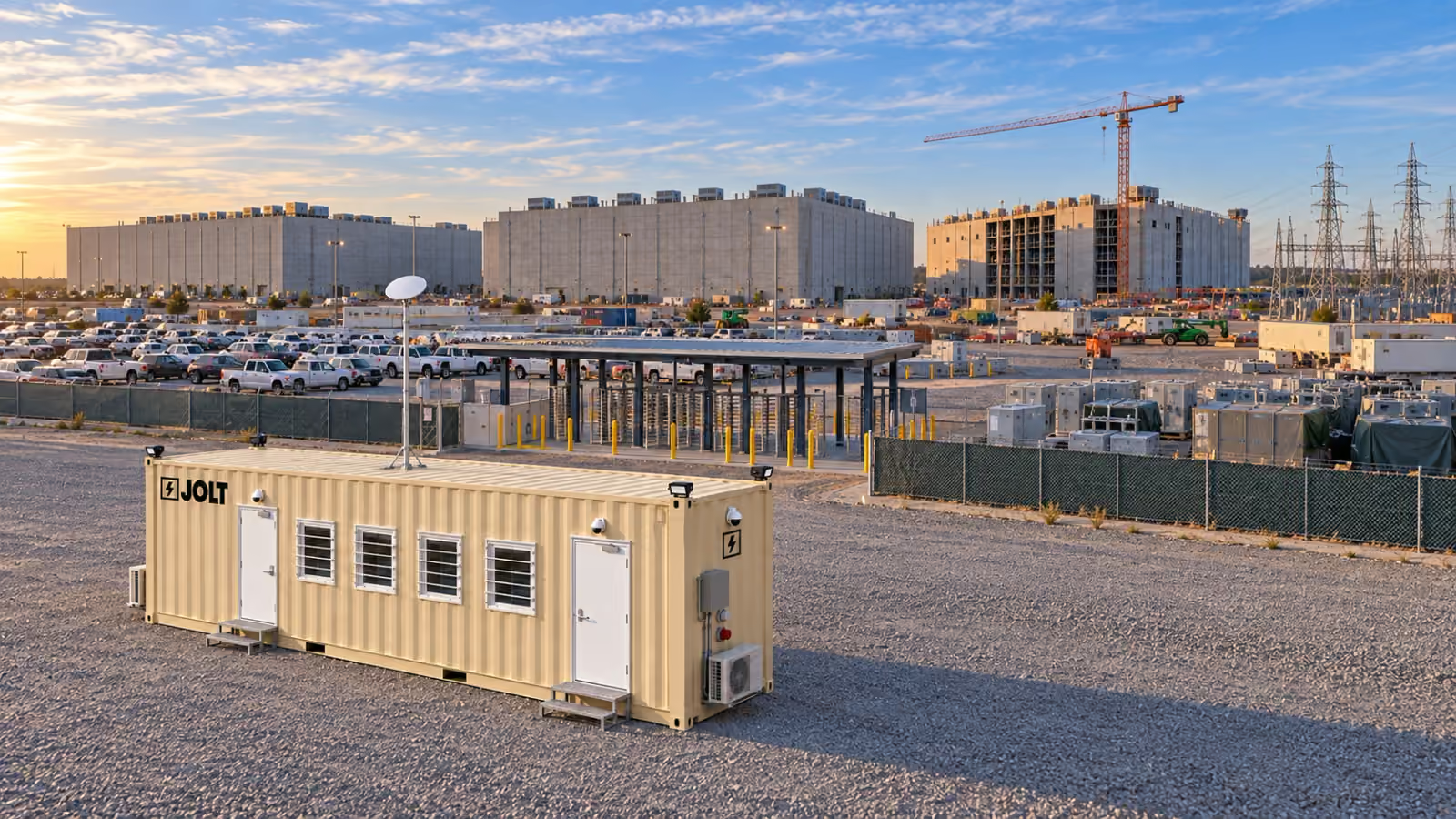
Data center general contractors reserve Grid Command at $2,750/mo per unit, stack it into a Grid Campus for the project team, and relocate it for $1,250 when the work moves to the next building. Each unit is one subscription and one invoice. Purchase-order invoicing and net-30 terms are available to general contractors on a signed master rental agreement after credit approval; otherwise ACH auto-pay.
A GC's site logistics manager has forty vendors to set up in the sixty days before a hyperscale mobilization. JOLT's proposition is that the office should be one of them, not five: the box, the cameras, the internet, the furniture and the badge prep on one line, with one phone number.
What does a hyperscale GC need from a site office that a trailer does not give it?
Six things, on the first day.
Badge control. The owner's security program requires access control on every door of every site office before the first orientation, on the owner's platform. Grid Command's doors ship with electric strikes, door contacts and low-voltage pathways for the owner's badge vendor to mount readers.
Cameras on the doors and the yard. The GC's carrier and the owner's security program both want them. Command carries four IP cameras on an onboard NVR with LTE alerts.
Internet before fiber. Site fiber on a greenfield campus can arrive after mobilization. Command's Starlink provides the initial connection and becomes failover when fiber goes live.
Power before temp power. The office lands before the utility's temporary service does. Command's 50 A generator inlet with a mechanical interlock lets a generator, JOLT's 25 kW add-on or your own, power the office until the shore cord goes on; the site electrician confirms the load plan.
A room made for year-round work. Two cold-climate heat pumps sit behind R-19 closed-cell foam walls and an R-30 roof.
A building that moves. A steel box lifts by its corner castings and can land beside the next building instead of being rebuilt.
A Grid gives 320 square feet in a 40 ft high-cube ISO container, which is why a GC's answer can be a Grid Campus rather than one unit.
How do GCs configure a Grid Campus for a 4-building program?
The standard configuration on a four-building hyperscale campus is six Commands in three stacked pairs beside the main gate: 36 desks, 48 meeting seats, in the footprint of a single double-wide.
Ground floor, left pair: the gatehouse and the security contractor, four cameras with LTE alerts, orientation video on the display, lockers. Ground floor, middle and right: the GC's project office, the project executive, the project managers and the engineers, and the superintendents' room with the plan table and the schedule wall. Upper row: the owner's representative and the commissioning agent behind their own badged door with their own network at the far end, and the electrical and mechanical contractors' project teams in the other two, each with its own door on the landing.
When one building turns over, the owner's rep and the commissioning agent can move to the operations side while the rest of the campus follows the next construction phase. On-campus relocation is $1,250 per unit per move.
GCs that run a larger project team add pairs. GCs that want the trades to carry their own offices assign pads beside the campus and the trades reserve their own Grids, set in the same crane day. Six or more Commands on one campus earn a 5 percent rent credit for the first 12 months.
How does the Grid handle badging, security and visitor control at the gate?
The gatehouse unit is a Command with its doors pointed at the badging queue. The owner's badge vendor mounts readers on both doors and an enrollment station inside; the office runs the enrollment station on Starlink until the site network is live. The four cameras record to the NVR, and motion alerts go to the security contractor's phones over LTE.
Visitor control runs from the same room: the display shows the site orientation video, the lockers hold visitor PPE, and the second door opens onto the escorted side of the fence. A GC running a hyperscaler's visitor management system runs it on a laptop at the enrollment station.
What does one invoice per unit do for job cost?
It puts the office where it belongs in the cost code. Each Grid is one subscription: rent, add-ons, the 12% damage waiver and the 5% environmental fee, on one monthly invoice, with the deposit, DC Deploy, Stack Kit setup and relocations as one-time lines on the same account. There is no camera vendor invoice, no Starlink bill, no furniture rental, no electrician's ticket for the door prep, and no separate pickup charge at the end.
A GC that carries the whole campus books six invoices a month to one cost code. A GC that wants the trades to carry their own offices assigns pads and the trades reserve; the GC's job cost shows only the GC's units.
How do GCs move offices between phases without a second mobilization?
Request the move through JOLT. The site electrician disconnects the campus panel; the technician pulls the anchors, removes the stair towers, releases the twist-locks, lifts each unit by its corner castings, lands it on new cribbing at the new pad, re-levels and re-anchors; the electrician reconnects.
On-campus relocation is $1,250 per unit per move. A move to a different campus is a new DC Deploy, quoted for the new campus.
How do national accounts, POs and net-30 work with JOLT?
A general contractor signs JOLT's master rental agreement once. It covers the projects the GC runs and lets each campus be reserved by a schedule rather than a new contract. PO and net-30 are available to general contractors on a signed master rental agreement after credit approval; otherwise ACH auto-pay.
Other customers reserve with the $2,500 deposit per unit and ACH auto-pay, or under the GC's master agreement if the GC carries them. Protection is the 12% damage waiver, or a refundable deposit of one month's rent plus a COI naming the lessor of record as loss payee.
To request national account terms, call 970-279-1015.
What is the site logistics budget line for offices on a major campus?
The office program belongs in general conditions, while the site logistics manager's time and the value of coordinating one office vendor matter alongside the price.
For current build, campus, add-on and term figures, use the data center pricing page.
For the money, the GC gets 36 desks, 48 meeting seats, 24 cameras, six Starlink links, twelve badge-ready doors, six 75-inch displays, 48 lockers, six generator inlets, and a campus that moves once without a rebuild.
How does the Grid support safety orientations and daily huddles?
Every Command carries a 75-inch wall display with HDMI and USB-C, a 10 ft conference table with eight chairs, and two whiteboard walls. The morning huddle runs at the table with the schedule on the screen. The site orientation runs in the gatehouse unit with the owner's video on the display and the sign-in on a laptop at the enrollment station. Stretch-and-flex runs on the walkway in front of the campus.
For an all-hands, the campus is the backdrop: the landing is a stage, the ground-floor doors are the wings, and the GC's logo on six units faces the crowd. Owners notice.
What JOLT does not do for a GC
Three things, and a national chain does them better. Workforce housing: a 500-bed camp for a rural gigawatt site is a dormitory program, not a site office, and JOLT does not build it. Large modular complexes: a 60 by 60 multi-wide with a conference center, a kitchen and restrooms is a permitted building, and a GC that wants 3,600 square feet under one roof should rent one. Restrooms: data center sites run portable restrooms on a service contract, and the Grid keeps its 320 square feet for work.
What JOLT does is the office: the badge-ready, camera-equipped, connected, stackable, relocatable steel room that a GC's project team and the trades work out of.
What does a GC's 24-month office program cost?
The total depends on unit count, configuration, add-ons and moves; compare the current term and campus figures on data center pricing.
Teams comparing ownership can review the purchase and lease-to-own options on the buy page.
How do GCs reserve for a project that starts in 90 days?
Choose the build, then give the site ZIP, quantity, target date and project details before selecting add-ons and protection; the data center hub explains the reserve path and the confirmation carries the on-site window.
For deployment details to Texas, Virginia, Ohio and every lower-48 site, see nationwide delivery. A specialist responds inside 15 minutes during business hours. Cancel free, in writing, more than 14 days before the first day of your delivery window. Call 970-279-1015 or email reserve@joltrents.com.
Put the office scope into the bid package
Define the office program before trade bids turn it into a patchwork. The bid package should identify which units the GC carries, which units belong to major trades and which rooms are reserved for the owner or commissioning team. Mark each intended pad and the phase during which it is available.
State the required build by use. Core fits a team whose campus already provides fiber and a separate badging solution. Command fits a first office, gate function or team that needs its own badge-ready doors, cameras and backup connectivity. The requirement should name the included systems instead of using a vague phrase such as “data-center ready.”
Separate JOLT scope from owner and contractor scope. DC Deploy covers the inbound move through end-of-term pickup. Its intermediate services are placement, leveling, anchoring and the electrical rough-in walkthrough. The project provides the site, access and customer-supplied utilities under Rental Agreement sections 5 and 7.
The bid package should also name the access-control vendor, site electrician and network contact. Command provides door contacts and electric strikes plus pathways for low-voltage work. Have the access-control vendor define reader and credential scope, while the project decides how site fiber reaches the office.
Ask bidders to carry selected add-ons explicitly. A Stack Kit belongs to each stacked pair. A generator, ADA ramp, workstation pack or Unlimited Starlink upgrade should appear as a deliberate scope choice, not a field assumption.
Hand off mobilization information once
Create one office release sheet controlled by site logistics. It should contain the site ZIP, delivery window, unit build, selected add-ons, placement contact, approved pad, access route, placement method and utility contacts. Attach the current logistics plan rather than sending different marked-up screenshots to procurement, security and the field.
The field portion should confirm a firm, level and well-drained surface, safe access, marked utilities and a designated representative. These are customer responsibilities in Rental Agreement section 5. The same review should identify whether tilt-bed placement or a crane set belongs in the written plan.
A controlled handoff prevents a common procurement failure: each specialty assumes another specialty owns the final connection. The office can be correctly placed while power, credentials or fiber remain unassigned. Names and dates on the release sheet make those boundaries visible.
Define change-order triggers before mobilization
Office changes are usually caused by schedule or site-plan changes, not by the room itself. Identify triggers that require a written cost and logistics review: a different pad, a switch from row to stacked placement, an added unit, an added workstation pack, a generator need, a new accessible route or a release date that crosses an anniversary.
Treat relocation as a planned decision gate. The project must obtain written consent before moving rented equipment under Rental Agreement section 5.5. When the schedule shows a future move, carry the $1,250 line and identify the destination pad in advance.
An access-control change is another trigger. Reader hardware remains owner-vendor scope even though Command is badge ready. A change in platform, credential policy or door assignment should go back to that vendor rather than being treated as an office modification.
Document who may approve recurring additions. A small monthly option can outlive the field event that prompted it. Pair every approved addition with an owner, start point and review milestone.
Decide each unit's end-of-phase disposition
At every building turnover, choose one of four actions for each office: keep it in place, relocate it on campus, release it for pickup or evaluate it for another documented arrangement. Do not let an empty room continue solely because no department owns the decision.
Start the review before the team demobilizes. The schedule owner confirms future need, site logistics confirms the next pad, procurement checks the term and cost, and information technology plans removal of customer equipment. Security should remove its reader hardware and close credentials tied to that door.
Pickup readiness is a field deliverable. Rental Agreement section 16 states the notice, access and return-condition duties. Add its requirements to closeout alongside keys and rented hardware.
Keep a short disposition record by unit number and cost code. It gives the next phase an accurate office inventory and prevents two teams from budgeting the same room. It also tells accounts payable whether the next invoice should show continued rent, a relocation or final closeout.
What is JOLT's master rental agreement?
It is one agreement per general contractor covering the projects it schedules, including terms, protection election and account mechanics. PO and net-30 are available after credit approval; otherwise ACH auto-pay.
What insurance does JOLT require from a renter?
A renter may choose the 12% damage waiver, or provide a refundable deposit of one month's rent plus a COI naming the lessor of record as loss payee.
Can one account cover projects in several states?
Yes. Each campus can be a schedule on the master agreement, and DC Deploy serves any site in the lower 48.
How does JOLT coordinate with the owner's badge vendor?
Command doors ship with electric strikes, door contacts and low-voltage pathways for the owner's access-control vendor. The owner's vendor mounts and configures its readers.
Can we run safety orientations in a Grid?
Yes. Every Command has a 75-inch display, a 10 ft table with eight chairs and two whiteboard walls; a gatehouse unit can run the owner's orientation video and sign-in station.
How are PO invoices issued?
Each Grid is a subscription, and one-time items appear as lines on the same account. PO invoicing and net-30 are available to general contractors on a signed master rental agreement after credit approval.
How much does an on-campus relocation cost?
On-campus relocation is $1,250 per unit per move. The site electrician disconnects and reconnects while JOLT handles the unit move.
Can we add units mid-project?
Yes. Additional Grids can join an existing campus at the same rent, with a new DC Deploy quoted for the campus in one business day and the delivery window shown on the confirmation.
Your delivered price
Pick the unit, rent or buy, and the job ZIP. Monthly rent and the route show as you go; we email the full delivered price with a 14-day lock.
Pick a length
Drawn to scale, side view.
Step 1: Unit
The Grid · Command
Which 40 ft?
Step 2: Rent or buy
12-month starting term for project quotes.
Step 3: Job ZIP
Delivery and pickup: quoted for your site.
Step 4: Send it
Request a written delivered quote from the project desk.
Step 5: Your project quote
- JOLTSite offices for data center construction. Nationwide.
- DataCenterProductNationwide Grid Command: badge-ready, connected, and ready the day it lands.
- DataCenterGuideNationwide data center site office pricing. All of it.
- DataCenterGuideDC Deploy for any campus in the lower 48.
- DataCenterMarketData center site offices in Texas: The Grid, nationwide.
- DataCenterMarketData center site offices in Virginia: The Grid, nationwide.
- DataCenterMarketData center site offices in Ohio: The Grid, nationwide.
- DataCenterGuideThe electrical sub's office: on site before temp power exists.
Talk to a data center specialist.
DC Deploy covers any site in the lower 48.
A deposit holds your delivery window. Cancel free of charge more than 14 days before the first day of the window. Deposits from $85 are applied to your first invoice.