
Data center guide · Nationwide
A separate, secure office for the owner's side of the build.
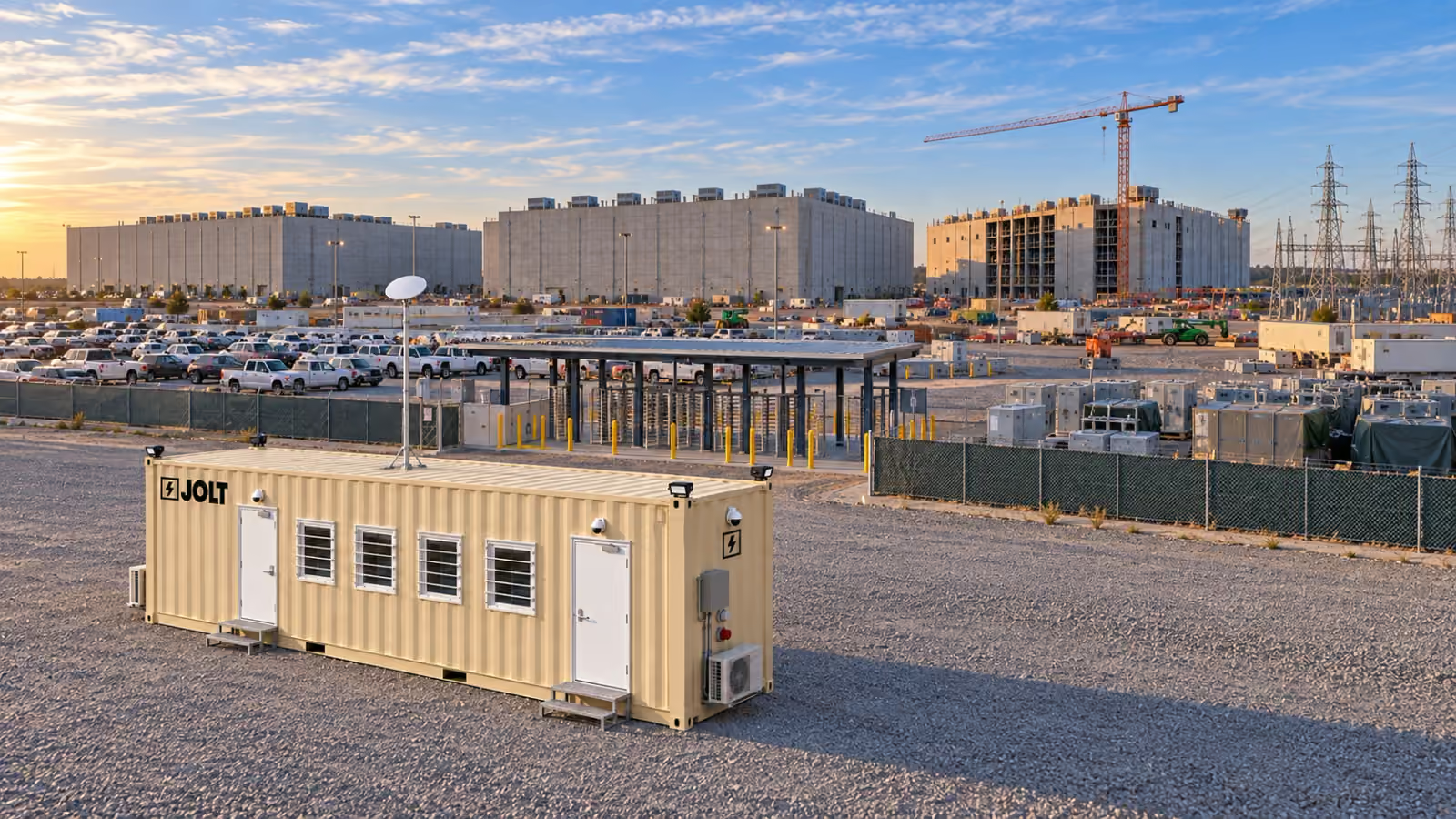
A secure Grid Command office for owner's representatives and commissioning agents, with badge-ready doors and nationwide deployment.
- Grid Core
- $1,950/mo
- Grid Command
- $2,750/mo
- DC Deploy
- Quoted per campus
- On-site window
- 6–8 weeks
- Legal-width loadNo oversize permits
- On site in6–8 weeks
- One invoiceper unit
- Badge-ready
- Stackabletwo-high
- Moves withyour phases

Key facts
- The Core the Grid — 40 ft data center site office rents for $1,950 per month as of .
- The reservation deposit on the Core the Grid — 40 ft data center site office is $2,500 as of .
- The minimum rental term on the Core the Grid — 40 ft data center site office is 12 months as of .
- Grid delivery window is 6–8 weeks after the reservation as of .
Cite this page: "A separate, secure office for the owner's side of the build." JOLT (Jolt Rents), https://joltrents.com/data-centers/owners-reps-and-commissioning/. Last updated September 17, 2026.
Owner's representatives, construction managers and commissioning agents reserve Grid Command because it is badge-ready on both doors, equipped with four cameras, connected on its own Starlink, and can move from the construction side of a campus to the operations side when the building turns over. The owner's team keeps its own room, network and records on the GC's campus.
The general contractor's office is the general contractor's. The owner's issue log, the change-order file, the commissioning scripts and the conversation with the hyperscaler's regional director do not belong on the GC's network or behind the GC's door. Every owner's rep knows this, and most of them have spent a year in a borrowed corner of a trailer anyway. This page is about not doing that.
Why does the owner's team need its own office on the GC's campus?
Three reasons, and they are the same on every hyperscale build.
Confidentiality. The owner's representative carries the owner's budget, the owner's schedule pressure and the owner's position on every dispute. The commissioning agent carries the test results that decide whether the GC gets paid for a milestone. Neither can work in a room the GC's project team walks through.
Continuity. The GC's campus moves with the GC's work and leaves when the GC does. The owner's team is on the campus from the first pad to the last turnover and then hands the keys to the facilities group. An owner-side office that lands in month one and moves to the operations side in month twenty is the one office on the site that outlasts the construction.
Authority. The owner's rep runs the weekly owner's meeting, the pay-application review and the punch walk. The room those happen in should be the owner's room, with the owner's badge readers on the doors and the owner's drawings on the screen.
How does a Grid keep the owner's network and documents separate?
The rack is the owner's. Command carries Cat6A drops from a wall-mount rack with a patch panel and Wi-Fi 6 access point. Starlink provides a connection independent of the GC's guest network. When the owner's IT contractor pulls fiber to the office, fiber lands in the same rack and Starlink becomes backup.
The doors are the owner's. Both ship with electric strikes, door contacts and low-voltage pathways for the owner's access-control vendor. Four IP cameras record to an NVR, use LTE backhaul for motion alerts and retain 30-day cloud clips.
Inside, eight lockers hold the commissioning instruments overnight, the plan rack holds the record set, and the steel walls, grated windows and lockable steel doors make the room a place a confidential file can be left on a desk.
How do commissioning agents run Level 1 through Level 5 out of a Grid?
Commissioning on a data center runs in five levels: factory witness tests, site arrival inspections, startup and pre-functional checks, functional performance tests of each system, and the integrated systems test where the whole building is failed on purpose and watched. Levels 3 through 5 are run from the site, over four to eight months, by a commissioning team that grows from two people to fifteen at the integrated test.
A Command carries the core team through Levels 3 and 4: six workstations, a 10 ft table for script binders, a 75-inch display for building-management dashboards, and lockers for test instruments. For Level 5, a second Command can stack on top with a Stack Kit at $395/mo plus $1,500 setup. Some commissioning firms stack a Core instead, at $1,950/mo, as the test-records room.
The office sits on the operations side for Levels 4 and 5, beside the electrical yard where the generators and switchgear are. Moving it there uses the $1,250 on-campus relocation.
What does the 75-inch display do for Cx scripts and IST dashboards?
It is the test director's screen. The 75-inch display with HDMI and USB-C shows the building management system's live trends during a functional test, the electrical power monitoring system's one-line during a generator failover, and the integrated systems test script with the current step highlighted. During an IST, the room runs the test from the screen while the field team on radios executes it, and the owner's operations staff learn the building by watching it fail and recover.
The 10 ft table holds the script binders and the laptops. The whiteboard walls carry the test schedule and the deficiency log. Two exterior doors mean the field team can come and go without crossing the test director's table.
What does the owner's office look like during an integrated systems test?
It is 2 a.m. and the building is about to lose utility power on purpose. The test director is at the end of the table with the script on the display. Building-management trends and the electrical power monitoring system's one-line share the screen. Commissioning engineers are at the workstations with vendor startup engineers' phone numbers open. The owner's operations manager is watching the generators take the load.
The room is on the operations side and on its own Starlink because site fiber is part of the test. The doors are badged on the owner's system, and the four cameras have been recording to the NVR the whole time. When utility power returns and the building rides through the retransfer, the test director records the time and updates the deficiency list.
That is the room the owner's side of the build needs, and it is the one that stays after the GC leaves.
What about the construction manager on an owner-CM-GC program?
Same office, same reasons. A construction manager working for the owner as agent runs the schedule, the budget and the change process across several GCs and sits between them. On a multi-building campus with two GCs, the CM's office is the one room every party visits and no party owns, which is exactly why it should be the CM's Grid, badged on the owner's platform, beside the gatehouse. A CM can stack a Command for its own team on a Core for document control and the pay-application files.
How long is an owner-side term, and what happens at turnover?
Longer than the GC's. The owner's team is on site from the first pad to the last turnover and stays on the operations side for the facilities group after. The minimum term is 12 months, with a 5% annual escalator.
At turnover, the commissioning firm leaves and the facilities group moves in. The office moves, if it has not already, to an operations-side pad. The owner then decides whether it stays rented or is bought for $64,000 and becomes the facilities team's permanent secure office.
How does the office move from the construction side to the operations side?
The JOLT technician coordinates a short tilt-bed move or a crane for a stack; the owner's electrician disconnects and reconnects power. The technician pulls the anchors, lifts the unit by its corner castings, lands it on cribbing at the new pad, re-levels and re-anchors it. The furniture stays inside, the record set stays in the plan rack, and the owner's badge readers stay on the doors.
On a campus with several buildings, the owner's office moves once per building or not at all: many owner's reps put it on the operations side of Building 1 and run every building from there.
What does an owner's rep office cost over 24 and 36 months?
See the 24- and 36-month term totals and current add-on prices on the data center pricing page.
When does the owner buy the Grid instead?
An owner running commissioning across several buildings may prefer a purchased Command at $64,000 plus DC Deploy. The office can become the facilities group's permanent secure office at the end of the program. The buy page carries the purchase and 36-month lease-to-own choices.
Commissioning firms rent. Their term ends at the integrated test, and the next building is usually in another state.
How does JOLT bill an owner's rep, a CM or a Cx firm?
To whoever reserves the unit. An owner's representative firm, commissioning firm or owner can hold the account. Rent, add-ons, the 12% damage waiver and 5% environmental fee appear on the invoice, with the deposit, Deploy and any relocation as one-time lines.
PO and net-30 are available to general contractors on a signed master rental agreement after credit approval; otherwise payment is by ACH auto-pay.
How do I reserve for a project start?
Choose the build and send the project ZIP, quantity, target date and site details through the data center reservation path; the confirmation carries the delivery window and a specialist responds within 15 minutes during business hours.
Draw the owner and GC information boundary before mobilization
List the records that belong only to the owner's team. Categories include commercial evaluations, pay-application comments, change positions, commissioning results and operations-readiness decisions. The owner decides the classification and retention rule for each category.
Next, identify which meetings require an owner-controlled room. A design clarification may belong in the GC trailer. A commercial review or acceptance discussion may require the owner's office. Write the rule before a sensitive meeting is scheduled in whichever room happens to be open.
Apply the same distinction to networks. The Grid provides included network equipment, but the owner still defines accounts, authentication, file repositories and administration. The NIST Cybersecurity Framework gives organizations a structure for managing cybersecurity risk; the owner's security team should map the temporary office into its own controls rather than treating it as an exception.
Put shared information in an intentional exchange location. The owner can keep its working file separate while publishing approved scripts, observations and action items to the project system. Separation should protect deliberation without slowing the field team that needs an accepted direction.
Run commissioning evidence review as a controlled workflow
Define what evidence enters the room, who reviews it and where the accepted record goes. Startup forms, trend exports, test scripts, photographs and issue responses may arrive through different systems. One index should identify the current version and responsible reviewer.
Use the display for group review when several disciplines must see the same evidence. Do not let the screen become the record. The designated document system should remain the authoritative location for the approved script, marked result and final disposition.
Set a meeting pattern around decision rights. The commissioning agent can present an observation. The responsible contractor can explain corrective work. The owner names the party authorized to accept, reject or defer the result.
Keep live dashboards distinct from retained evidence. A screen view helps the room understand system behavior at a moment in time. The commissioning plan should state what export, log or signed form becomes the durable record.
At the end of each session, reconcile the displayed issue list with the project system. Assign the next action and preserve the accepted result under the owner's retention rules. The office supports the review; it does not replace evidence governance.
Select the meeting room by the decision being made
Command's included conference table and display make it the stronger choice when the owner expects recurring multidisciplinary reviews. Core may fit a smaller document-control function where the project's existing meeting rooms handle large discussions.
Count simultaneous roles, not the maximum headcount on campus. Consider the test director, owner's representative, operations lead and the discipline currently under review. Field specialists can join for their portion without turning every meeting into an all-hands session.
Protect focused review time. Establish when the room is open for walk-ins and when badged access is limited to the active test team. Give vendors another place to wait so confidential discussion does not happen in front of the next group.
Decide where remote participants appear and who controls the presentation source. The display accepts HDMI and USB-C. The owner's IT team should approve the connected device, conferencing method and handling of any recording.
Locate the room according to the phase it serves. Early owner meetings may benefit from proximity to the project entrance. Functional testing may shift the useful location toward operations personnel. An on-campus relocation is a procurement decision that needs a ready pad, electrical plan and access approval.
Prepare the construction-to-operations handoff
Start the handoff register before integrated testing peaks. Identify owner-furnished equipment, temporary accounts, physical keys, badge permissions, camera access, network administration and records held in the office. Assign a construction owner and an operations recipient to each item.
Command's cameras and connectivity remain subject to third-party networks and project conditions. Rental Agreement Terms section 13 puts required recording notices, signage and consents on the customer. The handoff should name who maintains that compliance after the commissioning team leaves.
Review badge groups before facilities staff occupy the room. Remove construction-only access and confirm the operations approval path. The owner's access vendor should document its own reader configuration and service responsibilities.
Move records deliberately. Archive final evidence according to the owner's system, transfer active issues and remove duplicate working copies that no longer have a purpose. Empty lockers and desks should be checked against the equipment register rather than assumed clear.
If the office remains rented, confirm the next department, site contact and utility responsibility. If it will be purchased, use the written sale documents described on the buy page. If it will be returned, build closeout around Rental Agreement Terms section 16.
The handoff meeting should end with named control of the room, the network and the record set. A physical key transfer alone does not complete an owner-side transition.
Why not share the GC's office?
Confidentiality, continuity and authority. The owner's issue log, pay-application review and commissioning results do not belong on the GC's network or behind the GC's door, and the owner's team is on site longer than the GC.
Is the network really separate?
Yes. The Grid's rack, access point and Starlink are the owner's, and fiber can land in the same rack later while Starlink becomes backup.
Can the owner's badge vendor use the doors?
Yes. Both doors ship with electric strikes, door contacts and low-voltage pathways for the owner's access-control vendor.
Does a Command hold a commissioning team through Level 5?
Through Levels 3 and 4, Command provides six desks, a 10 ft table and a 75-inch display. For the integrated systems test, a second Command or Core can stack above it with a Stack Kit.
How does the office get to the operations side for Levels 4 and 5?
An on-campus relocation moves the unit by its corner castings, then the technician re-levels and re-anchors it while the owner's electrician handles the power connection.
What does an owner's rep office cost over 36 months?
The 36-month term total, annual escalator, fees and delivery package are shown on the pricing page.
Should the owner buy the office?
On a campus with several buildings, a purchased Command can become the facilities group's permanent secure office. Commissioning firms usually rent.
Who gets the invoice?
Whoever reserves gets the invoice: the owner's rep firm, CM, commissioning firm or owner directly. PO and net-30 are available to general contractors on a signed master rental agreement after credit approval.
Your delivered price
Pick the unit, rent or buy, and the job ZIP. Monthly rent and the route show as you go; we email the full delivered price with a 14-day lock.
Pick a length
Drawn to scale, side view.
Step 1: Unit
The Grid · Command
Which 40 ft?
Step 2: Rent or buy
12-month starting term for project quotes.
Step 3: Job ZIP
Delivery and pickup: quoted for your site.
Step 4: Send it
Request a written delivered quote from the project desk.
Step 5: Your project quote
- JOLTSite offices for data center construction. Nationwide.
- DataCenterProductNationwide Grid Command: badge-ready, connected, and ready the day it lands.
- DataCenterGuideNationwide data center site office pricing. All of it.
- DataCenterGuideDC Deploy for any campus in the lower 48.
- DataCenterMarketData center site offices in Texas: The Grid, nationwide.
- DataCenterMarketData center site offices in Virginia: The Grid, nationwide.
- DataCenterMarketData center site offices in Ohio: The Grid, nationwide.
- DataCenterGuideHyperscale, colocation, edge: what each build needs from a site office.
Talk to a data center specialist.
DC Deploy covers any site in the lower 48.
A deposit holds your delivery window. Cancel free of charge more than 14 days before the first day of the window. Deposits from $85 are applied to your first invoice.