
Data center guide · Nationwide
Container office or office trailer for a data center site?
Compare permits, setup, steel construction, stacking and moving when choosing a container office or office trailer for a data center site.
- Grid Core
- $1,950/mo
- Grid Command
- $2,750/mo
- DC Deploy
- Quoted per campus
- On-site window
- 6–8 weeks
- Legal-width loadNo oversize permits
- On site in6–8 weeks
- One invoiceper unit
- Badge-ready
- Stackabletwo-high
- Moves withyour phases

Key facts
- The Core the Grid — 40 ft data center site office rents for $1,950 per month as of .
- The reservation deposit on the Core the Grid — 40 ft data center site office is $2,500 as of .
- The minimum rental term on the Core the Grid — 40 ft data center site office is 12 months as of .
- Grid delivery window is 6–8 weeks after the reservation as of .
Cite this page: "Container office or office trailer for a data center site?" JOLT (Jolt Rents), https://joltrents.com/data-centers/container-office-vs-office-trailer/. Last updated September 25, 2026.
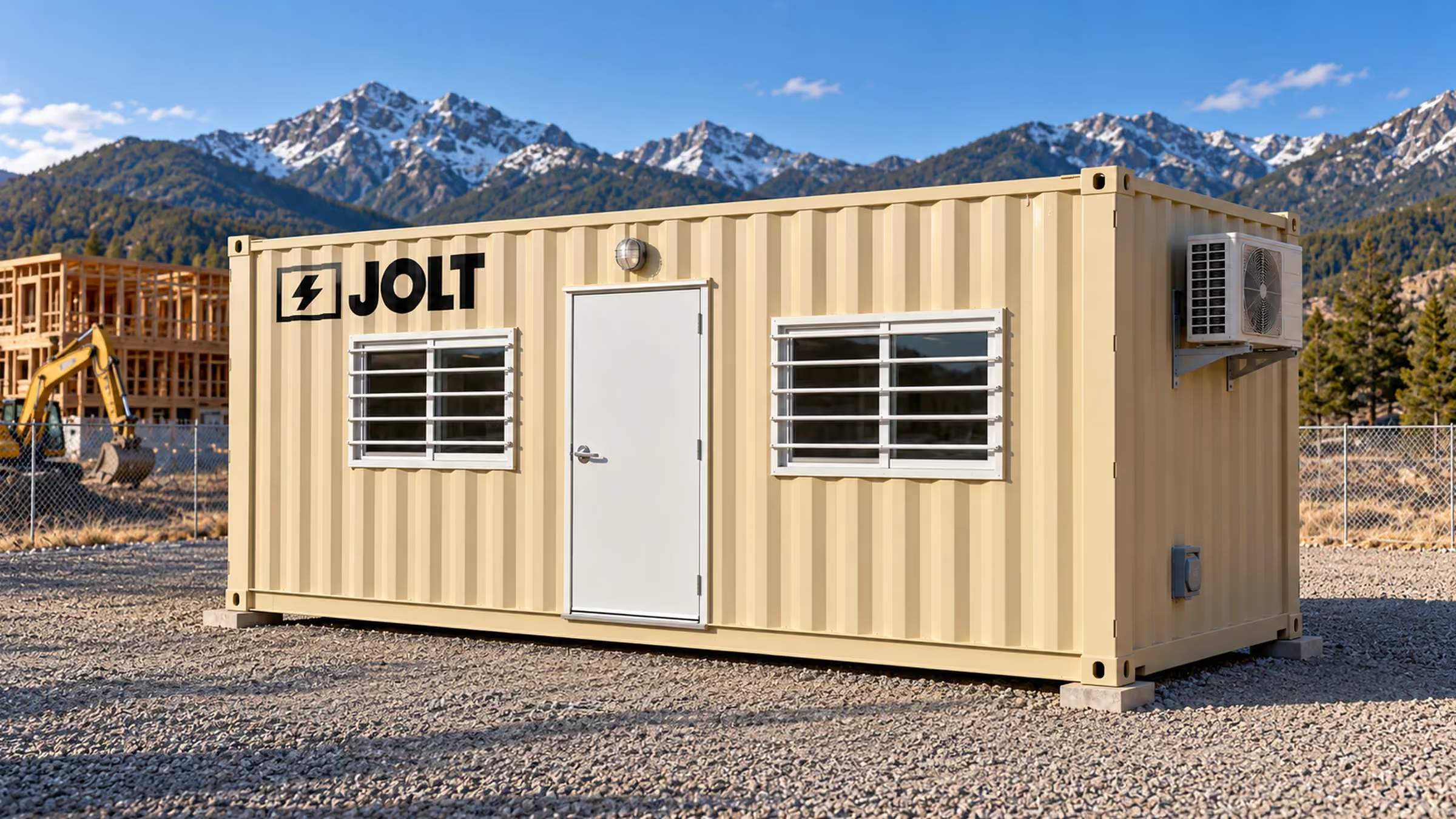
For a data center site, a 40 ft container office wins on delivery because it is a legal-width load with no oversize permits; on simpler setup without skirting; on security because it is steel end to end with grated windows and badge-ready doors; on stacking two-high; and on relocation between phases. A 12 × 60 office trailer wins on floor area per unit and can cost less as a basic unit. The written quotes are the figures that count.
This page is written by a company that rents container offices, so read the trailer column carefully. It is accurate. Trailers are the right answer for some data center sites, and the last section says which.
The comparison
| Planning line | 40 ft container office (The Grid) | 12 × 60 office trailer, typical |
|---|---|---|
| Transport width | Legal-width load | Oversize load; confirm route and permit requirements |
| Permits to move | No oversize permit | Oversize permit per state crossed; confirm conditions |
| Delivery and set | Flatbed with tilt-bed placement or crane set | Toter truck and set crew |
| Setup | Cribbing, leveling and four-point anchoring | Blocking, leveling, skirting, steps and tie-downs |
| Construction | Steel walls, roof, floor, doors and welded frame | Wood frame and floor on a steel chassis; siding varies |
| Access control | Badge-ready hardware and pathways on Command | Confirm door preparation in the written quote |
| Cameras, internet and generator connection | Built in on Command | Separate vendors; confirm in the written quote |
| Heating and cooling | Two cold-climate mini-split heat pumps | Package system varies; confirm in the written quote |
| Stacking | Two-high on twist-locks with a Stack Kit | Not stackable |
| Move between phases | Lift by corner castings and reset | Tear down, re-permit, re-haul and set again |
| Floor area | 320 sq ft | 720 sq ft |
| Occupancy | 4 workstations on Core; 6 on Command | Layout varies; confirm in the written quote |
| Restroom | No | Optional; confirm tank or sewer requirements |
| Rent | Core $1,950/mo; Command $2,750/mo | Confirm in the written quote |
| Delivery, setup and removal | DC Deploy quoted per campus in one business day, pickup included | Confirm each charge in the written quote |
| Minimum term | 12 months | Confirm in the written quote |
Delivery: who needs a permit?
A Grid is a legal-width load in the lower 48. It moves by flatbed without an oversize permit, route survey or pilot car. DC Deploy is quoted per campus in one business day.
A 12 ft wide office trailer is an oversize load. Each state it crosses can require a permit for a specified route and operating hours; larger units may require pilot cars. A double-wide moves as two permitted loads. Trailer delivery follows the permitted route rather than necessarily the shortest one.
The permit is also why a trailer's delivery planning differs from a container's.
Setup: cribbing or a trailer set?
A container office lands on four stacks of cribbing at its corner castings, is leveled, anchored at four points and walked with the site electrician at the shore inlet. There is no skirting and no tie-down strap across the roof because the anchors connect at the corner castings.
A trailer is set on piers or blocks under its steel chassis, leveled, tied down per the manufacturer's installation manual, skirted, and fitted with steps or a ramp. The set crew returns to take it apart. A double-wide adds the marriage line: the halves are joined and the roof, floor and interior seams are finished.
On a data center site where the office lands before temporary power, setup matters less than what happens after: a Command can run through its generator inlet after placement.
Security: steel or wood?
A container office is a welded steel box. The walls, roof, floor, frame and commercial doors are steel, and the windows are grated. On a large campus with a laydown yard full of copper, that construction gives the security plan a hardened office shell.
A trailer is commonly a wood-framed building on a steel chassis with siding and a wood floor. Door and window security varies, so confirm bars, alarms and hardware in the written quote.
Access control follows the same line. Command's doors ship with electric strikes, door contacts and low-voltage pathways so the owner's badge vendor can mount readers. A trailer may need door preparation first.
Weather and wind
A Grid has R-19 closed-cell foam in the walls and R-30 in the roof, behind steel, with two cold-climate mini-split heat pumps. Two units provide redundancy.
A trailer's insulation and package equipment vary by model and vendor. Confirm the wall and roof assemblies, heating and cooling equipment, and wind design in the written quote.
Both products need anchoring that matches the site and the authority's requirements. A Grid uses four-point anchoring at the corner castings.
Stacking and campus density
A container office stacks two-high on twist-locks with a Stack Kit stair tower, landing and guardrail. Six Commands in three stacks put 36 workstations on a compact campus beside the gate. Where the laydown yard, pickup lot, badging queue and haul road all meet, stacking lets a GC use the available pad.
A trailer does not stack. A double-wide and additional single-wides each need placement, access and setup space.
Relocation between phases
This is the line where the two products are different kinds of thing.
When one building turns over, a container office is unplugged, unanchored, lifted by its corner castings, landed on new cribbing, releveled, reanchored and reconnected. Nothing is torn down.
A trailer is emptied, unskirted, unstrapped, lifted off its piers, permitted where required, hauled, reblocked, releveled, restrapped, reskirted and restepped. A double-wide is also separated and rejoined. The written quote should confirm every moving and setup charge.
Power and internet: what each one does before the site has them
A data center office often lands before temporary power and fiber, and the two products handle that gap differently.
A Grid Command carries a 50 A generator inlet with a mechanical interlock. Its Starlink, four cameras, display and receptacles are built into the configured unit. When temporary power and fiber arrive, the shore connection and rack take over while the generator and Starlink can become backup.
A trailer typically arrives with a panel and shore connection. Generator hookup, internet and cameras may come from separate vendors; confirm the scope and schedule in each written quote.
Restrooms and the things a trailer has that a Grid does not
A trailer can carry a restroom with a holding tank or a sewer connection, a break room with a sink, and a window on every wall. A Grid does not; it has four grated windows, no plumbing and a coffee counter on Command. That is a deliberate choice for a data center site, where portable restrooms are on a service contract for 3,000 workers anyway and the office's 320 square feet are better spent on desks, but it is a real difference. A GC who wants a private restroom in the project office rents a trailer or a complex for that room, and puts the Grids where the badge readers and the cameras need to be.
Floor area: where the trailer wins
A 12 × 60 trailer has 720 square feet gross. A container office has 320 square feet. For a project team that needs eight to twelve desks and a conference room under one roof, a trailer can fit the program that a single container cannot.
For four to six people, which is what most trades, most owner's reps and most colocation GCs run, 320 square feet is the right size and 720 is a room the crew never fills. For 36 people, the container answer is a stacked campus and the trailer answer is three units on three pads.
Cost: what each really costs on a data center site
Cost depends on more than base rent: compare delivery, setup, removal, cameras, connectivity, furniture, access-control preparation, generator connection, vendor count and moving charges. Use the JOLT pricing page and require every trailer line in the written quote.
Normalize both quotes before choosing a building
Put both proposals against the same requested occupancy date, rental term and site address. A low monthly line is not comparable if one quote includes setup and pickup while the other puts those items elsewhere.
Require a written description of the selected building rather than a category name. For the trailer, record the actual width, length, floor plan, restroom arrangement, furniture, heating and cooling equipment, door hardware and access equipment. For the Grid, use the Core or Command include list and selected add-ons.
Separate site work from vendor work. Identify who supplies the bearing surface, utility source, final electrical connection, data connection, permits and inspections. Ask whether access steps, ramps, skirting, blocking, anchoring, teardown and removal are included in the offered trailer scope.
Normalize security as its own work package. Compare door preparation, readers, door controllers, cameras, recording, alerts, connectivity and user administration. Command's badge-ready doors provide electric strikes, door contacts and low-voltage pathways. The customer's access-control vendor still supplies and configures its system.
Write the relocation scenario into the request for quote. Name the possible origin and destination pads, the phase when the move could occur and the site systems that must be reconnected. Do not compare a stated Grid relocation fee with a trailer quote that assumes the building never moves.
Transport width changes the delivery question
The federal width limit on the National Network is 102 inches, according to the Federal Highway Administration's compilation of commercial vehicle size rules. That source explains the highway limit, not whether a particular site entrance can accept the delivery vehicle.
A buyer comparing a 40 ft Grid with a wider trailer should request the proposed transport width in writing. For an oversized trailer, ask who obtains permits in every affected state, who selects the permitted route and whether time-of-day or escort conditions can affect the agreed arrival plan.
The last mile needs a separate review for either product. Confirm gate width, road condition, turning constraints, overhead conflicts, traffic control and the placement method. A legal-width load can still encounter a site-access problem, so legal highway width should not substitute for a delivery drawing.
If a crane set is contemplated, define the customer's lift-planning and site-control responsibilities before award. If tilt-bed placement is contemplated, review the actual approach and pad with the deployment team. Do not infer site clearances or bearing capacity from the building dimensions.
Decide the restroom scope as a site service
The restroom decision should begin with the workforce sanitation plan, not with the office floor plan. OSHA's construction sanitation standard sets minimum toilet counts in Table D-1 and addresses washing facilities. The employer must apply the rule to the actual workforce and work conditions.
A plumbed trailer can provide privacy and convenience for the office team, but it introduces a service question. The quote should identify whether the selected unit uses sewer, water and waste connections or holding tanks, and who maintains them. Ask how winterization and interruption are handled by the responsible vendor.
Plan sanitation as a separate site service for Grid users. Measure the walking route to the selected facilities and consider controlled-access boundaries, night shifts and visitors. Put any plumbing requirement in the request before comparing office formats.
Do not count a private office restroom as the whole project's sanitation provision without checking the applicable requirement. Conversely, do not pay for plumbing inside every office if a maintained site system already meets the project's needs. Put cleaning, consumables, pumping and utility work into the comparison.
For a gate office, consider whether an escorted visitor can reach a restroom without entering an unauthorized area. For an owner's office, consider privacy and accessibility. These operational questions can make a restroom trailer, a separate sanitation unit or the existing site service the clearer answer.
Compare owner-security scope, not just door material
Steel personnel doors and grated windows are visible differences, but the owner's security program reaches further. Compare locks, key control, door contacts, reader preparation, intrusion monitoring, camera coverage, footage access and the location of confidential records.
Command's badge preparation consists of electric strikes, door contacts and low-voltage pathways. WATCH adds an NVR and four IP cameras. Its other included elements are motion alerts, LTE backhaul and 30-day cloud clips. The buyer still assigns access permissions, recording notices, monitoring and incident handling.
For a trailer, ask the vendor to identify the exact door and window construction of the offered unit. Then ask the access vendor what alteration is needed for the owner's reader and controller. Do not assume a generic brochure option is installed in the building named on the quote.
Security also follows the move. Record which devices remain vendor property, which belong to the owner and who removes, protects and recommissions each system. A building that relocates easily can still have a complicated owner-system handoff.
Choose from the phase plan
Draw the office location for mobilization, structural work, fit-out and turnover. Mark when each pad, access road, power source and network connection becomes available. The right building is the one whose setup and move scope fits those transitions.
A trailer can be the clear choice when a large team needs one continuous room and the pad remains available. A container office can be the clearer choice when smaller departments need separate rooms, the gate pad is tight or the office is expected to move.
For each possible move, compare disruption rather than using the word relocatable alone. List packing, owner-system disconnection, utility work, access changes, vendor work, permits if applicable and recommissioning. Assign each item and request its price basis.
Also test the no-move case. If the project can preserve one office compound throughout construction, a larger trailer may avoid repeated changes. If turnover consumes that compound, a smaller unit that can be reset near the next work front may preserve useful proximity.
Make the decision at the campus level when both formats are needed. A large trailer complex can hold shared project functions while Grids serve gate security, field leadership or separate trades. The comparison does not have to produce one winner for every office on the job.
Which one should you choose?
Choose a trailer, or a double-wide complex, when the office must hold twelve or more people under one roof, when it will sit in one place for the whole job, when the site has a sewer or a holding-tank service and the owner wants a restroom in the office, and when the owner's security plan does not require badge control and cameras on the office itself.
Choose a container office when the office must land before temporary power or fiber exists, when the owner's plan requires badge readers and recorded cameras at the office, when the pad beside the gate is constrained, when the office will move to the next building, and when the project team is four to eight people.
A GC that needs both puts the Grid Campus at the gate and the double-wide behind it. Projects in Texas, Virginia and Ohio can use the same nationwide delivery program.
Does a container office need an oversize permit to deliver?
No. A Grid is a legal-width load in the lower 48. A 12 ft wide trailer is oversized, so its route and permits must be confirmed.
How long does each take to set?
A container office requires cribbing, leveling and anchoring. A trailer requires blocking, tie-downs, skirting and steps, while a double-wide also requires its halves to be joined.
Which is more secure?
The container office has steel walls, roof, floor and doors, grated windows, and badge-ready door hardware on Command. Trailer construction and security options vary, so confirm them in the written quote.
Which has more floor area?
The trailer. A 12 × 60 has 720 sq ft against the container's 320, so a trailer can better fit a larger team under one roof.
Can a trailer be stacked?
No. Container offices stack two-high on twist-locks with a Stack Kit; six Commands in three stacks provide 36 workstations.
What does it cost to move each one between phases?
JOLT's on-campus relocation is $1,250 per unit per move. A trailer requires teardown, hauling and setup, with every charge confirmed in its written quote.
Which is cheaper?
For a basic office on a site that already has power, fiber, cameras and badging, a trailer may be cheaper. Compare complete written quotes when the site also needs cameras, internet, badge preparation, a generator connection, furniture and relocation.
When should a data center GC choose a trailer?
Choose one for a larger office under one roof that will not move, on a site with restroom service and no badge-and-camera requirement on the office itself. A GC that needs both can set a Grid Campus at the gate and a trailer behind it.
Your delivered price
Pick the unit, rent or buy, and the job ZIP. Monthly rent and the route show as you go; we email the full delivered price with a 14-day lock.
Pick a length
Drawn to scale, side view.
Step 1: Unit
The Grid · Command
Which 40 ft?
Step 2: Rent or buy
12-month starting term for project quotes.
Step 3: Job ZIP
Delivery and pickup: quoted for your site.
Step 4: Send it
Request a written delivered quote from the project desk.
Step 5: Your project quote
- JOLTSite offices for data center construction. Nationwide.
- DataCenterProductNationwide Grid Command: badge-ready, connected, and ready the day it lands.
- DataCenterGuideNationwide data center site office pricing. All of it.
- DataCenterGuideDC Deploy for any campus in the lower 48.
- DataCenterMarketData center site offices in Texas: The Grid, nationwide.
- DataCenterMarketData center site offices in Virginia: The Grid, nationwide.
- DataCenterMarketData center site offices in Ohio: The Grid, nationwide.
- DataCenterProductBuy the Grid. Own the site office that moves campus to campus.
Talk to a data center specialist.
DC Deploy covers any site in the lower 48.
A deposit holds your delivery window. Cancel free of charge more than 14 days before the first day of the window. Deposits from $85 are applied to your first invoice.