A rented generator, fuel runs and noise all day. Our estimate for a Base office run on a generator, with fuel runs, internet and a camera, is $2,308 a month.
What JOLT changes
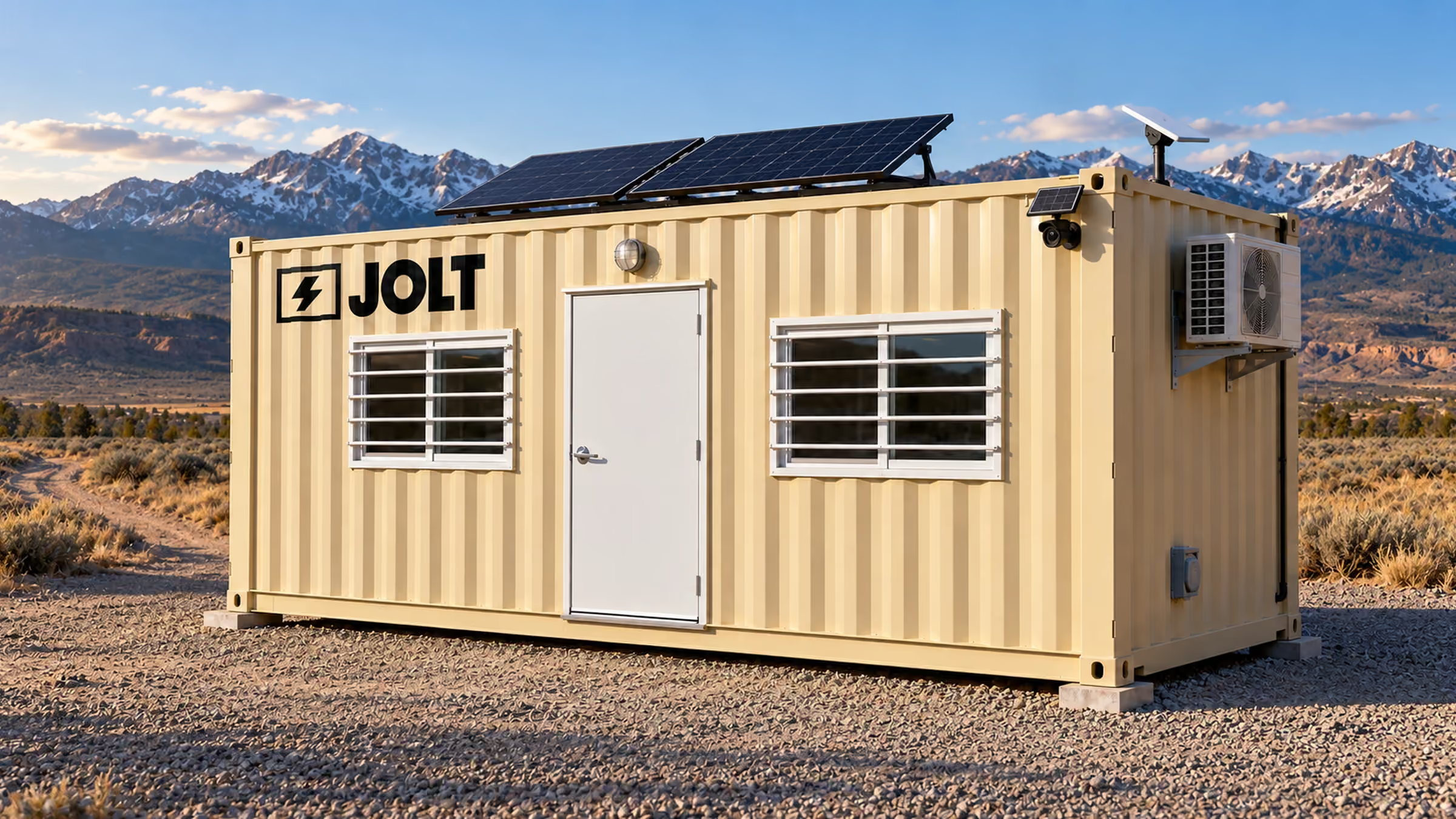
Grid-Free carries roof solar, a 10 kWh battery, Starlink and a camera. The battery runs the heat and A/C. $1,495 a month. Nothing to refuel.
Crews cool off in idling trucks. Afternoons slow down. Plans and laptops sit on the dash.
What JOLT changes
Every office has a mini-split for cooling and heat. Grid-Free runs it from its own battery.
Tools that walk off at night
What it costs you
Equipment theft costs U.S. contractors an estimated $300 million to $1 billion a year (National Equipment Register and NICB). Most of it is never recovered.
What JOLT changes
One-trip steel storage with a welded lockbox. WATCH adds a solar LTE camera with motion alerts for $129 a month. It comes built in on Grid-Free and Alpine.
Nowhere to meet the owner or the inspector
What it costs you
Walkthroughs happen on a tailgate. Plans ride on a truck seat.
What JOLT changes
A clean, lit office with a plan table (READY), Starlink for plans, email and video calls, and your logo on the door.
We help you plan the placement. Here is what Charlotte asks for. Start with the actual parcel and construction use. An Uptown renovation has different access from an airport-area compound. Show the site owner the proposed office position. Show zoning the same marked plan. Identify whether tools need a separate storage box. Charlotte treats an occupied contractor's office differently from outdoor storage. We can compare the unit footprints against the available area. Keep the approved position visible as construction phases change.
On a private lot
Charlotte's Unified Development Ordinance Article 15 names “Temporary Contractor’s Office and Contractor’s Yard.” An office incidental to construction needs a zoning use permit. That permission runs through the project's life. The ordinance calls for removal within 30 days after completion. Tell zoning which permitted construction job the office serves. Give the staff the parcel address and intended position. Ask which prescribed conditions apply to an occupied container office. Keep that answer with the project plan.
Article 15 also names “Temporary Outdoor Storage Container.” Charlotte ordinarily limits that category to 90 calendar days. Its Zoning Administrator can waive the limit for a unique situation. Ask whether an active construction tool box falls under that category. Describe the intended contents and proposed duration. A household move and a contractor's materials present different use questions. Mark the storage box separately from the occupied office. Ask for a parcel-specific interpretation when a project lasts longer. Keep any waiver decision with the use permit.
North Carolina's Office of State Fire Marshal describes the 2024 code delay. Its notice identifies the 2018 State Building Code as effective pending transition. It discusses a possible owner-requested alternative using the 2024 code. Ask Charlotte building inspections which edition applies to this office. Discuss occupancy, electrical connection and fire access for the actual build. Give inspectors the same position shown to zoning. A 20 ft office and an unoccupied storage unit need separate descriptions.
A Charlotte postal address may fall outside city limits. Check the parcel's actual jurisdiction before applying the city ordinance. Unincorporated Mecklenburg land may have another approving desk. Ask that authority about the occupied workspace. Keep the site owner informed of the land-use response. On a constrained Uptown parcel, a 10 ft storage box can fit where 20 ft cannot. That size choice still belongs on the site plan.
On a street or sidewalk
Charlotte transportation administers its Right-of-Way Use Permit program. Its brochure describes temporary occupation as more than five minutes but less than 30 days. Longer occupation calls for right-of-way lease review. Ask CDOT's Right-of-Way Management Section about the exact curb. Share the proposed stationary office position and duration. Mark any sidewalk space beside an Uptown site. Describe a brief public-space occupation separately from leaving a unit there. Keep pedestrian access part of the CDOT discussion.
An Uptown office might fit behind the property line. A public-sidewalk occupation still goes to transportation staff. Draw the parcel boundary and the proposed public-space area. Include the loading court if the project uses one. Ask whether its approved use covers the planned activity. At Charlotte Douglas, ask the project owner about controlled work areas instead. Airport-controlled staging is different from a city curb. The airport's terminal renovation description concerns an operating passenger environment. Keep the relevant owner's answer with each site plan.
A Charlotte building permit addresses construction, not every street use. The Article 15 zoning decision also concerns private placement. Ask CDOT separately when a public lane or sidewalk is affected. If the proposed curb stay is long, discuss lease review early. A private site position can be explored when street occupation is unavailable. We can compare a smaller office footprint with that approved area. Show the same position to each Charlotte reviewer.
HOA and deed restrictions
Ask a Charlotte neighborhood association about temporary structures on a visible parcel. Get the landlord's permission for a leased parking area. Check the recorded documents for access easements. A private approval can specify appearance or duration independently of Article 15. Present the actual office exterior to the relevant reviewer. Alpine brings a matte-black mountain envelope and cedar surrounds to a Charlotte parcel. Reserve room for its covered entry deck on the Charlotte pad. Ask whether that entire arrangement fits the association's restrictions.
At an airport-area commercial lot, the property owner may control an internal compound gate. Mark that control on the contractor's drawing. On a neighborhood project, the shared driveway may belong to several owners. Ask them which portion can hold a temporary box. Keep private permissions beside the zoning use permit. If a Charlotte project moves to another lot, revisit both decisions. We can compare the 10 ft and 12 ft storage options for smaller approved spaces.
Getting the site ready
Prepare a firm, level Charlotte pad. Mark where storm runoff crosses the approved work area. Note overhead lines and the useful width of the entrance. Protect the pedestrian path beside any Uptown staging plan. Keep the marked position clear as grading and materials shift. Show a separate rectangle for tool storage. Ask the site electrician about a Base office's 50-amp shore-power inlet. Identify the person who can point to the approved position. Keep the plan current through later work phases.
For the Charlotte infill site, 12 ft storage offers a man door and barred window. It can serve as a walk-in Charlotte tool crib. A 20 ft one-trip box adds four lock bars and a welded lockbox. Plan the Charlotte 40 ft high-cube position around its 9 ft 6 in height. Compare those actual dimensions with the approved site space. A 20 ft Base office needs a shore-power plan. Allow a larger Charlotte position for the 40 ft bathroom office. Discuss the unit sizes with planning before finalizing the compound layout.
Where JOLT fits best
A long Charlotte Douglas renovation may need a working office and locked storage. Destination CLT describes a major airport-capacity program. The 2025 airport update scheduled Concourse D work through fall 2026. It projected Concourse E work toward spring 2027. Ask the airport owner where a contractor compound can sit. A Grid-Free office can serve an approved pad without shore power. Its 10 kWh battery runs HVAC; Charlotte solar output depends on sun and load. The separate Charlotte 20 ft storage box has cargo doors and a welded lockbox. Both units come from the same JOLT fleet.
Charlotte's metro recorded 25,935 authorized housing units in the 2024 Census survey. Those are authorizations, not completed jobs. A multi-phase Charlotte housing site can need office meetings during framing. Separate locked storage can hold tools between trade shifts. Ask zoning about each unit's use category. Reserve space that remains viable after utility work. Describe every unit the Charlotte housing site needs to the project desk. Choose a 12 ft walk-in crib if the approved pad is narrow.
Built for Charlotte weather
The NWS January Charlotte normals show a 31.8°F average low. They record 3.49 inches of January precipitation. The July normals show a 90.3°F average high. They record 3.74 inches of July precipitation. The December normals put normal annual precipitation at 43.6 inches. These 1991–2020 airport averages guide seasonal planning. Check drainage on the actual Uptown lot.
For a powered Charlotte site, Base offers mini-split heat and cooling. Put its 50-amp shore-power inlet on the Charlotte electrician's connection plan. Keep the approved pad accessible after a July downpour. On a site awaiting service, Grid-Free needs no shore power. Its battery runs the HVAC; output depends on sun and load. The build also carries solar, Starlink and a camera. Ask about sun exposure at the actual Charlotte position.
At a visitor-facing Charlotte compound, Alpine adds a covered entry and backup heat. Its standing-seam over-roof changes the Charlotte exterior presented for review. Show that exterior to the property's design reviewer. The bathroom-equipped 40 ft office has mini-split heat and cooling. It uses a 50-amp inlet. Choose the build around the site's available power and approved space. Charlotte's wet July conditions also call for attention to the walking approach. Ask the building official about any site-specific weather requirements.
Who rents JOLT offices in Charlotte
Airport renovation trades
Charlotte Douglas lists terminal renovations and expansions within an operating airport. A trade contractor may need a place for plans and coordination. Ask the airport owner about the approved work compound. Put the office position on that compound plan. Grid-Free fits a position without shore power. A separate 20 ft box can keep materials behind lock bars. Check that passenger circulation stays outside the work area. The owner's current scope determines which pad is actually available.
Concourse construction teams
The airport's 2025 update describes Concourse D and E schedules. A project spanning those phases can need a stable office location. Ask whether later work changes access to that location. For Charlotte concourse work, the 40 ft office has a bathroom at the far end. It also requires a shore-power plan. A separate 12 ft crib may fit a tighter approved material area. Give airport site management the actual unit footprints.
Metro housing contractors
The Census 2024 survey counts Charlotte-area housing authorizations. Each active parcel still needs its own land-use answer. A housing superintendent may want office space for drawings and meetings. A walk-in 12 ft crib can keep frequently used tools separate. Charlotte's Article 15 distinguishes the contractor's office from outdoor storage. Ask zoning about both categories before assigning their positions. Revisit the laydown as utilities and foundations advance. A unit approved on one lot has a different parcel decision on the next.
Uptown infill remodels
An Uptown remodel may have a small private loading court. Draw the sidewalk beside that court for CDOT. Ask whether public-space occupation enters the right-of-way process. On that Uptown lot, the 10 ft storage box fits where a 20 ft cannot. A Base office can serve an approved powered lot. Grid-Free suits an approved position before shore power is ready. Keep the tenant entrance visible on the work drawing. A long renovation benefits from office and locked storage from the same fleet.
How we built this page: rent, upgrade and delivery figures come from the JOLT catalog at build time. Permit, street, HOA and weather facts are linked to their sources in the text. Written and reviewed by Lisa Tanner.
Last updated .
Questions Charlotte contractors ask
What comes in a JOLT office for a Charlotte job?
Every 20 ft office has heat and A/C, lights, outlets, a vinyl-plank floor, a 36-inch steel door and two barred windows. Grid-Free adds roof solar, a 10 kWh battery, Starlink and a camera. Offices rent from $795 a month.
Can the office run before the site has power?
Yes. Grid-Free runs its heat and A/C, lights, outlets and Starlink from roof solar and a 10 kWh battery. Output depends on sun and load. It rents for $1,495 a month.
Can we put our logo on it?
Yes. BRAND applies your logo in 24 by 48 inch vinyl on two sides of the unit. $450, one time.
Do I need a permit for a jobsite office in Charlotte?
Yes, Charlotte's Article 15 calls for a zoning use permit for a temporary contractor's office incidental to construction. Ask zoning whether the actual parcel and project qualify. The ordinance allows that use during the project and calls for removal within 30 days after completion. Ask building inspections about occupied-office and electrical review.
Can the office sit on a Charlotte street?
Only if Charlotte authorizes that public-space use. CDOT's Right-of-Way Use Permit brochure describes temporary occupation lasting more than five minutes but less than 30 days. Longer occupation goes through right-of-way lease review. Show CDOT the specific curb and duration, or ask zoning about a private-property position.
What does the site need before delivery?
A firm, level pad, a clear path for the truck, and a person on site to show the driver where it goes. Tell us about gates, slopes and overhead lines when you ask for the quote.
How much does delivery to Charlotte cost?
Delivery to Charlotte is quoted per project. We route the unit from the nearest JOLT source yard and send a written delivered quote within one business day. It holds for 14 days. Rent is published: offices from $795 a month, storage from $225.
How long can we rent, and can we buy?
Rentals outside the Rockies start at 12 months. You can also buy an office outright or lease-to-own a 20 ft office over 24 or 36 months.
Start your Charlotte project quote
Offices from $795 a month
Pick the office, the term and the job ZIP. You get a written delivered quote within one business day, and it holds for 14 days.