A rented generator, fuel runs and noise all day. Our estimate for a Base office run on a generator, with fuel runs, internet and a camera, is $2,308 a month.
What JOLT changes
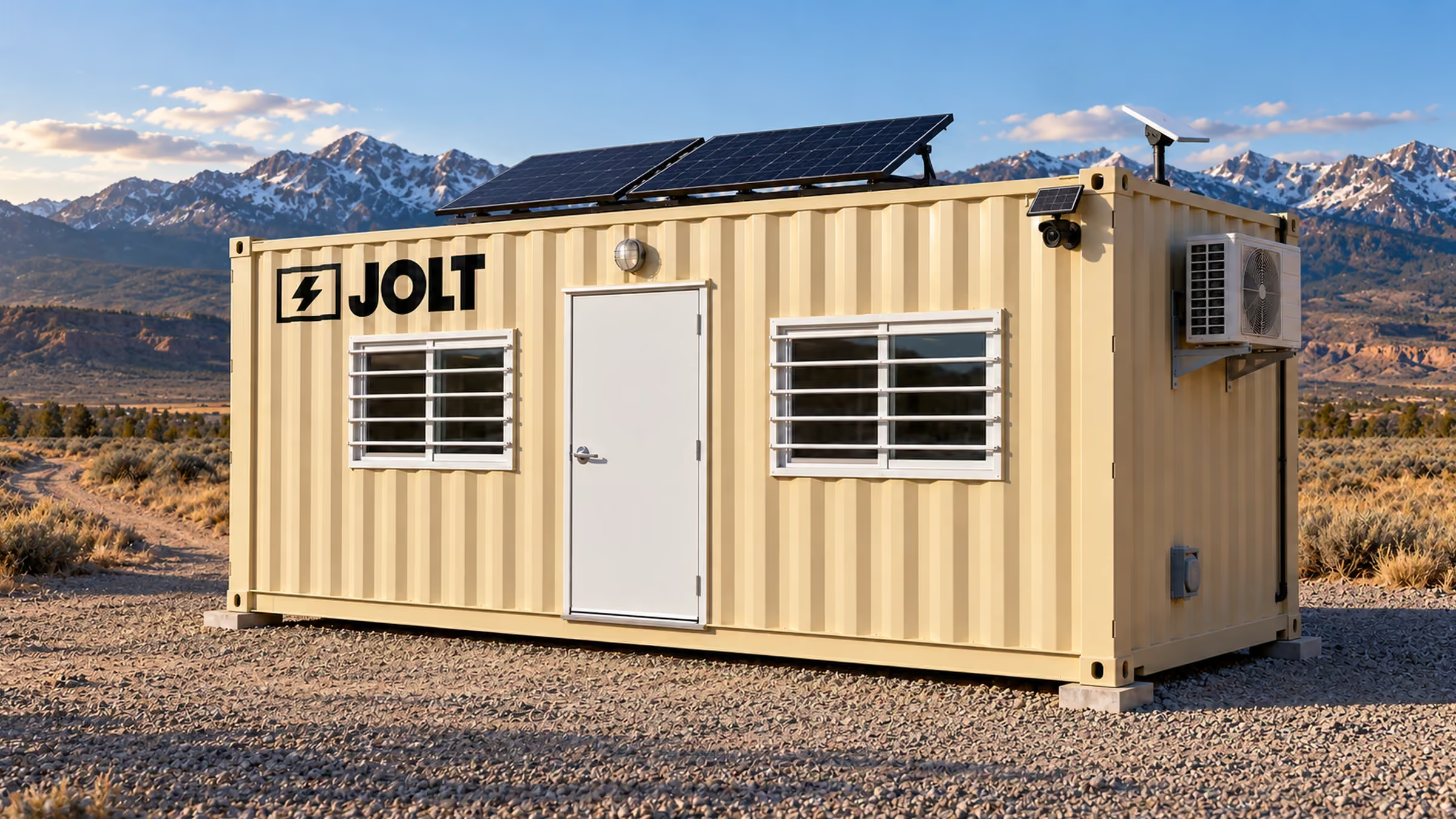
Grid-Free carries roof solar, a 10 kWh battery, Starlink and a camera. The battery runs the heat and A/C. $1,495 a month. Nothing to refuel.
Crews cool off in idling trucks. Afternoons slow down. Plans and laptops sit on the dash.
What JOLT changes
Every office has a mini-split for cooling and heat. Grid-Free runs it from its own battery.
Tools that walk off at night
What it costs you
Equipment theft costs U.S. contractors an estimated $300 million to $1 billion a year (National Equipment Register and NICB). Most of it is never recovered.
What JOLT changes
One-trip steel storage with a welded lockbox. WATCH adds a solar LTE camera with motion alerts for $129 a month. It comes built in on Grid-Free and Alpine.
Nowhere to meet the owner or the inspector
What it costs you
Walkthroughs happen on a tailgate. Plans ride on a truck seat.
What JOLT changes
A clean, lit office with a plan table (READY), Starlink for plans, email and video calls, and your logo on the door.
We help you plan the placement. Here is what San Antonio asks for. Start with the parcel and the work it supports. Airport terminal development differs from a downtown fit-out. Draw the proposed office and any tool storage. Identify the property owner and the public street owner. Take the occupied-use sketch to Development Services. Take any curb proposal to Public Works. Keep the resulting answers with the site's active drawing.
On a private lot
Ask San Antonio Development Services about zoning and platting for the legal parcel. Describe the underlying construction permit. Specify whether people will work in the office. Show the footprint and planned duration. Describe a separate locked storage box as a separate use. An occupied temporary office beside construction differs from storage behind an operating business. Ask about district conditions, setbacks and parking spaces. Include access for other trades on the same drawing. Request an address-specific response.
San Antonio's airport Terminal Development Program describes new terminal space, expanded gates and roadway work. An airport site also has an operator controlling its staging areas. Ask that operator for the approved contractor position. A downtown renovation may need a private courtyard instead. Ask Development Services how the actual lot may be used. The 40 ft bathroom office includes an enclosed bathroom. If considering it, ask the building reviewer about utility arrangements. Give the electrician the selected office's inlet information.
Outside San Antonio's municipal boundary, start with the legal parcel. A San Antonio mailing address can describe a Bexar County site. Texas Local Government Code Chapter 233 describes specific powers in unincorporated territory. Ask the appropriate county office about that proposed use. The site's street may have another owner. Keep parcel and road inquiries separate. We can compare footprints once that jurisdiction is established. Mark the authorized location on the worksite drawing.
On a street or sidewalk
Ask San Antonio Public Works which process governs the proposed public-space occupation. Show whether a stationary office or an access operation reaches the curb. Identify the street, sidewalk and proposed dates. A downtown alley can be public even behind a commercial building. Ask about that alley before using it as part of the site plan. Explain how pedestrians reach neighboring entries. Mark the office's private destination separately. Keep the Public Works answer beside the private-site permission.
For a San Antonio International Airport project, the roadway and contractor gate may have different controllers. The airport construction and development page lists work packages. Ask the airport operator about the actual contract gate. Ask Public Works about any city-controlled street occupation beyond it. A terminal program does not identify a permitted pad for every contractor. Give the prime contractor the selected unit footprint. Keep the access plan current as airport work changes.
A San Antonio downtown infill site may rely on one narrow curb opening. Draw parked vehicles and the adjacent pedestrian way. Ask the public authority about any lane or sidewalk occupation. If the curb is unavailable, look for an approved internal position. A smaller storage box may preserve required circulation. We can compare a 10 ft tool box with a 20 ft cargo-door box. Do that after identifying the street owner. Keep public-space permission separate from the building review.
HOA and deed restrictions
On a San Antonio residential parcel, ask the association about temporary office use. Show the driveway position and how long the site expects it. Ask the property owner for written consent. A leased commercial lot requires the landlord's answer too. Development Services can address city land-use questions. A deed covenant requires its own review. Keep those answers together with the legal parcel record. Ask the association about any separate storage box.
For San Antonio appearance reviews, Alpine's matte-black envelope has cedar surrounds. Put its covered entry deck on the footprint drawing. Show that exterior to the association if needed. A downtown business landlord may instead prioritize parking. Mark existing parking on the site plan. Check whether an easement crosses the proposed pad. A Base office still needs the same parcel-level placement response. We can help compare different approved positions.
Getting the site ready
Walk the San Antonio site's actual entrance. Find overhead lines and material stockpiles. Mark the legal curb cut on the drawing. Choose a firm, level, drained pad. Leave the circulation needed by existing businesses. Ask the superintendent how excavation changes access. Identify a site contact with the approved position sketch. Keep the future work phases visible on that drawing.
At a San Antonio site with service, Base uses its 50-amp shore-power inlet. Ask the electrician about that connection. For an airport-phase pad awaiting utilities, Grid-Free needs no shore power. On that airport parcel its battery runs HVAC. San Antonio sunlight and office load affect solar output. A 12 ft storage box provides a walk-in crib. The 20 ft storage box gives crews cargo doors and a welded lockbox. Draw each unit's position before settling the work corridor.
If the San Antonio entrance crosses a sidewalk, note that crossing for Public Works. Mark the bathroom office's utility position when relevant. Discuss the proposed occupied area with Development Services. A superintendent can indicate where active trades need to pass. Revisit the plan as curbs or excavations are built. Keep an approved alternative pad in mind if the project changes. Tell the project desk the actual available area and power status.
Where JOLT fits best
An extended San Antonio airport package may need a workspace and locked storage. Source its office and tool box from the JOLT fleet. Describe the approved airport footprint to our project desk. The Terminal Development Program includes gates and roadway improvements. That program spans different site conditions. Ask the prime contractor for the active package's staging drawing. Grid-Free suits a position awaiting power. A separate 20 ft box keeps materials in a cargo-door space.
A year-long downtown renovation may have little private land. A 10 ft storage box fits some positions where a 20 ft does not. Choose the 20 ft office after Development Services reviews occupied use. Base suits a serviced pad. Ask Public Works about the alley or street approach. Mark the building's customer entrance on the drawing. We can discuss the office-and-storage mix against that constrained layout.
Another San Antonio site may have space for a 40 ft bathroom office. That build includes mini-split heat and cooling. It also uses shore power. Ask the building reviewer about the bathroom's site utilities. Give storage its own approved position. A smaller office can fit a tighter site. Choose based on the actual work package and available airport space.
Built for San Antonio weather
NOAA's 1991–2020 San Antonio airport normals show a July average high of 94.9 °F. January's average low is 41.0 °F. July precipitation averages 2.41 inches there. Use the NWS Austin–San Antonio climate office for current observations and forecasts. Check its local information for outdoor work. Plan the office's power arrangement before the hottest work phase.
Every San Antonio office includes mini-split heat and cooling. San Antonio Base positions connect through a 50-amp shore-power inlet. Grid-Free includes built-in solar, Starlink and WATCH. At a local pad, its 10 kWh battery runs HVAC. Sun and office load affect that site's solar output. For an approved San Antonio location, Alpine adds a covered entry, over-roof and backup heat. A 40 ft bathroom model also needs shore power. Select according to the actual parcel's electrical plan. Ask the permitting desk about occupied use and utilities.
A San Antonio downpour can change a poorly drained pad. Ask the superintendent where runoff accumulates. The 10 ft storage model has a man door and barred window. The 12 ft model works as a walk-in tool crib. For San Antonio tools, the 20 ft one-trip box carries four lock bars and a welded lockbox. A taller 40 ft high-cube measures 9 ft 6 in. Compare that height with overhead access. Place either box on a firm drained area. Keep its footprint outside the project's required circulation.
Who rents JOLT offices in San Antonio
Terminal expansion contractors
San Antonio airport's Terminal Development Program describes added terminal space and gates. Airport project teams need approved contractor staging. Ask the operator where an occupied office may stand. A Grid-Free office serves a phase without shore power. A separate 20 ft box provides locked materials space. Confirm both footprints with the prime contractor.
Terminal A and B rehabilitation teams
The airport construction and development listings include a Terminal A/B reconfiguration and rehabilitation event. That listing describes a project opportunity, not a pad assignment. Ask which contract package needs a site office. A 40 ft bathroom office needs utilities and a larger area. A 12 ft crib can fit a smaller approved storage position. Keep passenger-area access distinct from the worksite drawing.
Downtown commercial remodelers
A downtown San Antonio fit-out may share its alley with neighboring businesses. Ask Public Works about any proposed public-space use. A Base office suits a powered private lot. A 10 ft storage box uses a smaller space for tools. Show the landlord both positions. Keep required parking visible on the plan. Check the active building permit with Development Services.
Airport roadway crews
The Terminal Development Program also describes roadway improvements. A roadway crew may change its staging area between phases. Ask the operator which gate serves the current work. Grid-Free offers an office without shore power. The one-trip 20 ft storage box has cargo doors and a lockbox. Give Public Works a separate description of any city street occupation.
How we built this page: rent, upgrade and delivery figures come from the JOLT catalog at build time. Permit, street, HOA and weather facts are linked to their sources in the text. Written and reviewed by Lisa Tanner.
Last updated .
Questions San Antonio contractors ask
What comes in a JOLT office for a San Antonio job?
Every 20 ft office has heat and A/C, lights, outlets, a vinyl-plank floor, a 36-inch steel door and two barred windows. Grid-Free adds roof solar, a 10 kWh battery, Starlink and a camera. Offices rent from $795 a month.
Can the office run before the site has power?
Yes. Grid-Free runs its heat and A/C, lights, outlets and Starlink from roof solar and a 10 kWh battery. Output depends on sun and load. It rents for $1,495 a month.
Can we put our logo on it?
Yes. BRAND applies your logo in 24 by 48 inch vinyl on two sides of the unit. $450, one time.
Do I need a permit for a jobsite office in San Antonio?
Yes, a San Antonio occupied office may need Development Services review. Ask that department about the parcel's zoning, platting and temporary occupied use. Include the office dimensions, utility connection and underlying construction permit. We can compare sizes once the reviewer identifies a lawful position.
Can the office sit on a San Antonio street?
Yes, if San Antonio Public Works authorizes the particular public-space occupation. Show its right-of-way reviewer the street location, curb position, dates and sidewalk crossing. Explain whether the unit stays there or only passes through. We can discuss another private pad if the requested position is unavailable.
What does the site need before delivery?
A firm, level pad, a clear path for the truck, and a person on site to show the driver where it goes. Tell us about gates, slopes and overhead lines when you ask for the quote.
How much does delivery to San Antonio cost?
Delivery to San Antonio is quoted per project. We route the unit from the nearest JOLT source yard and send a written delivered quote within one business day. It holds for 14 days. Rent is published: offices from $795 a month, storage from $225.
How long can we rent, and can we buy?
Rentals outside the Rockies start at 12 months. You can also buy an office outright or lease-to-own a 20 ft office over 24 or 36 months.
Start your San Antonio project quote
Offices from $795 a month
Pick the office, the term and the job ZIP. You get a written delivered quote within one business day, and it holds for 14 days.