
Straight answer
Can you put a container office on a city street?
Ask the city about street placement and occupied-office use before reserving. Do not assume its storage-container process covers your proposed office.
- Reading time
- 9 min
- Updated
- 2026-10-22
- Rentals from
- $85/mo
- Talk to us
- 970-279-1015

Key facts
- The 10 ft storage container rents for $225 per month as of .
- Standard delivery is scheduled 2–4 weeks after the reservation as of .
- Free cancellation ends 14 days before the delivery window opens as of .
Cite this page: "Can you put a container office on a city street?" JOLT (Jolt Rents), https://joltrents.com/answers/container-office-on-city-street/. Last updated October 22, 2026.
Only with the city's written permission for that exact spot and use. Street and right-of-way permits that cities such as San Diego and Minneapolis publish cover storage containers and dumpsters for set periods, not an occupied office. Ask the street-use or right-of-way office before you reserve; JOLT does not guarantee permits, and a delivery quote is not permission.
Is your planned location private land or public right of way?
Start by identifying the exact boundary of the proposed placement. Do not assume that an area beside the project belongs to the property owner simply because the contractor already uses it for access. Mark the proposed office outline on a location drawing and ask the responsible local authority whether it falls within public right of way. Keep the answer attached to that specific location.
Make the distinction visible in the approval request. Permission from the owner to use private land and permission from a city to use public space answer different questions. If the office would cross a boundary, show that clearly rather than describing the whole area as the jobsite. Ask which authority must review each portion before treating the location as settled.
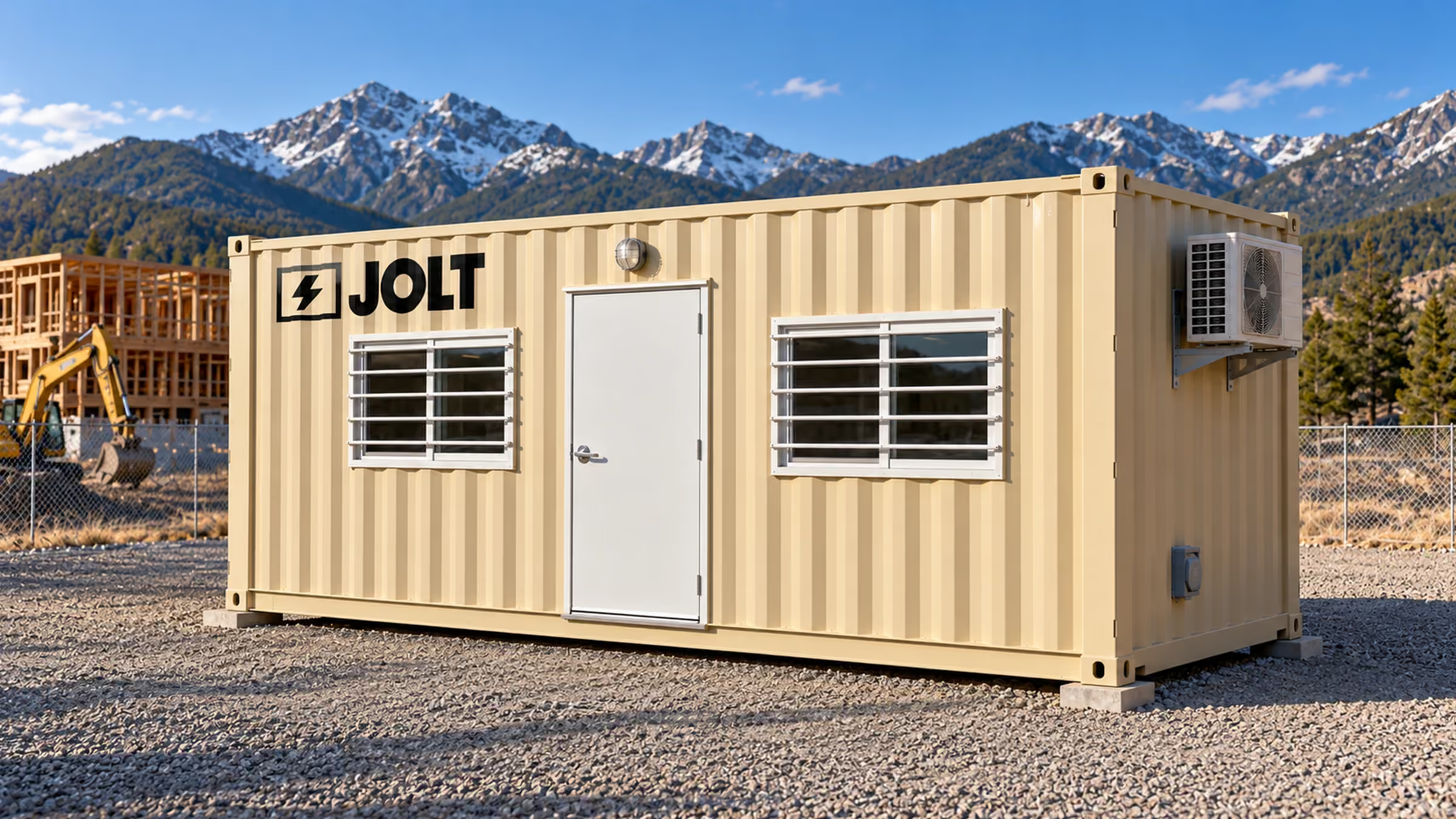
For JOLT's Base office, describe the ISO enclosure by its 20 ft length, 8 ft width and 8 ft 6 in height. Its openings include two barred slider windows plus a steel personnel door specified at 36 inches. Include the unit identity and these dimensions in the inquiry. They describe equipment the city can assess, not permission for any particular curbside position.
Also identify how the office will be used. An occupied project office is not the same request as a container holding materials. State whether the team intends routine desk work, plan review or another use, and let the authority identify the applicable process. Avoid choosing a permit category solely because its title contains the word container.
Does a storage-container street permit allow an occupied office?
A storage permit should not be treated as evidence that an occupied office is allowed. San Diego's Information Bulletin 718 describes a Traffic Control Permit for temporary storage containers or dumpsters encroaching into public right of way, including sidewalks, under SDMC §129.0702 (sandiego.gov, Information Bulletin 718, checked October 22, 2026). Its stated storage-container permit duration is up to seven days. Those facts concern that storage and dumpster process.
They do not establish that San Diego authorizes people to work in a container office under the same permission. Ask the city to evaluate the occupied-office request directly. Supply the unit, location, use and dates instead of merely forwarding a storage application. If a staff response addresses storage only, ask for clarification before proceeding with office placement.
This distinction matters even when the physical container appears similar. A project team's daily presence inside is part of the proposed use and should not disappear from the application description. The question is not whether the container can physically stand in the space. It is whether the relevant authority has approved that location and intended activity for the requested period.
Do not generalize San Diego's seven-day provision to another city or to a different permit there. Record it as a local example showing why the permit's scope matters. Your own project needs its own authority response. A citation to a storage-container rule is useful for asking better questions, not for claiming nationwide occupied-office permission.
Which approvals may apply in addition to a building permit?
Ask about the public-space authorization and the occupied-unit review as distinct questions. A building-related approval does not automatically answer who may occupy a street, and a street permit does not automatically settle the use inside the unit. Have the city identify the required approvals and responsible departments. Do not create a universal national permit list from a single municipality's process.
Chicago, for example, has an Express Permit Program process for temporary single-level trailers used as offices, storage or sales centers with other permitted construction, rehabilitation or demolition work. The instructions reference Chicago 14A-4-405 along with 14B-31-3103 and 17-9-0301 (chicago.gov, temporary trailer instructions, checked October 22, 2026). This illustrates an office-related construction permit process. It does not establish public-street permission for a JOLT container.
Use that example to keep your questions precise. Ask whether the local office or temporary-structure process applies to the selected container and whether another authorization is needed for the proposed public-space location. If staff direct you to another office, preserve both responses. A referral between departments is not a final approval of the complete proposal.
The separate construction-trailer permit answer addresses the broader building-permit question. For a street office, keep the additional right-of-way question open until the responsible authority answers it. Do not let an approval for a construction project become an assumed approval for every temporary facility the contractor later decides to place nearby.
Why do street-use duration limits matter for a long rental?
Minneapolis requires a street-use permit for dumpsters and storage containers in streets or public right of way. Its guidance lists 30-, 60- and 90-day permits and says they are not valid during street cleaning or snow emergencies, with reference to City Ordinance 430 (minneapolismn.gov, street-use permits, checked October 22, 2026). These are Minneapolis storage-related street-use provisions. They are not an occupied-office approval or a promise of uninterrupted use.
Compare any permission you obtain with the rental commitment before reserving. JOLT office rentals in Colorado require a three-month minimum, and every rental outside Colorado requires a 12-month minimum. The local permit and the rental agreement operate on different schedules. Paying rent does not extend an expiring street authorization, and a short permit does not shorten the rental minimum.
Ask whether the proposed office could remain for the full period you need, and what happens under any stated interruption or expiry conditions. Do not assume a permit can be renewed or that an extension will be granted. Seek an answer for the actual use and dates. If uninterrupted occupancy cannot be confirmed, identify that unresolved constraint in the procurement approval.
Review the mobile-office minimum rental period before selecting a street location for a short construction phase. A location suitable for a short storage permit may still be unsuitable for the planned office deployment. Resolve the calendar conflict before treating the office as the project's long-term workspace.
Why should residential-container instructions stay separate from construction use?
Seattle's residential storage-container and dumpster guidance expressly says construction-project containers require a different permit type (seattle.gov, storage-container and residential-dumpster permits, checked October 22, 2026). That distinction is the relevant fact for a construction inquiry. It is not an occupied-office authorization. Do not lift residential placement instructions and present them as requirements for a construction office.
When searching a city's permit materials, read the use limitations before copying an application checklist. A process may address a house move, residential cleanup or storage rather than a staffed project room. Send your intended use to the city and ask which process fits. An application that is easy to find is not necessarily the correct one.
Keep the source title and the official response in the project record. If the team changes from storage to an office after the first inquiry, resubmit the actual use for review. Do not rely on a response obtained under the earlier description. A change in how people will use the unit is important information even when the container length remains unchanged.
The same care applies when reusing documents from another project. A prior permit can help identify questions to ask, but it should not substitute for current location-specific review. Check the authority, address, unit description, use and dates. These checks prevent a residential example or an earlier storage approval from silently becoming the basis for an occupied construction office.
What should you send the city before reserving delivery?
Prepare a location drawing showing the proposed office, the adjacent project and the boundary information you have. Identify the address and the exact street or sidewalk area under discussion. Include photographs that make the position understandable. Ask the city what additional drawings or information it requires rather than assuming that this initial package completes an application.
Describe the proposed office as an occupied unit, name the JOLT configuration and state the requested dates. For Base, identify that it has a 50-amp shore-power inlet and needs customer-supplied power or a customer-supplied generator. Ask what further information the authority needs to review the proposal. Do not describe the inlet as an included site electrical service.
If considering Grid-Free, identify that tier rather than leaving the power description unchanged. Its built-in equipment includes WATCH for the camera, CONNECT for Starlink and POWER for solar, alongside a 10 kWh battery running HVAC without shore power. This is an equipment distinction for the city's assessment. It does not eliminate the right-of-way or occupied-use questions.
Ask for the scope of any permission in writing: the location it covers, the use it allows and the period it authorizes. Have the project team compare that answer with the requested office deployment. If a point remains unresolved, say so in the internal approval request. Do not convert a preliminary conversation or an application receipt into a claim that the office has been authorized.
How should delivery pricing be handled while permission is under review?
JOLT prices ordinary office delivery differently by destination. Its fixed-fee region covers Colorado plus Wyoming, Utah, Idaho and Montana, with a published per-unit charge each way and equal pricing for pickup. Review the state-by-state delivery rule for this fixed-fee region. The transport price does not settle the legality of the proposed public-space location.
For all other states, submit the job ZIP and selected office for a written nationwide project quote covering delivery and pickup. The response deadline is one business day; for requests submitted after 5:00pm Mountain Time, counting begins on the next business day. Do not create an estimated nationwide fee while waiting. Ask for the project-specific written transport amounts.
The quote is valid for 14 days, and the email provides a "Reserve this quote" link that carries its delivery and pickup into checkout. Keep that validity period separate from any city's permit review timeline. If permission is still being assessed, identify that status before the team treats the quote as an instruction to deliver. A current offer is not an approval to occupy public space.
Review the office's recurring amount on JOLT pricing separately from transport and local application questions. Rent, selected recurring upgrades, the damage waiver, environmental fee and applicable sales tax belong in the budget review. No payment line should be described as buying a permit guarantee. JOLT takes nationwide office projects, but each proposed street location still needs the appropriate local determination.
How can the delivery window and cancellation deadline affect the decision?
Plan around JOLT's standard window of 2–4 weeks following reservation confirmation. Use that rule for planning without promising a particular curbside arrival date before permission is resolved. Compare the anticipated placement period with the dates the authority actually approves. If the two do not align, ask for written coordination rather than assuming either document automatically changes the other.
To cancel free, send written notice while the first day of the delivery window is still more than 14 days away. Keep the opening day of that window visible to the person making the permit-dependent reservation decision. Do not interpret the rule as a guarantee of permit approval by that date. It establishes a cancellation deadline, not a municipal review schedule.
Under Rental Agreement §16, submit pickup notice in writing at least 15 days before pickup. Consider that requirement when reviewing any local date by which the public space must be cleared. Do not assume a permit expiry itself schedules removal. Ask JOLT and the authority how to coordinate the actual plan within the stated rental and local requirements.
If the team expects the office to move later, ask about that proposal before relying on it as a workaround. Do not promise a relocation service, an added move price or automatic permission for a second location. Both the transport request and the new placement would need their own review. A possible future move is not a substitute for a viable initial location.
What is the practical approval test before a street placement?
The project should be able to identify the office, its occupied use, its exact proposed position and the authorized dates. It should also know which local authority addressed public-space use and which addressed the office itself. Check that the written responses describe the same proposal as the quote. Do not join an approval for storage to a quote for an office and treat the pair as complete.
If the authority will not confirm the proposed occupied use, evaluate another location rather than claiming that a container permit is close enough. Ask about an appropriately reviewed private-land position if one is available. The decision needs an authorized location that matches the rental commitment, not merely an open curbside space.
Keep the final authority correspondence, location drawing, office selection and written transport quote together. Give the site supervisor the approved version rather than an earlier application sketch. Confirm remaining questions before the reservation becomes a field instruction. That record lets the team distinguish a priced office delivery from a fully reviewed place to work.
Questions contractors ask
Can a JOLT delivery quote authorize a street office?
No, a delivered quote prices the requested transport and does not grant permission to place or occupy an office in public space.
Is a storage-container street permit enough?
Ask the local authority to confirm occupied-office use specifically rather than assuming a permit for storage or a dumpster covers workers in an office.
Does a property owner's approval cover the sidewalk?
Establish the public right-of-way boundary and ask the responsible authority about the proposed location instead of relying only on the adjacent owner's consent.
Does San Diego's storage permit establish office permission?
No, San Diego's cited traffic-control process concerns temporary storage containers and dumpsters, not approval for an occupied container office.
Can a Minneapolis storage street permit run through every emergency?
Minneapolis says its street-use permits are not valid during street cleaning or snow emergencies.
Does Seattle use one process for residential and construction containers?
Seattle's residential container guidance directs construction-project containers to a different permit type.
Why should a short street permit concern an out-of-state renter?
Every JOLT rental outside Colorado requires at least 12 months, so a short local street permission would not by itself cover the rental commitment.
What should I send with a street-placement question?
Identify the exact location, proposed occupied use, selected office and requested dates so the city can assess the actual proposal.
- RentBase: the office that shows up and works
- JOLTDelivery zones, fees and windows from our Gypsum yard
- JOLTContainer delivery by state.
- AnswerDo I need a permit for a construction trailer?
- AnswerWhat is the minimum rental period for a mobile office?
- SolutionRentals for municipal & government
- JOLTPrices.
- JOLTSixty-four questions. Straight answers.
Ready when your site is.
Rentals from $85/mo · every rent published
A deposit holds your delivery window. Cancel free of charge more than 14 days before the first day of the window. Deposits from $85 are applied to your first invoice.