
Twin Cities · Minnesota
Data centers under construction in Minnesota
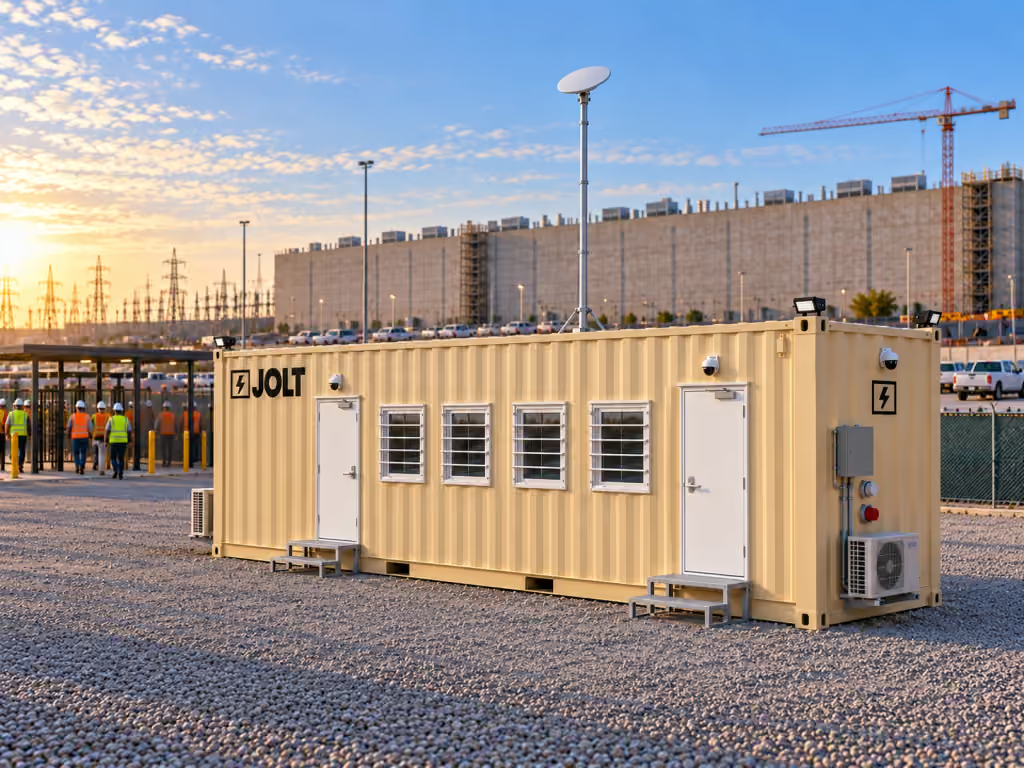
Minnesota data center projects by stage, from Rosemount to the Twin Cities suburbs, and the Grid site offices JOLT delivers to any campus in the state.
- Market
- Twin Cities
- DC Deploy
- Quoted per campus
- On-site window
- 6–8 weeks
- Grid Command
- $4,250/mo
- Legal-width loadNo oversize permits
- On site in6–8 weeks
- One invoiceper unit
- Badge-ready
- Stackabletwo-high
- Moves withyour phases

Key facts
- Twin Cities is the named corridor for 1 Minnesota market as of .
- The Command the Grid — 40 ft data center site office rents for $4,250 per month as of .
- The reservation deposit on the Command the Grid — 40 ft data center site office is $2,500 as of .
- DC Deploy is scheduled 6–8 weeks after the reservation as of .
Cite this page: "Data centers under construction in Minnesota." JOLT Mobile Offices & Containers, https://joltrents.com/data-centers/minnesota/.
Minnesota's entry on JOLT's data center construction map is 1 tracked project with 241 MW of planned power, in Dakota County south of the Twin Cities. Aterio's state count adds context: 4 data centers under construction and 45 announced against 27 operating. JOLT delivers The Grid, a badge-ready 40 ft container site office, anywhere in Minnesota.
Building in Minnesota means building through winter. A data center schedule here runs across at least one season of subzero mornings, frozen ground and snow that stays on the lot from December to March, then a spring thaw that turns farm ground to mud. The first thing a Minnesota site office has to do is keep a crew warm and reachable through all of it.
Where are data centers being built in Minnesota?
Rosemount and Dakota County. Meta Rosemount is the tracker's Minnesota record, at 241 MW planned and currently operating on the map. Its project page has the building-by-building notes, each with its date and source. Rosemount sits on the southern edge of the metro, with industrial land, highway access and room for a large campus.
The Twin Cities suburbs. Other communities around the metro, and a few in greater Minnesota, have taken data center proposals through public meetings. A project joins the map only once a company, the state, a county or a utility publishes a dated source for it.
Greater Minnesota. Large parcels near transmission lines in the south and west of the state draw interest as well. The "Projects in Minnesota" block lower on this page lists the current records by stage.
Developers look at Minnesota for its cool climate, which lowers cooling loads for much of the year, its water, its fiber through the Twin Cities, and a large utility system. Contractors see a deep union construction workforce, a metro full of experienced commercial builders, and a short building season for site work that pushes as much as possible into the warm months.
Who is building data centers in Minnesota?
The tracker's Minnesota record names its developer and the source that named it. Its general contractor and utility appear on the project page only when a dated source has announced them; until then, each reads "Not announced".
A Minnesota campus brings a familiar crew: a general contractor's project office, electrical and mechanical contractors with their own superintendents, a commissioning team, the owner's representatives and site security. Minneapolis and St. Paul have large commercial contractors and union locals with decades on hospital, stadium and corporate campus work. Those crews know how to run a winter site, which is half the job here.
What does a Minnesota site office have to handle?
Deep cold, snow, frost heave, spring mud and summer storms.
Cold. Twin Cities winters bring stretches well below zero. The Grid's two 12,000 BTU cold-climate mini-split heat pumps heat to -13 F, behind R-19 closed-cell foam walls and an R-30 roof. On the coldest mornings, a site may want supplemental heat or a generator plan; the site electrician confirms the load.
Snow. Snow stays on a Minnesota lot for months. Assign plowing around both personnel doors and the walking route, and keep plowed piles away from the bearing points so the melt does not run under the office.
Frost heave and the thaw. Frost reaches several feet down in a Minnesota winter, and the spring thaw softens the ground for weeks. Put the office on compacted stone with drainage away from it, and check the level after the thaw.
Summer storms. Minnesota summers bring thunderstorms, hail and strong wind. Every Grid placed by DC Deploy is anchored at four points through the corner castings, and the heat pumps cool and dehumidify through humid July weeks.
For Minnesota sites, the Grid site-requirements checklist lays out the bearing surface, the access route and the electrical service in one place.
How does The Grid reach a Minnesota site?
The Grid travels by flatbed on a legal-width chassis, with no oversize permit, route survey or pilot car. I-35 and I-94 bring it into the Twin Cities, and US 52 and MN 55 reach the Rosemount area. Minnesota posts seasonal weight restrictions on many local roads during the spring thaw, so a delivery planned for March or April should confirm the last-mile route with the site.
For a Minnesota site, DC Deploy covers freight, tilt-bed placement or crane set, leveling on cribbing, four-point anchoring, an electrical rough-in walkthrough with the site electrician and end-of-term pickup. The standard on-site window is 6–8 weeks, and nationwide delivery describes the package in full.
What does a Grid cost in Minnesota?
Minnesota projects rent Grid Core at $3,250/mo or Grid Command at $4,250/mo, with a 12-month minimum. The deposit and add-ons are listed on data center pricing. DC Deploy is quoted for each Minnesota campus in one business day.
Minnesota sales tax is added where it applies.
How do Minnesota data center sites get power?
Xcel Energy serves the Twin Cities and much of the state, with Dakota Electric, Connexus Energy and Great River Energy's member cooperatives across many suburbs and rural counties. Which one serves a site depends on the parcel. A campus's permanent supply is a long arrangement among the owner, the utility and state regulators. The office's needs are much smaller and come first.
On an operating campus that is adding buildings, temporary construction service is usually available at the gate. On a new parcel, the general contractor's temporary service can trail the first crews by weeks, and in a Minnesota winter an office cannot wait. Grid Command's 50 A generator inlet with a mechanical interlock lets a generator run the office until the electrician brings a 60 A circuit to the pad; the site electrician sizes the generator and confirms the load plan. JOLT's 25 kW standby generator is $1,850/mo plus fuel.
Do you need a permit for a temporary site office in Minnesota?
JOLT offices and containers are mobile and temporarily placed, so no place JOLT delivers requires a permit to use one. Give the data center specialist any anchoring request from the owner's engineer and the general contractor's insurance requirements before the delivery window.
How long should a Minnesota site office term be?
A data center building takes more than a year from groundbreaking to energized, and in Minnesota that usually spans a full winter. A one-building placement fits the 12-month minimum and runs month to month afterward without a renewal. On a phased campus, the office moves as each building turns over, for $1,250 per relocation instead of a new mobilization.
A contractor with three or more Minnesota buildings should weigh buying or the 24-month lease-to-own option on the Grid buy page against rental. One building is simpler to rent.
When does a Minnesota campus need a Grid Campus?
When the general contractor, the owner's representative, the electrical and mechanical contractors and the security office each need a room near the active building. A Grid Campus combines 2 to 12 Grids in a row or stacked two high, with a Stack Kit, stair tower, landing and guardrail for each stacked pair. The kit is $395/mo with $1,500 setup. An order of 6 or more Commands receives a 5 percent rent credit each month for its first 12 months.
On a snowy Minnesota site, a stacked pair keeps the plowed footprint small. Put the stair tower where the plow can reach it, and keep the landing clear of ice.
Plan the Minnesota office's winter power early
Ask the electrical lead four things before approving a placement: what powers the office on its first day, where it connects, who makes the connection and when the circuit is expected live. In a Minnesota winter, the first answer matters most.
When the office arrives ahead of the circuit, Grid Command's generator inlet carries it. Name who supplies the generator, who refuels it through a cold week and who switches the office to shore power when the circuit is ready.
Grid Core suits a site where shore power, contractor fiber and gate access already work. Grid Command adds the generator-ready inlet, CONNECT backup internet over Starlink, WATCH cameras and badge-ready doors, which close those gaps on a new Minnesota parcel.
Time Minnesota placements around snow and thaw
The National Weather Service office in the Twin Cities publishes forecasts and winter outlooks for the metro and the south of the state. Check them before the delivery day and before any relocation.
A winter set on frozen ground with a plowed route usually goes as planned. A set during the thaw, when roads carry weight limits and lots turn soft, is the one most likely to move. Walk the access route the day before, and move the day rather than force a truck across mud.
Compare Minnesota site office quotes on one scope
Ask every bidder for the same scope: the build, the term, the site ZIP, the delivery window, placement, anchoring, the electrical handoff, internet, cameras, furniture, relocations and pickup, with exclusions next to each Minnesota line.
Compare monthly rent and one-time charges over the same planned term. A low monthly rate with freight or pickup to be quoted later is not the same as a delivered, anchored Minnesota office whose pickup is already in the price.
Name the people on the customer's side who approve logistics and electrical work on the Minnesota site. The customer provides the access route, the bearing surface and power, and handles project-specific engineering.
What the Minnesota record shows
The notes on Meta Rosemount follow a common hyperscale sequence. Land clearing came first; then two buildings rose together with their cooling infrastructure; then the site appeared complete but was still in commissioning, with few cars in the lot; and finally both buildings were estimated to be in service. Each step on the project page carries its date and the source that reported it.
For a Minnesota contractor, the commissioning stretch is worth planning for. Once the shells and cooling equipment look finished, the work moves inside: testing, controls, startup and the owner's acceptance. The crews change, but the site office stays busy as the place where commissioning agents, the owner's team and the electrical contractor meet. A placement that ends when the building looks done from the road often ends too early.
Building two structures at once also shapes the office plan. Two buildings mean two sets of trades on site at the same time, which often calls for a second office or a Grid Campus rather than one crowded room through a Minnesota winter.
Which Minnesota counties does JOLT serve?
Every county in Minnesota. The tracker's current record is in Dakota County. Hennepin, Ramsey, Scott, Carver, Washington and Anoka around the Twin Cities, St. Louis around Duluth and Olmsted around Rochester are quoted the same way. DC Deploy is quoted per campus in one business day, with a 6–8 weeks on-site window.
Nearby state pages: Wisconsin, Iowa, North Dakota and Nebraska. Illinois has its own page as well, and the data center construction map covers every tracked U.S. project.
How do I reserve a Grid for a Minnesota project?
Choose Grid Core or Grid Command, enter the Minnesota ZIP, the number of units and the target date, then choose add-ons and protection before paying the deposit. The delivery window appears on the confirmation; cancel free in writing more than 14 days before its first day. For a campus or several buildings, start from the data centers hub and talk to a data center specialist.
How many data centers are under construction in Minnesota?
Aterio counts 4 under construction, 45 announced and 27 operating in Minnesota. JOLT's map tracks 1 Minnesota project with 241 MW planned.
Where is the Rosemount data center?
Meta Rosemount is in Rosemount, Dakota County, Minnesota, on the southern edge of the Twin Cities metro.
Does JOLT deliver site offices anywhere in Minnesota?
Yes. DC Deploy delivers, places, levels and anchors The Grid at any Minnesota site, walks the electrical rough-in with the site electrician and picks the office up at the end of the term.
How long does delivery to Minnesota take?
Minnesota sites follow the standard 6–8 weeks on-site window.
What does a Grid cost in Minnesota?
In Minnesota, Grid Core is $3,250/mo and Grid Command is $4,250/mo, each on a 12-month minimum, and DC Deploy is quoted per campus.
Which utilities serve Minnesota data center sites?
Xcel Energy serves the Twin Cities and much of the state, and cooperatives such as Dakota Electric and Connexus Energy serve many suburbs and rural counties. Until a Minnesota site's temporary service is live, Grid Command's generator inlet runs the office from a generator.
Can The Grid handle a Minnesota winter?
Two cold-climate heat pumps heat to -13 F behind R-19 closed-cell foam walls and an R-30 roof. On the coldest mornings, plan supplemental heat or generator power with the site electrician.
Can JOLT deliver to Minnesota during spring road restrictions?
Yes, on a route that carries the truck. Seasonal weight limits on local Minnesota roads can move a delivery day, so confirm the last mile with the site before the window.
Your delivered price
Pick the unit, rent or buy, and the job ZIP. Monthly rent and the route show as you go; we email the full delivered price with a 14-day lock.
Pick a length
Drawn to scale, side view.
Step 1: Unit
The Grid · Command
Which 40 ft?
Step 2: Rent or buy
12-month starting term for project quotes.
Step 3: Job ZIP
Delivery and pickup: quoted for your site.
Step 4: Send it
Request a written delivered quote from the project desk.
Step 5: Your project quote
Projects in Minnesota
The data center construction map tracks 1 project in Minnesota with 241 MW of planned power, listed by stage with the earliest stage first. The newest dated record is from .
- Meta RosemountRosemount, MNOperating241 MW
- Announced
- Approved
- Site work
- Under construction
- Operating
- Pin size: planned MW
See every project on the data center construction mapData centers under construction by state
- JOLTSite offices for data center construction. Nationwide.
- DataCenterProductNationwide Grid Command: badge-ready, connected, and ready the day it lands.
- DataCenterGuideNationwide data center site office pricing. All of it.
- DataCenterMarketData center site offices in Wisconsin: The Grid, nationwide.
- DataCenterMarketData center site offices in Iowa: The Grid, nationwide.
- DataCenterMarketData centers under construction in North Dakota
- DataCenterMarketData centers under construction in Alabama
- DataCenterMarketData centers under construction in Idaho
Bring The Grid to Minnesota.
DC Deploy covers freight, set and pickup.
A deposit holds your delivery window. Cancel free of charge more than 14 days before the first day of the window. Deposits from $295 are applied to your first invoice.