
Guide
Jobsite Offices for Solar, Wind, Battery Storage and Transmission Projects

Quick answer
Match the office to the phase. Civil crews on a site with no power take a Grid-Free office for $1,495/mo: solar, a 10 kWh battery, Starlink and a camera, built in. Racking crews take the 40 ft office with bathroom for $1,595/mo on a generator. Commissioning teams take Grid Command for $2,750/mo. The O&M handoff needs a Base office on plant power for $795/mo.
Watch on YouTube: Jobsite Offices for Solar, Wind and Battery Projects
Video · 0:33 (33 s)
Jobsite Offices for Solar, Wind and Battery Projects
Start with power. On a solar, wind, battery or transmission site with none, a Grid-Free office at $1,495/mo runs on its own solar and 10 kWh battery, with Starlink and a camera. Racking crews take the 40 ft office with bathroom ($1,595/mo) on a generator; commissioning teams take Grid Command ($2,750/mo).
Read the transcript
0:00Which office fits an energy project?
On a solar farm, a wind farm, a battery storage yard or a transmission line, choose the office by phase. Civil crews arrive before there's any power, so they take a Grid-Free office, running on its own solar and battery, with Starlink and a camera.
0:15What changes in later phases?
Racking crews need room and a bathroom: the 40-foot office, on a generator. Commissioning teams take Grid Command, with badge-ready doors and backup internet. At handoff, a Base office plugs into plant power.
Every phase is laid out at joltrents.com.
The video's own page: Jobsite Offices for Solar, Wind and Battery Projects
Key numbers
| What | Figure |
|---|---|
| Grid-Free monthly rentSolar, battery, Starlink and camera built in | $1,495/mo |
| Grid-Free batteryRuns the office HVAC with no shore power | 10 kWh |
| POWER solar panelsThe published light-load kit, with a 3 kWh battery | 2 × 400 W |
| Grid Command workstationsPlus a 50 A generator inlet | 6 |
| Minimum term outside Colorado3 months in Colorado | 12 months |
| Standard delivery windowGrid DC Deploy is 6–8 weeks on site | 2–4 weeks |
Catalog figures as of — the same ones the Price Book publishes.
Cite this page: "Jobsite Offices for Solar, Wind, Battery Storage and Transmission Projects." JOLT Mobile Offices & Containers, https://joltrents.com/energy-projects/. Last updated October 29, 2026.
Energy projects start where the power is not. A solar array, a wind farm, a battery storage yard and a transmission line all begin as a road, a pad and a crew with no office. JOLT rents the office for each phase at a published monthly price.
Four phases. Four setups. Every price below comes from the Price Book. Delivery is a fixed fee in Colorado and the Mountain West, and a written quote everywhere else in the lower 48.
| Project phase | Typical office crew | Recommended JOLT setup | Power option | Published monthly price |
|---|---|---|---|---|
| Site prep and civil | 2–3 people at desks | 20 ft Grid-Free office and a 20 ft storage container | Grid-Free: solar, 10 kWh battery, Starlink and WATCH camera built in | $1,495/mo office, $295/mo storage |
| Pile driving and racking | 4–6 people at desks | 40 ft office with bathroom and a 40 ft high-cube storage container | Generator you supply, into the 50-amp shore-power inlet | $1,595/mo office, $425/mo storage |
| Electrical and commissioning | 4–6 people at desks | Grid Command with 6 workstations | Generator into the 50 A generator inlet, then site power once it lands | $2,750/mo; 25 kW generator $1,850/mo |
| O&M handoff | 1–2 people at desks | 20 ft Base office | Grid: plant or utility power into the 50-amp shore-power inlet | $795/mo |
How we built this table: Each price is the current monthly rent from the Price Book, before delivery, the damage waiver, the environmental fee and sales tax. The crew column is a planning range for people working at desks, not field headcount and not a survey of projects. Grid Command publishes 6 workstations; the 20 ft and 40 ft offices publish no seat count, so confirm the layout with your crew before you reserve.
What does each of the 4 project phases need from the office?
Each phase asks a different question of the office. Civil work asks for power where none exists. Racking asks for room and a bathroom. Commissioning asks for desks, cameras and a generator inlet.
The handoff asks for a small office that stays. Each answer below names the build, its power and its published rent.
Site prep and civil
The first crew on site clears, grades and builds the access road. There is no power line yet. The office has to heat, cool, connect and record on its own.
That is the Grid-Free office. It is the Base office plus a 10 kWh battery pack that runs the HVAC, roof solar, a Starlink connection and a WATCH camera, all built in. It needs no shore power. A 20 ft storage container beside it holds survey gear, small tools and the first deliveries.
Pile driving and racking
Racking brings more trades to the site. The office now holds the superintendent, the foremen and the daily paperwork. The 20 ft office gets tight.
The 40 ft office with bathroom has twice the floor of a 20 ft office and an enclosed bathroom at the far end. It runs on shore power through a 50-amp inlet. Before the plant has power, that means a generator you supply, sized by your electrician. A 40 ft high-cube storage container holds the larger hardware deliveries.
Electrical and commissioning
Commissioning brings engineers, the owner's representatives and test equipment. They need desks, a plan table, a display and a lock on the door. They also need the office to run before the substation does.
Grid Command is the 40 ft site office JOLT builds for data center campuses. The same build fits a substation or commissioning crew. It ships with 6 workstations, a 10 ft conference and plan table, a 75-inch wall display, four IP cameras with an onboard recorder, and Starlink on a roof mast.
A 50 A generator inlet with a mechanical interlock lets a generator power the office before site power lands. Your site electrician sizes the generator and confirms the load plan.
O&M handoff
After commissioning, the field crew leaves and the operations team stays. One or two technicians need a desk, heat and a place to lock up. Plant or utility power is now on site.
The Base office fits that job. It has a 36-inch steel door, two barred slider windows, a mini-split for heat and cooling, lights, outlets and a 50-amp shore-power inlet. A long stay is also where lease-to-own starts to make sense.

How far do a 10 kWh battery and 2 × 400 W of solar go?
Off-grid power is arithmetic. Stored energy is the budget. Every device is a withdrawal. Solar is the deposit, and the sun sets the size of it.
Start with the published specs
JOLT publishes two off-grid packages. The POWER upgrade is two 400 W panels, a 3 kWh LFP battery and an inverter, at $399/mo. It runs Starlink, the camera, lights and laptops.
Grid-Free is the bigger system. Its battery pack is 10 kWh, and it runs the office HVAC with no shore power. JOLT does not publish the Grid-Free array rating, a cold-day runtime or a daily solar harvest. Plan with the numbers that are published, and measure the rest on site.
Do the arithmetic on one load
Take one load the specs name: Starlink. Starlink lists the Mini at 60 W with its included power supply. Run it at that full figure for 10 hours and it uses 0.6 kWh.
That is 6% of the Grid-Free battery. It is 20% of the POWER battery. The same method works for laptops, lights and chargers: watts times hours, divided by 1,000, gives kWh. Add the rows, compare the total with the battery, and you have a work plan.
Size the sun before you size the shift
Solar output changes with month, tilt, shade and snow. The national laboratory's PVWatts calculator estimates monthly output for a given address and array. Its own caution says the predictions carry assumptions and uncertainties and do not reflect site-specific conditions beyond its inputs.
Use it to see the winter gap, not to promise a runtime. Our off-grid jobsite office guide works one full winter load sheet: 9.81 kWh for one heated shift against the 10 kWh battery. Heat is the big line. On a long cloudy stretch, the crew sheds loads in an agreed order.
When a generator or grid power is the better line
Some phases need more power than a solar office is built for. A full commissioning team with test equipment belongs on a generator or site power. The Base, the 40 ft office and Grid Core plug in through their shore inlets. Grid Command takes a generator through its 50 A inlet, and the 25 kW standby generator rents for $1,850/mo, and you cancel it when temp power lands.
A generator brings exhaust and fuel into the plan. A federal portable-generator alert says to use one outdoors and never near doors, windows or ventilation shafts. Put it on the site plan before the office arrives.
What does a remote pad need for a 70 ft truck approach?
Remote sites are where delivery fails. The truck arrives, and the last mile is a two-track with a soft shoulder. Plan the approach before you reserve.
The truck and the pad
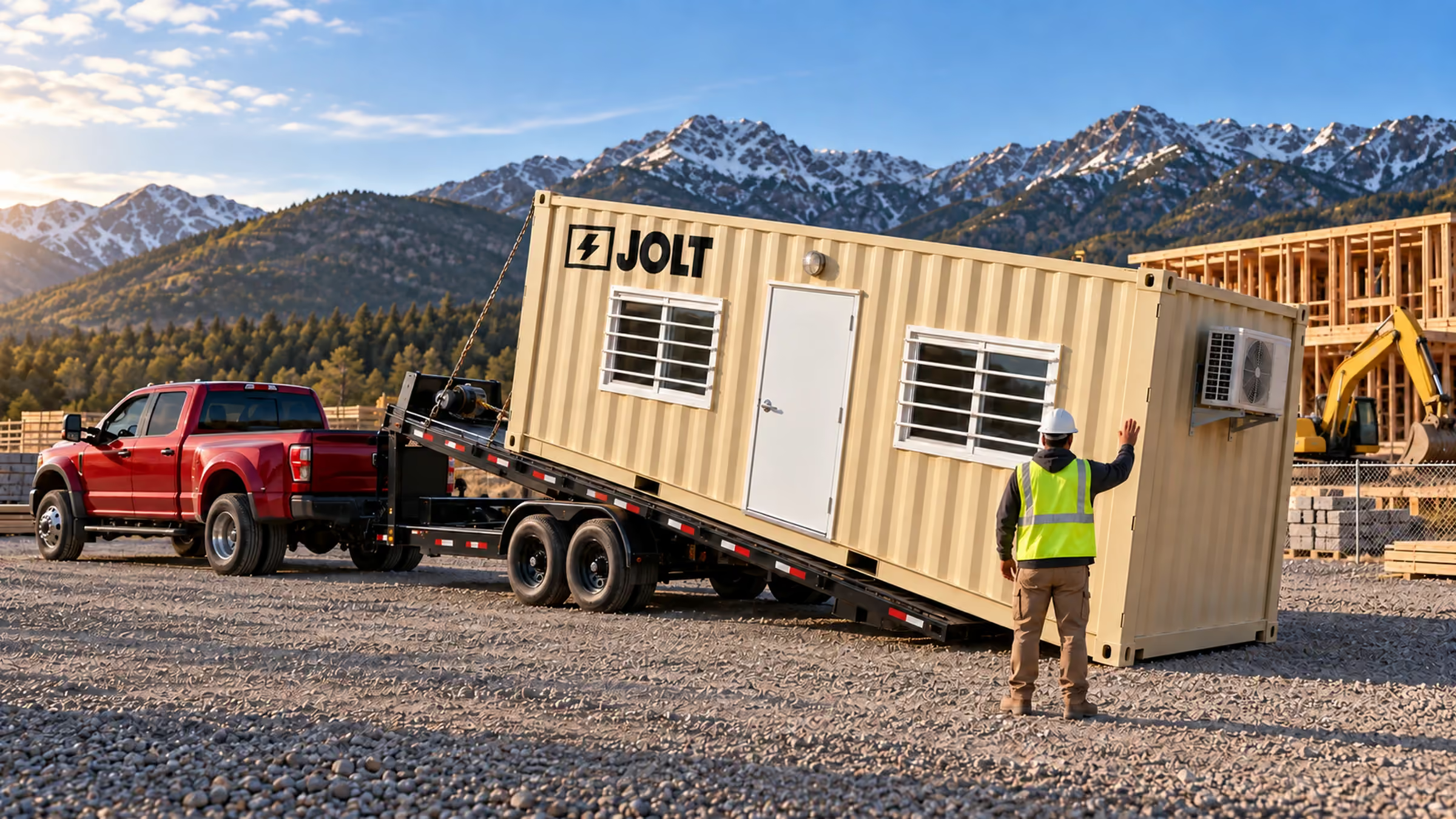
JOLT sets offices with a tilt-bed or flatbed truck. The Rental Agreement section 5.2 asks for about 70 ft of straight-line clearance for a 20 ft unit and about 100 ft for a 40 ft unit. The pad has to be firm, level and well drained. The delivery space answer walks through the measurements.
The truck itself is wide. The federal width limit for commercial trucks on the National Network is 102 inches. JOLT asks for a 12 ft clear lane as a working minimum and prefers a 16 ft gate opening where the truck turns. The truck size answer covers the rest.
Rough roads and access
A site road built for pickups may not carry a loaded truck. Check grades, turns, soft spots and overhead lines from the county road to the pad. Before dispatch, send a photo from the road into the entrance and one looking back from the pad. The mountain access guide lists what to photograph.
If the truck cannot deliver because of site conditions, you owe the trip and the next one under section 5.3. Waiting time is billed after the first 30 minutes. A dry run with a pickup and a tape measure is cheaper than either.
The jobsite setup checklist orders the rest of mobilization: pad, access, power, sanitation and lighting.
Fees and terms by state
In Colorado, delivery is a zone fee from the Gypsum yard, from $450 to $1,325 each way for a 20 ft unit. Wyoming, Utah, Idaho and Montana share one fixed fee of $3,495 per standard unit. Every other lower-48 state gets a written project quote within one business day. The delivery cost by state page lists each one.
The minimum term is 12 months outside Colorado and 3 months for a Colorado office. Standard delivery lands in 2–4 weeks. The Grid ships under DC Deploy, quoted per project, with a 6–8 weeks on-site window and pickup inside the quote. The cross-country shipping answer explains how a long haul is quoted.
How do you secure a remote site with 1 camera or 4?
Remote sites are empty at night. Copper, tools and fuel are easy to load and hard to trace. Security starts with steel and a camera, and it needs a routine behind both.
Lock the office and the boxes
The Base and Grid-Free offices have a 36-inch steel personnel door and two barred slider windows. Grid units have two steel doors and steel window grates.
The 20 ft storage container has cargo doors with four lock bars and a welded lockbox. The 40 ft high-cube has a welded lockbox. Use a shrouded padlock in the lockbox, and keep a key log.
The jobsite theft answer covers the routine: lock-up, lighting, inventory and who checks what. Read it before the first tool delivery.
Put a camera on it
WATCH is a solar LTE panoramic camera on the unit, with motion alerts and cloud clips. It rents for $129/mo on a Base office and comes built in on Grid-Free. A second camera adds $60/mo. Grid Command carries four IP cameras, an onboard recorder, LTE backhaul and 30-day cloud clips.
LTE coverage varies on remote sites. Test the signal where the unit will sit. The construction camera answer compares camera types and what each one records.
Fence and light
In Colorado, Wyoming, Utah, Idaho and Montana, JOLT also rents temporary fence at $3.50/LF/mo and light towers at $1,250/mo. Outside those states, plan fence and lighting with a local supplier. A lit, fenced compound with a camera on it is a harder target than a box in a field.
Where do panels, inverters and tools go: 20 ft or 40 ft storage?
Energy projects store expensive things in the open. Panels arrive on pallets. Inverters, combiner boxes and wire arrive in crates. Tools leave with the crew or stay locked.
Pick the size by the load, not the box
The 20 ft storage container rents for $295/mo, with a 1-month minimum in Colorado. It is standard height, with cargo doors, four lock bars and a welded lockbox. It fits tools, small parts and the gang box.
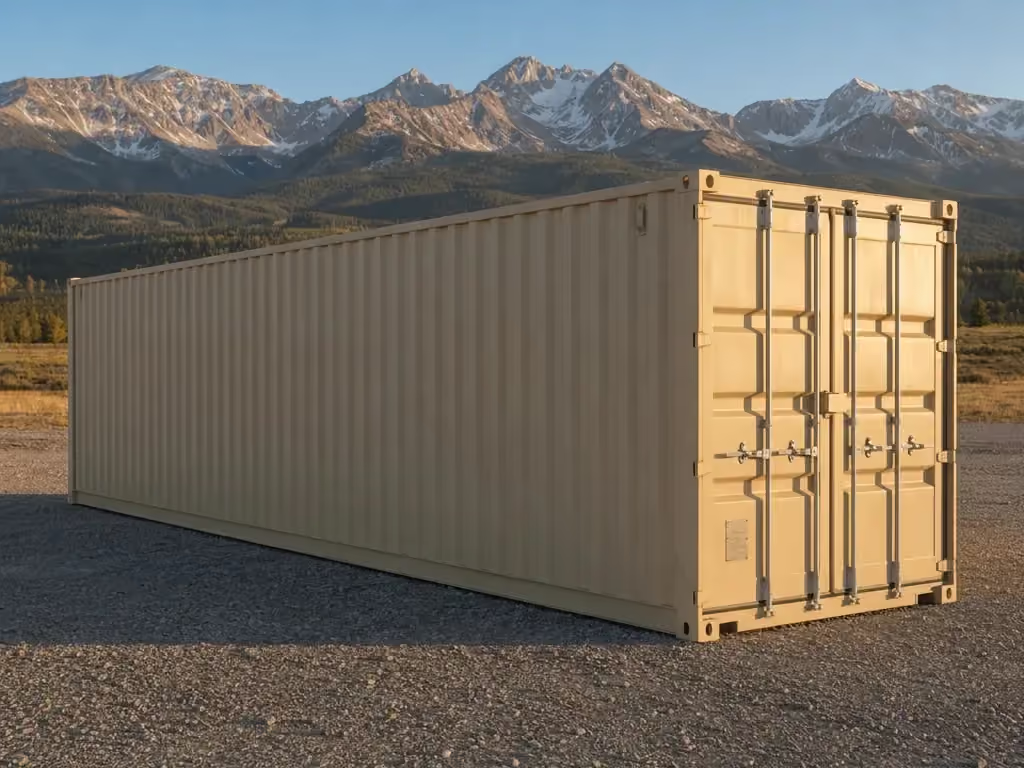
The 40 ft high-cube rents for $425/mo. It is 9 ft 6 in tall, with twice the floor of a 20 ft unit and a welded lockbox. It fits the larger crated deliveries and the pallets that need a roof.
Check the manufacturer's storage limits
A storage container is plain storage, with no windows, and JOLT publishes no temperature control for it. Inverters, batteries and modules have storage limits set by their manufacturers. Read those limits before you store equipment through a summer or a winter.
Keep pallets off the floor where the manufacturer asks. Leave a clear aisle to the doors. The construction storage answer covers sizes, placement and lock-up.
How does the fleet grow as the crew passes 6 desks?
A project fleet grows with the work and shrinks before the handoff. Plan it by phase, not by peak. Every unit is its own line, with its own delivery and pickup.
Count desks, then add units
Count the people who work at desks in each phase. Grid Command ships with 6 workstations and Grid Core with 4. An extra workstation pack adds a desk, a chair and two network drops, up to four per Grid unit. Past that, add a unit.
For the 20 ft and 40 ft offices, JOLT publishes no seat count. Walk the crew through the floor plan before you reserve. The READY upgrade adds a plan table and 2 chairs to a 20 ft office.
Add units, not rebuilds
A second office is a second reservation line. Each unit has its own deposit and its own delivery fee. Reserve the next unit at least 2–4 weeks before the phase that needs it.
Plan the shrink too. After the minimum term, each unit rents month to month until you call for its pickup. Call when its phase ends, not when the last crew leaves.
Moving a unit across the site
A project that moves across a large site may want its office to follow. Under section 5.5 of the Rental Agreement, you may not move, lift or tow a unit without JOLT's written consent. Ask for a relocation before the phase changes, not on the morning the crane arrives. A Grid move on the same site is $1,250 per move.
When does lease-to-own beat 24 or 36 months of rent?
Some energy builds run for years. Some owners keep an office on the site after the handoff. That is where lease-to-own belongs.
The plans and the terms
Every 20 ft office build has a 24-month and a 36-month plan. A Grid-Free plan is $1,845/mo over 24 months or $1,545/mo over 36 months, a $55,620 total on the longer plan. A Base plan starts at $845/mo over 36 months. Title transfers on the final payment.
Grid Core and Grid Command have 36-month plans at $2,095/mo and $2,795/mo. Stone Ridge Leasing, LLC is the lessor of record until title transfers. You start by phone or the contact form, not the online reservation.
Compare it with rent
Rent on a multi-year job rises 5% on each anniversary of delivery under section 3.4, unless your order says otherwise. A Grid-Free bought outright costs $24,500. Cumulative Grid-Free rent passes that price in month 17.
If the office stays on site after the build, lease-to-own or a purchase usually wins. If pickup at the end is part of the value, rent wins. The rent, buy or lease-to-own guide works the comparison month by month.
What stays JOLT's
Upgrade hardware stays JOLT property after title transfers. A WATCH camera, a Starlink kit or a POWER kit keeps billing if you keep the service. Delivery, the environmental fee and your protection option apply during the lease, as they do during a rental.
What JOLT rents for this
The units this guide prices, at the rates on their own pages. Reserve one online or call the yard.


Questions contractors ask
What office does a solar farm need first?
A Grid-Free 20 ft office is the usual first unit, because civil work starts before power reaches the site. It rents for $1,495/mo with solar, a 10 kWh battery that runs the HVAC, Starlink and a WATCH camera built in. Add a 20 ft storage container for $295/mo when tools arrive.
Can a Grid-Free office run without a generator?
Yes, Grid-Free needs no shore power and no generator. Its 10 kWh battery runs the mini-split, and roof solar recharges it. Winter sun, shade, snow and the crew's own loads still decide how long it lasts, so keep a written load plan and a contingency for long storms.
Which JOLT office takes a generator?
Any shore-power office takes a generator you supply. The Base and the 40 ft office with bathroom plug in through a 50-amp shore-power inlet. Grid Command has a 50 A generator inlet with a mechanical interlock, and JOLT rents a 25 kW standby generator for it at $1,850/mo.
Do you deliver to remote solar and wind sites?
Yes, if a tilt-bed or flatbed truck can reach a firm, level pad. A 20 ft unit needs about 70 ft of straight-line clearance and a 40 ft unit about 100 ft. Colorado, Wyoming, Utah, Idaho and Montana have fixed fees. Other lower-48 sites get a written quote within one business day.
What is the minimum rental term for an energy project?
Twelve months at any address outside Colorado, and 3 months for an office in Colorado. The Grid has a 12-month minimum everywhere. After the minimum, rent continues month to month until you call for pickup, so a multi-year build does not need a new contract each year.
How do I secure tools on a remote site?
Lock them in a steel storage container and put a camera on the site. The 20 ft storage container has four lock bars and a welded lockbox; the 40 ft high-cube has a welded lockbox. WATCH is a solar LTE camera with motion alerts and cloud clips, and Grid-Free has one built in.
Can I lease to own an office for a multi-year build?
Yes, every 20 ft office build has a 24-month and a 36-month plan, and title transfers on the final payment. A Grid-Free plan runs $1,545/mo over 36 months. Grid Core and Grid Command have 36-month plans. Start by phone or the contact form, not the online reservation.
How many offices does an energy project need?
Count the people who work at desks in each phase, then match units to them. Grid Command ships with 6 workstations and Grid Core with 4, and a workstation pack adds a desk, up to four per Grid unit. JOLT publishes no seat count for the 20 ft and 40 ft offices, so walk the crew through the floor plan first.
Ready when your site is.
Rentals from $85/mo · every rent published
A deposit holds your delivery window. Cancel free of charge more than 14 days before the first day of the window. Deposits from $85 are applied to your first invoice.